Which kubotan keychain actually delivers when it counts — and which ones are just novelties that belong in a junk drawer? After testing and researching the top options available in 2026, one product stands out as the clear everyday-carry winner: the MUNIO Self Defense Keychain. But the right choice for you depends on your lifestyle, budget, and what you need from a personal protection tool. Read on for the full breakdown.
Kubotans have been a staple of self-defense training since the 1970s, and for good reason. These compact striking tools multiply the force of your natural strikes, target pressure points, and work without batteries, permits, or expiration dates. Whether you're a college student walking to a parking garage at night, a commuter navigating a crowded transit system, or simply someone who wants a low-profile backup option, a quality kubotan keychain can be one of the smartest small investments you make this year. If you're interested in layering your personal safety plan, our review of the Police Magnum OC Pepper Spray is worth reading alongside this guide.
In this guide, we cover seven of the best kubotan and tactical keychain options on Amazon — classic aluminum kubotans, stylish MUNIO-style defenders, tactical pens, and professional key management tools. We break down the specs, pros, cons, and real-world usability of each so you can make an informed decision. For context on the physical techniques that make kubotans effective, check out our Q&A on whether hapkido is effective for self-defense — many hapkido practitioners train specifically with kubotan-style tools.

Contents
- Our Top Picks for 2026
- Detailed Product Reviews
- GladTime Kubaton Keyring — Best Budget Pick
- Design-Pie Safety Key Chain — Best for Everyday Carry
- MUNIO Self Defense Keychain (Brownie) — Best Made in USA
- MUNIO Self Defense Keychain (Spring Breeze) — Best for Style
- MecArmy TPX8 Tactical Pen — Best Tactical Pen
- Cold Steel Pocket Shark — Best Felt Tip Defense Pen
- JOTOVO Tactical Key Ring Holder — Best for Duty Belt
- How to Pick the Best Kubotan Keychain
- Questions Answered
Our Top Picks for 2026
- #PreviewProductRating
- Bestseller No. 1
 Rating:

- Bestseller No. 2
 Rating:
 - Bestseller No. 3
 Rating:
 - Bestseller No. 4
 Rating:
 - Bestseller No. 5
 Rating:
 - Bestseller No. 6
 Rating:
 - Bestseller No. 7
 Rating:

Detailed Product Reviews
Below you'll find in-depth reviews of every product on our list. Each review covers build quality, real-world usability, and who the tool is actually designed for. The kubotan market has expanded significantly — there are now solid aluminum sticks, elegantly designed polymer defenders, tactical pens, and professional-grade key management tools all competing for space on your keyring. Here's what you need to know about each one.

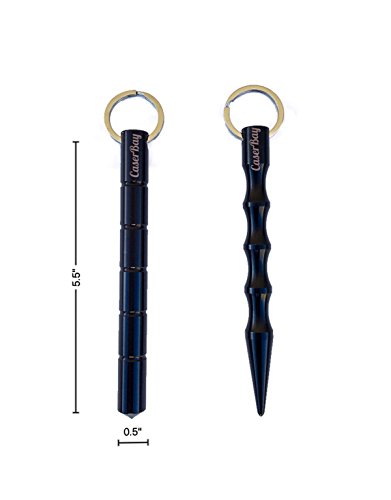
1. GladTime Kubaton Keyring Aluminum Solid Black — Best Budget Pick
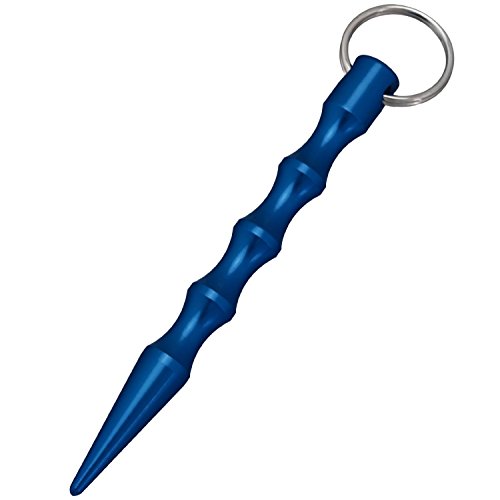
The GladTime Kubaton is about as straightforward as a self-defense tool gets, and that is not a criticism. At 5.5 inches long and 0.5 inches in diameter, it hits the classic kubotan dimensions that have been proven effective for decades. The solid black metal construction gives it real heft without being cumbersome, and the all-black finish keeps it low-profile — it doesn't scream "weapon" when it's clipped to your keyring.
What you're getting here is a no-frills, purpose-built striking tool. There are no gimmicks, no flashlights, no glass breakers — just a dense aluminum rod that amplifies the force of your palm strikes and gives you a rigid surface for pressure-point techniques. For women who want a legal, always-ready option that doesn't require special training to deploy, this is one of the most honest products in this category. You hold it in your fist with the tip extending from the bottom of your hand, and that's essentially the entire user manual.
The build quality is solid for the price point. The oxidized surface provides grip without sharp texturing that would wear on pocket linings. It's light enough to forget it's on your keyring, heavy enough to matter when you need it. This is the kind of tool you buy, attach to your keys, and simply have — without overthinking it.
Pros:
- Classic 5.5" x 0.5" dimensions — ergonomic and proven
- Solid black metal construction with anti-corrosion surface finish
- Extremely affordable — easy to replace if lost
- No-frills design that works out of the box with no learning curve
- Discreet appearance — doesn't draw attention on a keyring
Cons:
- No textured grip — can slip in sweaty hands under stress
- No additional features (no flashlight, glass breaker, etc.)
- Very plain aesthetics — not much to look at

2. Design-Pie Safety Key Chain Solid Aluminum — Best for Everyday Carry
The Design-Pie Safety Key Chain takes the same basic concept as the GladTime and refines the materials. It's constructed from solid aluminum alloy with a high-hardness surface oxidation process that makes it genuinely anti-corrosion and anti-rust — details that matter if you live somewhere humid or tend to sweat through your pocket. At 14cm (5.5 inches) long and 1.5cm (0.6 inches) in diameter, it's marginally thicker than some competitors, which improves grip security.
The cylindrical design is specifically chosen so it takes up almost no pocket space — you can carry it in a jeans pocket without any visible bulge. One hand can grip it fully, the tip extending beyond your fingers for striking. What separates this from bargain-bin alternatives is the quality of the alloy. It's hard enough to resist deformation under impact, light enough that it doesn't weigh down your keyring, and the surface finish is smooth enough not to snag fabric. Design-Pie calls it "easy to camouflage" and they're right — this looks like a novelty keyring accessory to anyone who isn't looking for it.
The real selling point is the combination of quality materials at an accessible price. This is the kubotan you hand to a family member who's just starting to think about personal safety. Simple, effective, and built to last.
Pros:
- High-hardness aluminum alloy — genuinely resistant to corrosion and rust
- Slightly wider 0.6" diameter improves grip security
- Pocket-friendly cylindrical design with almost no footprint
- Light enough for all-day keyring carry without fatigue
- Clean, understated look that doesn't draw attention
Cons:
- No grip ridges or texturing — still smooth under pressure
- Basic packaging — doesn't arrive gift-ready without extra presentation

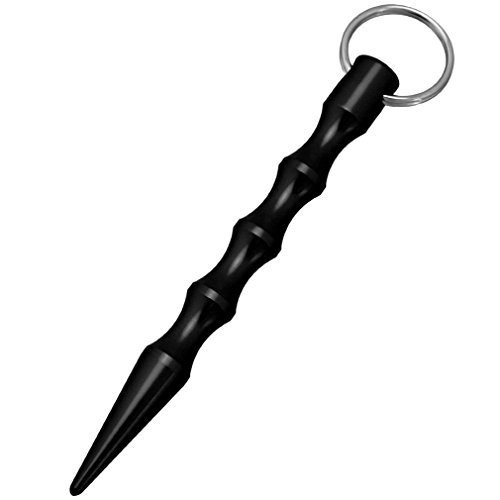
3. MUNIO Self Defense Keychain (Brownie Design) — Best Made in USA
The MUNIO Self Defense Keychain is the product this category has needed for years. While most kubotans are blunt aluminum rods, MUNIO brings a thoughtfully engineered polymer body with a slim, ergonomic profile designed specifically to fit the hands of teens, adults, and seniors alike. Made in the USA, it carries a quality assurance that mass-produced imports rarely match. The Brownie colorway gives it a warm, neutral appearance that looks nothing like a weapon — which is exactly the point.
MUNIO's core pitch is reliability. No batteries to die, no pepper spray canister to expire, no mechanical components to fail at the worst possible moment. You grip it, you strike with the pointed tip, or you swing your keys as a deterrent — that's the entire system. The slim shape is deliberately chosen so your grip is natural and instinctive, not something you have to practice to activate under stress. TSA compliance is a genuine differentiator here: you can take this through airport security in all 50 states, something you absolutely cannot do with pepper spray or most tactical pens with hard tips.
The ergonomics are where MUNIO separates itself from basic aluminum sticks. The shape distributes grip pressure evenly across your hand, reducing the chance of the tool slipping during a strike. For anyone who has spent time reading about how martial arts apply to real-world self-defense, you'll recognize immediately that grip reliability under adrenaline is everything. MUNIO gets that right.
Pros:
- Made in the USA — consistent quality control
- TSA approved — carry on planes legally in all 50 states
- No batteries, no expiration, no mechanical failure points
- Ergonomic slim shape fits teens through seniors comfortably
- Discreet, stylish Brownie colorway doesn't read as a weapon
- Legal in all 50 states — no permit required
Cons:
- Polymer construction — less dense than aluminum alternatives
- Higher price point than basic aluminum kubotans
- Requires at least minimal technique knowledge to use optimally
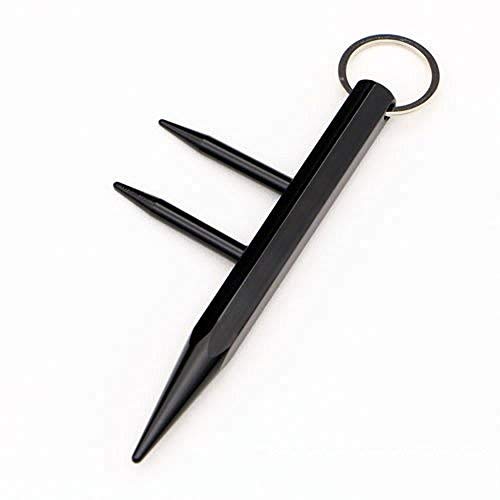
4. MUNIO Self Defense Keychain (Spring Breeze Design) — Best for Style
This is the same trusted MUNIO platform as the Brownie edition — same USA manufacturing, same TSA-compliant polymer body, same ergonomic design proven across thousands of customers. The Spring Breeze colorway is what sets it apart. The soft floral pattern makes this the most visually approachable kubotan on the market, which matters more than you'd think.
Here's the practical reality: the best self-defense tool is the one you actually carry every day. If a plain black aluminum rod feels out of place on your keyring or makes you self-conscious pulling out your keys in public, you'll eventually leave it at home. The Spring Breeze design solves that problem. It looks like a decorative keychain accessory — because it also is one. Nobody at a coffee shop or office lobby is going to give it a second glance, but it delivers identical defensive capability to every other MUNIO model.
Everything else about the Spring Breeze mirrors the Brownie: fail-proof operation with no moving parts, legal everywhere in the US, and an ergonomic form that works for a wide range of hand sizes. If you're buying this as a gift for a daughter, mother, or friend who might resist carrying something that looks overtly tactical, this is the version to choose. The presentation is subtle; the protection is real.
Pros:
- Attractive Spring Breeze design — doesn't look like a weapon
- Identical defensive capability to the Brownie model
- Made in the USA with consistent quality
- TSA compliant — flies in carry-on bags legally
- Excellent gift option for women who want subtle protection
- Works for teens, adults, and seniors equally
Cons:
- Same polymer build — not as dense as solid aluminum
- Premium pricing compared to basic aluminum alternatives
5. MecArmy TPX8 Mini Bolt Action Tactical Pen (Copper) — Best Tactical Pen
The MecArmy TPX8 is the most technically sophisticated product on this list. This is a precision-machined copper tactical pen that doubles as an EDC writing instrument — and it does both jobs exceptionally well. At just 3.07 inches long and 0.41 inches in diameter, it's genuinely mini. The L-type bolt action mechanism deploys the Germany M22 refill smoothly and retracts it just as cleanly, preventing ink from marking pockets or bags.
The copper body is not just aesthetic. Copper has natural antimicrobial properties, develops a unique patina over time, and carries real weight and density for its size. The CNC precision machining across 9 interlocking parts produces a tool that feels like jewelry but performs like equipment. The bolt action is satisfying to operate — the kind of mechanism that becomes a desk habit — but it's designed for function: no accidental deployment, no cap to lose, no wasted motion.
From a self-defense perspective, tactical pens work on the same principles as kubotans — focused blunt force at pressure points. The hardened tip of the TPX8 concentrates strike force effectively. It doesn't look threatening at all, which means it passes through environments where even the sight of a kubotan might make people uncomfortable. The D-ring keychain attachment keeps it accessible on your keys. This is an EDC tool for someone who values craftsmanship as much as capability.
Pros:
- Premium copper construction — antimicrobial, develops character over time
- CNC precision machined across 9 parts — exceptional build quality
- Smooth L-type bolt action — functional and satisfying to operate
- Uses widely available Germany M22 refills — easy to resupply
- Mini size (3.07") fits on keyring without bulk
- Serves dual purpose as a real writing instrument
Cons:
- Shorter than traditional kubotans — less striking leverage
- Premium price point — copper version costs more than basic models
- Small size may not suit larger hands
- Check local laws — some jurisdictions restrict tactical pens specifically
6. Cold Steel Pocket Shark Felt Tip Pen — Best Felt Tip Defense Pen
Cold Steel built its reputation on tools that work under worst-case conditions, and the Pocket Shark is no exception. This looks like an ordinary felt-tip marker. It is not. The body is constructed from Grivory high-impact polymer — the same class of engineered materials used in law enforcement duty equipment — making it far more rigid and impact-resistant than standard plastic pens. The thick, chunky profile gives you a natural grip that anchors in your hand during a strike.
The felt tip is functional as a marking tool, but the real utility is the body itself. Cold Steel designed the Pocket Shark to be gripped and used as a blunt striking weapon using the same principles as a yawara or kubotan. The rounded cap end provides a striking surface; the thick barrel concentrates force. Because it looks exactly like a marker, it moves through almost any environment without scrutiny. Schools, offices, courthouses — environments where even a MUNIO might raise eyebrows.
The Grivory construction is critical. Unlike softer polymers that flex on impact, Grivory maintains rigidity, transmitting your strike force rather than absorbing it. It won't crack or deform under realistic use. This is the tool you choose when you need absolute maximum concealment. The trade-off is that the felt tip will eventually run dry like any marker, but the defensive function is entirely unaffected by that.
Pros:
- Looks like an ordinary felt-tip marker — maximum concealment
- Grivory high-impact polymer body — rigid under strike force
- Functional writing instrument — dual purpose in any environment
- Thick barrel provides excellent natural grip
- Cold Steel quality assurance — proven brand in defensive tools
- Works where tactical pens might draw attention
Cons:
- Felt tip eventually runs dry — needs periodic replacement
- Larger form factor — not ideal for keyring attachment
- No keyring loop or attachment point included

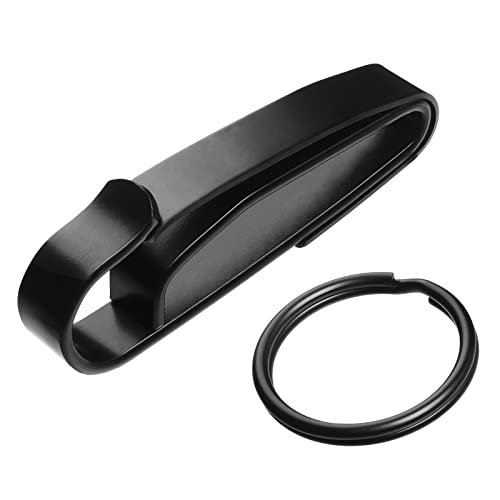
7. JOTOVO Tactical Stealth Key Ring Holder — Best for Duty Belt
The JOTOVO is the only product on this list that's explicitly designed for law enforcement and first responder use, and it shows in every detail. This is not a striking tool — it's a professional duty belt key management system that keeps your keys secure, accessible, and silent while you work. If you're in law enforcement, security, firefighting, or any profession that requires rapid, reliable key access from a duty belt, this solves a real problem.
The quick-release detachable keyring is the core feature. It slips in and out smoothly when you need it, but the spring clip keeps the ring locked in place during movement — no rattling, no accidental drops. Compatibility covers 1.5-inch to 2.25-inch duty belts, which handles the full range of standard law enforcement and security belts. The design is compatible with all standard handcuff models, a critical detail for patrol officers who need the holder integrated into their duty belt loadout rather than fighting against it.
The all-black Grivory-class construction keeps the profile low and avoids reflective surfaces that could compromise a tactical position. If you're a civilian buyer who simply wants better key management on a gun belt or work belt, the JOTOVO performs equally well in that role. It's a different product category than a kubotan, but it belongs in any serious discussion of tactical keychain accessories in 2026.
Pros:
- Designed specifically for law enforcement and first responder duty belts
- Quick-release detachable keyring — rapid access under pressure
- Fits 1.5" to 2.25" wide duty belts — broad compatibility
- Spring clip prevents keyring from slipping free accidentally
- Compatible with all standard handcuff designs
- All-black tactical profile — no reflective surfaces
Cons:
- Designed for belt carry only — not a standalone keychain tool
- Overkill for civilian everyday carry needs
- No self-defense striking function on its own
How to Pick the Best Kubotan Keychain
The kubotan market looks simple on the surface — it's just a stick, right? In practice, the differences between products matter a great deal when you need one. Here's what to evaluate before you buy.
Material: Aluminum vs. Polymer vs. Specialty Metals
Material determines weight, durability, striking density, and legal classification in some jurisdictions. Here's the breakdown:
- Aluminum alloy — The traditional choice. Dense, rigid, corrosion-resistant. Concentrates force effectively. GladTime and Design-Pie both use aluminum alloy with oxidized surface finishes. This is the most straightforward option for most buyers.
- High-impact polymer (Grivory-class) — MUNIO and Cold Steel use engineered polymers that are rigid under impact but lighter than metal. TSA-compliant, legal virtually everywhere. Less dense than aluminum but ergonomically superior in many designs.
- Copper/Brass/Titanium — Premium EDC metals used in tactical pens like the MecArmy TPX8. Maximum durability, unique aesthetics, premium pricing. Copper develops patina; titanium is rust-proof and featherlight.
For a primary self-defense carry, aluminum or high-quality polymer are both reliable choices. The material debate matters less than grip quality and whether you'll actually have it on you when needed.
Legal Status and TSA Compliance
This is not a minor consideration. Kubotans are broadly legal in the United States, but individual states and municipalities have varying rules about carrying impact weapons. California, for instance, has historically restricted them in certain contexts. Always check your local regulations before carrying any self-defense tool.
- MUNIO products are explicitly TSA-approved and legal in all 50 states — the safest choice for air travel
- Solid metal kubotans may be flagged at airport security — do not assume aluminum tools will pass
- Tactical pens vary by jurisdiction — some are treated as weapons based on their tip design
- The Cold Steel Pocket Shark's marker disguise gives it the most universal environmental access
Size, Grip, and Ergonomics
The grip is everything. A kubotan that slips in your hand under adrenaline is worse than useless — it creates a false sense of security. Evaluate these factors:
- Length: 5.5 inches is the proven standard. Shorter tools (like the MecArmy at 3.07") sacrifice some leverage
- Diameter: 0.5"–0.6" fits most hands. Go narrower for smaller hands; wider for larger hands
- Texturing: Ridges, grooves, or knurling dramatically improve grip under stress. Smooth aluminum can slip
- Ergonomic shaping: MUNIO's tapered design distributes grip pressure across more surface area than a plain cylinder
If possible, hold the tool before buying. Your grip instinct under calm conditions will be significantly degraded under adrenaline — choose something that anchors naturally, not just comfortably.
Concealability and Daily Carry
The best kubotan keychain is the one you actually carry every day. Think honestly about your environment:
- Office or school settings: A stylish MUNIO or the Cold Steel Pocket Shark avoids the uncomfortable conversations that a blunt black aluminum rod might trigger
- Outdoor and commuter use: Any aluminum model works well — they're weather-resistant and nearly indestructible
- Air travel: MUNIO is the clear answer — it's designed for exactly this use case
- Law enforcement / security professionals: JOTOVO for key management; pair with any kubotan for defensive capability
- Gift purchase: MUNIO Spring Breeze is the strongest option for women who might resist overtly tactical aesthetics
A layered personal security approach — combining a kubotan with car security measures and situational awareness — is far more effective than any single tool alone. Your kubotan is a last resort, not a primary security strategy.

Questions Answered
What exactly is a kubotan keychain?
A kubotan is a compact cylindrical striking tool — typically 5 to 6 inches long and roughly half an inch in diameter — designed to be gripped in the fist and used to amplify the force of palm strikes, target pressure points, or rake across sensitive areas of an attacker's body. It attaches to a keyring so it's always accessible. The tool was developed by Sōke Takayuki Kubota in the 1970s and quickly adopted by law enforcement training programs for female officers. In 2026, the design has evolved to include polymer versions, tactical pens, and stylized non-weapon-looking variants, but the core function remains unchanged: multiplied force from a tool that fits in your hand.
Is a kubotan keychain legal to carry?
In most US states, yes — kubotans are broadly legal to carry as personal safety tools. However, laws vary by jurisdiction. Some states classify them as impact weapons subject to restrictions; some localities have banned them outright. Always verify the specific laws in your city and state before carrying one. The safest options legally are polymer-bodied models like the MUNIO — they're explicitly legal in all 50 states and TSA-compliant. If you travel internationally, research destination laws carefully, as many countries treat any dedicated impact weapon very differently from the US.
How do you use a kubotan for self-defense?
The most accessible technique is to grip the kubotan in your dominant fist with the tip extending from the bottom of your hand (hammer grip), then strike at the bony surfaces of an attacker's hands, wrists, or forearms to create an opportunity to escape. The tip can also target pressure points on the back of the hand or the collarbone area. You can also grip it with the tip protruding from the top of your fist for forward jabs. Some users simply whip their keys attached to the ring as a deterrent before any physical contact occurs. Formal kubotan training greatly improves effectiveness — look for local self-defense courses or hapkido schools that include pressure-point weapon work in their curriculum.
Is a kubotan keychain TSA approved?
Standard metal kubotans are generally NOT TSA-approved and will typically be confiscated at airport security. The TSA classifies solid metal impact tools as prohibited in carry-on luggage. The exception: MUNIO polymer keychains are specifically TSA-compliant and are legal to carry through airport security in all 50 states. If you fly regularly and want to carry a self-defense keychain, MUNIO is the only product on this list that reliably solves that problem. Always check the TSA's current prohibited items list before your flight, as policies can change.
What material is best for a kubotan keychain?
It depends on your priorities. For maximum striking force, solid aluminum alloy is the traditional choice — dense, rigid, corrosion-resistant, and proven in decades of self-defense training. For TSA compliance and legal universality, high-impact polymer (as used by MUNIO) is the superior option — slightly less dense but ergonomically excellent and welcome in environments where metal tools raise flags. For EDC enthusiasts who value craftsmanship and dual-purpose function, premium metals like copper or titanium (as in the MecArmy TPX8) offer unique properties and longevity. There is no single best material — match the material to your environment and carry habits.
Can a kubotan replace pepper spray?
No — and you shouldn't think of it that way. Kubotans and pepper spray serve overlapping but distinct roles. Pepper spray creates distance and incapacitates at range without requiring contact; a kubotan requires proximity and physical engagement. Kubotans never run out, never expire, and work in environments (like airplanes) where pepper spray is completely banned. Pepper spray works faster and requires less technique at distance. Ideally, you carry both if local laws allow. If you must choose one, the right answer depends on your specific environment: frequent air travel and office environments favor kubotans; outdoor commuting where aggressive dogs or attackers at range are concerns may favor pepper spray as a primary tool.
Buy on Walmart
- GladTime Kubaton Keyring Aluminum Solid Black Safety Keychai — Walmart Link
- Design-Pie Safety Key Chain, Solid Aluminum Short Stick Prot — Walmart Link
- MUNIO Self Defense Keychain – Lightweight, Stylish & Portabl — Walmart Link
- MUNIO Self Defense Keychain – Lightweight, Stylish & Portabl — Walmart Link
- MecArmy TPX8 Mini Bolt Action Tactical Pen, Keychain Tactica — Walmart Link
- Cold Steel Pocket Shark Felt Tip Pen, Black, Grivory — Walmart Link
- JOTOVO Tactical Stealth Key Ring Holder Special for Police a — Walmart Link
Buy on eBay
- GladTime Kubaton Keyring Aluminum Solid Black Safety Keychai — eBay Link
- Design-Pie Safety Key Chain, Solid Aluminum Short Stick Prot — eBay Link
- MUNIO Self Defense Keychain – Lightweight, Stylish & Portabl — eBay Link
- MUNIO Self Defense Keychain – Lightweight, Stylish & Portabl — eBay Link
- MecArmy TPX8 Mini Bolt Action Tactical Pen, Keychain Tactica — eBay Link
- Cold Steel Pocket Shark Felt Tip Pen, Black, Grivory — eBay Link
- JOTOVO Tactical Stealth Key Ring Holder Special for Police a — eBay Link
The best kubotan keychain is the one you actually have on your keys the day you need it — so choose the tool that fits your life, not just your grip.


About Robert Fox
Robert Fox spent ten years teaching self-defence in Miami before transitioning into home security consulting and writing — a background that gives him an unusually practical, threat-aware perspective on residential security. His experience spans physical security assessment, lock and alarm system evaluation, and the behavioral habits that make homes harder targets. At YourHomeSecurityWatch, he covers home security product reviews, background check and criminal records resources, and practical guides on protecting your property and family.
You can Get FREE Gifts. Furthermore, Free Items here. Disable Ad Blocker to receive them all.
Once done, hit anything below