How Allegion's Dedication to Innovation Drives the Schlage Upswing
by Robert Fox
What separates a brand that merely survives market disruption from one that architects its own resurgence? When our team examines Allegion Schlage locks innovation as a system rather than a series of isolated product launches, the answer snaps into immediate focus. Sustained R&D investment, a sharpened emphasis on smart-home connectivity, and rigorous manufacturing discipline have positioned Schlage as a benchmark brand in residential security. The broader home security community has recognized this shift, and the financial data confirms it decisively.

Allegion PLC was spun off from Ingersoll Rand in late 2013, gaining the operational independence needed to accelerate Schlage's development roadmap without the drag of a sprawling industrial conglomerate. That structural freedom translated directly into faster product cycles, deeper software integration, and a more coherent brand narrative across every price tier. Our team has tracked this evolution closely, and the momentum reflects deliberate engineering investment rather than marketing spend alone.
This article unpacks six dimensions of Allegion's success — corporate context, persistent myths, upgrade strategy, competitive positioning, maintenance discipline, and critical pitfalls — so that home users and security practitioners can make fully informed decisions. The evidence is compelling, and the practical takeaways are immediately actionable for anyone evaluating their entry-point security.
Contents
- Understanding Allegion: The Corporate Engine Driving Schlage's Innovation
- Clearing Up Misconceptions About Schlage's Security and Pricing
- How to Assess Whether a Schlage Smart Lock Upgrade Is the Right Move
- Allegion Schlage Locks Innovation vs. the Competition: A Direct Comparison
- Maintaining Schlage Hardware for Long-Term Reliability
- Critical Errors That Compromise Smart Lock Investments
- Final Thoughts
Understanding Allegion: The Corporate Engine Driving Schlage's Innovation
Origins and Structural Advantages
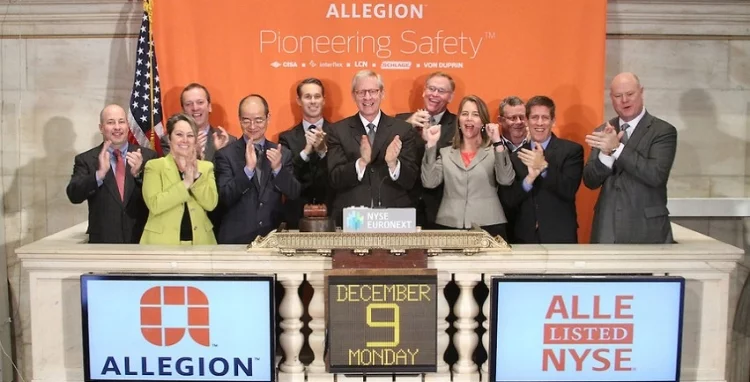
Allegion operates across more than 130 countries, managing iconic security brands including Schlage, Von Duprin, and LCN, with annual revenues exceeding three billion dollars. That scale provides R&D funding that most dedicated lock manufacturers simply cannot match. According to Allegion's Wikipedia entry, the company holds hundreds of active patents spanning both mechanical and electronic security domains, a portfolio that reflects sustained innovation investment rather than opportunistic licensing.
Our team consistently observes that Schlage's manufacturing standards benefit from Allegion's commercial-grade engineering heritage. Residential products carry tolerances originally developed for high-traffic institutional environments, and that trickle-down quality advantage is entirely deliberate — a cross-pollination strategy Allegion's leadership has articulated explicitly in investor communications since the spinoff.
Investment Priorities That Matter
Allegion's capital allocation reveals a clear emphasis on three interconnected areas that shape the Schlage product experience home users encounter at every price tier:
- Electronic and connected access technologies, including the Encode, Connect, and Touch series
- Durability certifications at or above ANSI/BHMA Grade 1 standards across the full deadbolt lineup
- Integration partnerships with major smart-home platforms, including Z-Wave, Zigbee, and native Wi-Fi protocols
For home users seeking to understand the wireless protocols powering these locks, our breakdown of Z-Wave technology explains why Allegion's platform choices matter for long-term ecosystem compatibility and device longevity.
Clearing Up Misconceptions About Schlage's Security and Pricing
The "Premium Price Without Premium Security" Myth
Pro insight: ANSI/BHMA Grade 1 deadbolts survive 250,000 open-close cycles in standardized testing — most budget competitors are certified to only 25,000 cycles, a tenfold difference that reveals itself in long-term field performance.
One persistent misconception frames Schlage's higher price point as a branding premium rather than an engineering investment, but the certification data tells a different story. Grade 1 deadbolts undergo destructive testing — covering kick resistance, cylinder attack, and cycle durability — that budget alternatives routinely fail to pass. Understanding what makes a deadbolt truly secure requires looking beyond finish aesthetics to hardware tolerances, strike plate engineering, and cylinder construction standards.
The "Smart Locks Are Easier to Hack" Myth
Digital skepticism around smart lock security is understandable but frequently overstated when applied to enterprise-backed brands like Schlage. The Encode series uses 128-bit AES encryption for all wireless communication, a standard that matches financial-grade security applications. The more practical vulnerability in most installations remains the door frame itself, not the lock cylinder. Our analysis of common home security weak points addresses this structural reality in detail, and the data consistently points to frame reinforcement as the higher-value investment.
How to Assess Whether a Schlage Smart Lock Upgrade Is the Right Move
Baseline Security Audit First
Warning: Installing a premium smart lock on a hollow-core door or undersized strike plate creates a false sense of security — the weakest structural element still determines total forced-entry resistance, regardless of the lock's grade rating.
Before any lock upgrade, our team recommends a structured assessment of the entire entry point, covering door material, frame integrity, and existing deadbolt throw length. The burglary statistics our team has compiled make clear that forced entry through the door frame remains the dominant attack method in residential break-ins. Addressing the frame before upgrading the lock delivers a higher security return than any hardware substitution alone.
Step-by-Step Selection Framework

- Define the access model: a primary residence with keyless entry needs differs substantially from a rental property requiring time-limited code management
- Audit the smart-home ecosystem: Schlage Encode works natively with Amazon Alexa and Google Home; the Connect model requires a Z-Wave hub for remote access
- Verify door prep dimensions: confirm backset measurement, bore hole diameter, and door thickness before placing any order
- Confirm network coverage: Wi-Fi dependent locks require a stable 2.4 GHz signal at the entry point without dead zones
- Review local code requirements: certain jurisdictions mandate specific lock grades for rental or multi-family properties
Home users who want a broader framework for entry-point hardening should review our analysis of strengthening a home against burglars, which covers door reinforcement alongside lock selection within a cohesive layered approach.
Allegion Schlage Locks Innovation vs. the Competition: A Direct Comparison
Feature and Value Matrix
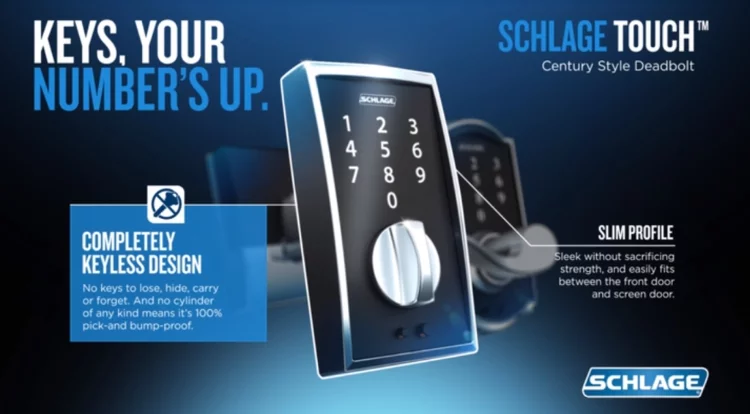
| Feature | Schlage Encode Plus | Kwikset Halo Touch | Yale Assure Lock 2 |
|---|---|---|---|
| ANSI/BHMA Grade | Grade 1 | Grade 2 | Grade 2 |
| Encryption Standard | 128-bit AES | 128-bit AES | 128-bit AES |
| Native Wi-Fi (no hub) | Yes | Yes | Yes |
| Apple Home Key Support | Yes (Encode Plus) | No | Yes |
| Access Code Capacity | 100 codes | 250 codes | 250 codes |
| Built-in Door Alarm | Yes | No | No |
The Grade 1 certification gap between Schlage and most competitors represents a meaningful real-world durability difference that shows up in long-term field performance. Schlage's built-in door alarm sensor — which triggers on forced entry attempts — is a feature no other mainstream smart lock brand currently matches at the residential tier, and our team treats it as a genuine differentiator rather than a marketing footnote.
Bump and Pick Resistance
Both the Encode and Connect lines incorporate Schlage's patented SecureKey technology, which modifies the pin-tumbler mechanism to resist bump key attacks that defeat conventional deadbolts. Our review of lock bumping vulnerabilities and defenses walks through the attack mechanics in detail. The distinction between bump-proof and pick-proof claims deserves careful attention. Our analysis of bump-proof vs. pick-proof locks clarifies the technical differences that marketing language frequently obscures.
Maintaining Schlage Hardware for Long-Term Reliability
Mechanical Maintenance Fundamentals
Schlage deadbolts are engineered for durability, but consistent maintenance extends service life and prevents the gradual stiffening that increases forced-entry vulnerability over time. Our team follows a straightforward routine that both home users and facility managers benefit from adopting on a fixed schedule:
- Apply a dry PTFE lubricant — not WD-40 — to the bolt mechanism twice annually to maintain smooth operation
- Clear the keyway with compressed air to remove debris that accelerates internal pin wear
- Inspect and tighten all mounting screws quarterly, as vibration gradually loosens hardware over normal use
- Test the deadbolt throw for smooth, full-extension operation — any hesitation signals a lubrication or alignment issue requiring correction
Electronic and Battery Care
Tip: Most people miss the LED low-battery indicator on Schlage smart locks and only respond to the audible alert when the situation is urgent — our team recommends setting an annual calendar reminder for battery replacement rather than relying on any warning signal.
The Encode series operates on four AA batteries, and cold weather accelerates discharge significantly in exterior installations. Our team recommends lithium AA cells for any lock installed in climates that experience freezing temperatures, as alkaline cells lose substantial capacity in cold conditions. Keeping firmware current through the Schlage Home app also ensures the lock benefits from security patches that Allegion deploys based on ongoing vulnerability research.
Critical Errors That Compromise Smart Lock Investments
Installation and Configuration Mistakes
The most common installation error our team encounters is a misaligned strike plate that causes the bolt to bind. This creates both operational friction and a structural weakness that reduces forced-entry resistance substantially. Proper alignment requires the bolt to extend fully without any drag, and resistance during installation demands correction before the lock is placed into service.
- Using the stock strike plate rather than upgrading to a reinforced model with 3-inch screws driven into the door stud
- Skipping the door alignment verification before mounting the lock chassis on the door face
- Failing to enroll a backup access code before relying exclusively on app-based or fingerprint entry
- Leaving the auto-lock feature disabled, which eliminates most of the smart lock's practical security advantage
Operational Mistakes After Installation
Sharing access codes broadly without utilizing scheduled or single-use code features eliminates the access-control advantage that Schlage smart locks provide over conventional keyed deadbolts. Our team also encounters home users who disable the built-in alarm to reduce false alerts, which removes a meaningful intrusion-detection layer entirely. Calibration adjustment resolves the false-alert problem directly without sacrificing that defense. Managing access codes with the same discipline applied to physical keys is the operational standard our team recommends without exception.
Final Thoughts
Allegion's track record demonstrates that sustained innovation requires deliberate investment, platform discipline, and products engineered to outlast any single market cycle. Our team recommends that home security practitioners review the full Schlage lineup through the lens of their specific entry-point vulnerabilities, starting with the structural audit framework outlined in this article and then layering smart connectivity and alarm features on top of a sound mechanical foundation. Explore the full range of smart lock strategies and integrated defense approaches through our home security guides to build a system that functions as a cohesive, layered whole rather than a collection of isolated hardware decisions.


About Robert Fox
Robert Fox spent ten years teaching self-defence in Miami before transitioning into home security consulting and writing — a background that gives him an unusually practical, threat-aware perspective on residential security. His experience spans physical security assessment, lock and alarm system evaluation, and the behavioral habits that make homes harder targets. At YourHomeSecurityWatch, he covers home security product reviews, background check and criminal records resources, and practical guides on protecting your property and family.
You can Get FREE Gifts. Furthermore, Free Items here. Disable Ad Blocker to receive them all.
Once done, hit anything below