Picture this: you're locking up a busy retail store late on a Tuesday evening when the fire alarm sounds unexpectedly. Every second counts, and the last thing anyone needs is a door that won't cooperate under stress. That scenario is exactly why choosing the right panic bar for business use isn't a luxury — it's a baseline safety requirement. The CRL Cross Bar Panic Exit Device is one of the most widely stocked options in commercial hardware, and if you're evaluating it for your property, this guide covers everything from practical use cases to total installation costs to side-by-side comparisons. You can also browse our full security product reviews for additional hardware breakdowns.
CRL — short for CR Laurence — has been a staple in architectural hardware for decades. Their aluminum cross bar panic exit device is built around a single, non-negotiable function: push the bar, the door opens. No key, no code, no grip strength required. That simplicity is what makes it code-compliant across a wide range of commercial and light-industrial occupancies, and what makes it a genuinely practical choice for facilities managers and property owners alike.
This guide walks you through where these devices are actually used in practice, what it costs to buy and install one, how CRL's model holds up against the competition, and the maintenance and pairing strategies that keep your exit hardware performing reliably for the long term.
Contents
- How Businesses and Organizations Actually Use Panic Exit Devices
- Breaking Down the Cost of a CRL Panic Bar for Business
- Which Properties Actually Need a Panic Exit Device?
- Basic Setup vs. Full-Featured Installation
- CRL Cross Bar vs. Other Exit Device Brands
- Getting the Most Out of Your CRL Panic Bar
- Frequently Asked Questions
- Key Takeaways
How Businesses and Organizations Actually Use Panic Exit Devices
Schools, Hospitals, and Assembly Spaces
Panic exit devices are most visible in high-occupancy, high-stakes environments. In these settings, a panic bar for business or institutional use is often legally mandated — not just recommended. Standards like NFPA 101, the Life Safety Code, specify when and where panic hardware is required based on occupancy type and occupant load.
- School gymnasium exits and cafeteria back doors are common installation points.
- Hospital stairwell doors and emergency ward exits are high-priority locations where reliable operation is non-negotiable.
- Government buildings, theaters, and houses of worship with large assembly rooms typically require panic hardware on every secondary exit.
- Sports arenas and convention centers often use them on every exterior door in the assembly area.
In these settings, the CRL device works precisely because it's easy to operate under stress. Anyone can push a bar — regardless of age, physical ability, or whether they've ever seen the door before.
Retail and Office Applications
Smaller-scale commercial use is just as common and sometimes overlooked. Think about the back door of a restaurant, the emergency exit of a grocery store, or the side exit of a mid-size office building. These doors serve double duty: daily-use access for staff plus life-safety function in an emergency.
- Many retail locations install panic devices on stockroom and loading dock doors.
- Offices with 50 or more occupants frequently fall under local code requirements for compliant exit hardware.
- Restaurants place them on kitchen back exits to satisfy fire marshal inspections.
- Warehouses and light manufacturing facilities use them on emergency egress points throughout the floor plan.
For context on how exit hardware fits into a broader door security strategy, understanding what makes a high-quality mechanical deadbolt is a useful companion read — both hardware types often appear on the same building, sometimes on the same door set with different functions assigned to each side.
Breaking Down the Cost of a CRL Panic Bar for Business
Device Pricing and Accessories
The CRL aluminum cross bar device sits in the budget-friendly tier of commercial exit hardware. Before you order, build out a full cost picture — the device price is only part of what you'll spend.
| Item | Typical Price Range | Notes |
|---|---|---|
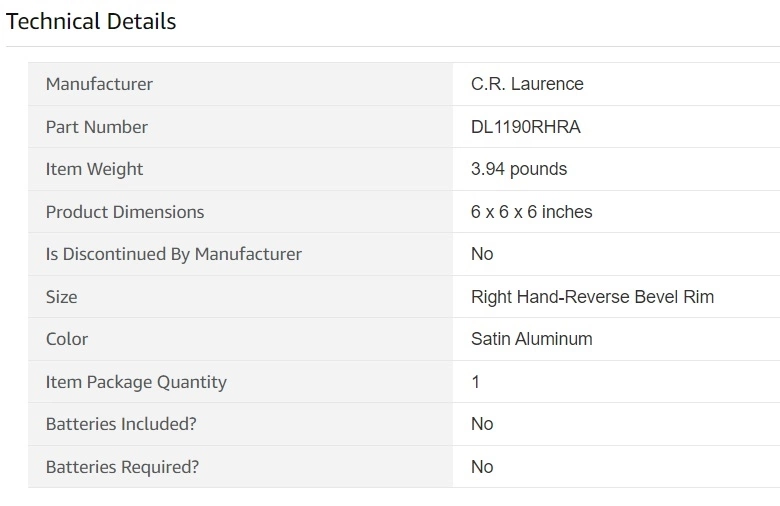
| CRL Aluminum Cross Bar Panic Exit Device (single unit) | $80 – $150 | Aluminum body, left or right hand, standard or reverse bevel |
| Rim cylinder (for exterior key access) | $15 – $40 | Optional — only needed if staff require key entry from outside |
| Surface-mounted door closer | $40 – $120 | Recommended for fire-rated door compliance |
| Strike plate and mounting hardware | $10 – $25 | Often included with device — verify before ordering |
| Professional installation (per door) | $100 – $250 | Varies by region and existing door condition |
| Permit (if required by jurisdiction) | $50 – $150 | Not always required — check with your local AHJ |
| Total per door (device + basic install) | $180 – $400+ | Without optional accessories; quantity pricing reduces cost |
If you're outfitting multiple doors, commercial hardware distributors typically offer quantity pricing. Getting quotes from two or three suppliers before committing can save a meaningful amount on larger projects.
Installation and Compliance Costs
Compliance can add to your total beyond the device and basic installation. Post-installation fire marshal inspections are common for assembly occupancies like restaurants and theaters, and some jurisdictions require them before you can open.
- ADA compliance: if the exit serves an accessible egress route, door opening force and hardware height must meet accessibility standards — this may require a lighter-action door closer or frame adjustment.
- Fire-rated doors: not all panic devices carry UL listings for fire door assemblies — verify that CRL's specific model matches your door's fire rating before purchasing.
- Alarmed exit options: adding a door alarm increases upfront cost by $50–$150 but actively deters unauthorized use after hours.
- Electrified options: if you need remote release or access control integration, electrified hardware adds $200–$600 per door depending on configuration.
Pro tip: Always verify that your panic exit device carries the appropriate UL listing for your door's fire rating before purchasing — a mismatch can void your fire door assembly and create significant compliance problems during inspections.
Which Properties Actually Need a Panic Exit Device?
Code Mandates and Legal Requirements
Not every door needs a panic bar — but more do than most property owners realize. In the U.S., occupancy type and occupant load drive the requirement. Here's a general framework:
- Assembly occupancies (restaurants, theaters, churches) with 50 or more occupants typically require panic hardware on all exit doors serving the assembly area.
- Educational occupancies (schools, daycare centers) require it on most exterior exit doors regardless of specific occupant count thresholds.
- High-hazard occupancies may require it regardless of how many people are in the building at a given time.
- Business occupancies (standard office buildings) often fall under a 100-occupant threshold before the requirement activates.
Your local Authority Having Jurisdiction (AHJ) — typically the fire marshal's office — is the final word on what applies to your specific building. Requirements vary between the International Building Code (IBC), NFPA 101, and local amendments, so never assume one standard applies everywhere.
When a Standard Lock Falls Short
Even where panic hardware isn't legally required, it can be the smarter practical choice over a standard smart lock or keyed lockset on certain exit doors. Ask yourself a few questions:
- Will untrained or stressed individuals — customers, visitors, or new employees — need to use this door in an emergency?
- Is the door frequently used by staff who may have their hands full with boxes, equipment, or food trays?
- Is the exit located in a low-light area or a noisy environment where finding and turning a key handle would be difficult under pressure?
If you answered yes to any of those, a panic exit device is worth serious consideration even without a code mandate. It also pairs well with bump-proof lock hardware on adjacent entry doors — balancing free outward egress with controlled access on the same building perimeter.
Basic Setup vs. Full-Featured Installation
What an Entry-Level Configuration Looks Like
If you're setting up a panic bar for business use for the first time, the most straightforward configuration is the standard rim-latch device — exactly what the CRL aluminum cross bar provides out of the box. Here's what you get:
- Cross bar mechanism mounted directly to the door face
- Rim latch that engages the strike plate mounted on the door frame
- Exit-only function — no exterior access from outside without a separate door or rim cylinder add-on
- Standard aluminum finish, available in left-hand or right-hand orientation depending on your door's hinge placement
- Reverse bevel option for doors with non-standard latch geometry
This is the cleanest and most cost-effective setup. It's appropriate for most secondary exits where staff can re-enter through a nearby door rather than through the emergency exit itself. For those curious about how the underlying latch mechanism works at a mechanical level, how a pin tumbler lock works builds a solid foundation for understanding commercial latch systems in general.
Advanced Options Worth Considering
Once you move past the basic rim-latch setup, several add-ons become available:
- Rim cylinder for exterior key access — allows staff to enter from outside using a standard key, eliminating the need for a separate adjacent door.
- Alarmed exit bar — a built-in or add-on alarm sounds when the bar is pushed, alerting staff to unauthorized use and deterring casual misuse.
- Electric strike or electric latch retraction — enables remote release or hold-open function, useful for integrating with a building access control system.
- Delayed egress feature — a 15-second delay between bar push and door release, allowing staff to respond; only permitted in specific occupancy types under life safety codes.
- Surface-mounted door closer — ensures the door returns to a fully closed and latched position automatically, which is critical for fire-rated door assemblies.
For most small businesses, the rim cylinder plus a door closer hits the right balance between cost and functionality. A fully electrified configuration is better suited to larger operations that already have an access control infrastructure in place to integrate with.
CRL Cross Bar vs. Other Exit Device Brands
Side-by-Side Comparison
CRL isn't the only name in exit hardware. The market has several well-established brands, and knowing where each one positions itself helps you make a confident purchase decision.
| Brand / Model | Construction | Price Range | UL Fire Rating Available | Electrified Options | Best Fit |
|---|---|---|---|---|---|
| CRL Aluminum Cross Bar | Aluminum | $80–$150 | Yes (select models) | Limited | Budget-conscious commercial, light to medium duty |
| Von Duprin 99 Series | Steel/Aluminum | $200–$400 | Yes | Full | Heavy commercial, ADA-critical applications |
| Sargent 8800 Series | Steel | $250–$500 | Yes | Full | High-traffic institutional (schools, hospitals) |
| Falcon X Series | Aluminum/Steel | $150–$300 | Yes | Partial | Mid-range commercial, moderate traffic |
| Detex ECL Series | Steel | $100–$200 | Select models | No | Alarmed exits, budget industrial |
Where the CRL Device Holds Its Own
CRL's primary advantage is price-to-functionality ratio for light to medium commercial applications. If you're not dealing with a high-traffic, heavily cycled door — one that opens 5 to 10 times daily rather than 100-plus — the CRL aluminum cross bar is frequently more than adequate at a price point well below Von Duprin or Sargent.
- Aluminum construction makes it lightweight and corrosion-resistant, which matters on exterior doors exposed to weather.
- Available in both right-hand and left-hand configurations, with standard and reverse bevel options for non-standard door setups.
- Widely stocked at commercial hardware distributors nationwide — replacement parts are accessible without long lead times.
- Simple enough for an experienced contractor or handyman to install without specialized tools or training.
Where CRL loses ground is in heavy-duty, high-cycle environments. A school's main corridor exit or a hospital wing door that sees hundreds of daily uses is better served by a Von Duprin or Sargent device built and tested to a significantly higher cycle rating. Choosing the wrong tier of device for your traffic level will cost more in replacements and maintenance over time than simply buying the right product upfront.
Getting the Most Out of Your CRL Panic Bar
Maintenance That Keeps the Device Reliable
A panic exit device is life-safety hardware. It's not something you install and forget. Treating it like a set-it-and-ignore-it product is how you end up with a door that fails during the one moment it absolutely cannot. Build these steps into your facilities routine:
- Test the device monthly. Push the bar and confirm the door opens fully with the latch retracting cleanly. This takes about 30 seconds and catches most problems before they become serious.
- Lubricate annually. Use a dry lubricant — not WD-40 — on the latch bolt and pivot points. Oil-based lubricants attract dust and eventually gum up the mechanism.
- Check strike plate alignment. If the latch doesn't engage cleanly, the strike may have shifted. Tighten mounting screws or realign the plate as needed.
- Inspect bar mounting fasteners. Heavy use loosens screws over time. A loose bar reduces force transfer to the latch and can cause incomplete latching on return.
- Verify door closer tension. A door that slams or fails to close fully leaves your facility unsecured — and a fire-rated door that doesn't latch can violate your fire door assembly requirements.
- Document your inspections. A written log supports code compliance and can be important for commercial property insurance documentation.
Perimeter hardware maintenance extends beyond doors. For window security that complements your door hardware routine, how to burglar-proof your windows covers the hardware checks that round out a complete perimeter security inspection.
Pairing With Other Security Hardware
Your panic exit device handles emergency egress — but the door it's mounted on is still part of your building's security perimeter. You can add meaningful layers of security without compromising exit function in any way.
- Exterior keypad or keyless entry on a nearby door — lets staff re-enter the building without propping the panic exit open, which is a common workaround that defeats the purpose of the device. The Code-A-Key Mechanical Keyless Lock is one reliable pairing option for all-weather exterior use.
- Security camera coverage on the exit door — deters misuse by making unauthorized exits visible and creates a time-stamped record if the door is opened outside authorized hours.
- Door contact sensor or alarmed exit bar — sends an alert when the door opens unexpectedly, particularly useful during nights and weekends when the facility is unoccupied.
- Door frame and hinge reinforcement — panic bars are designed for push-out egress, but a weak door frame can still be compromised by a forced entry attempt from outside. Reinforce the frame and hinge-side independently of the exit device.
For a broader look at layered perimeter security that integrates both door and window hardware decisions, the guide on the best ways to burglar-proof your property walks through a practical, prioritized approach that works alongside strong exit hardware choices.
Frequently Asked Questions
What is a panic bar for business use, and is it the same as an exit device?
Yes — "panic bar," "crash bar," "push bar," and "exit device" all refer to the same category of hardware. The cross bar style is formally classified as a "rim-type panic exit device" in building codes. The term "panic hardware" is used specifically because these devices are engineered for emergency egress under high-stress, high-speed conditions where fumbling with a key or lever knob is not acceptable.
Does the CRL Cross Bar Panic Exit Device meet fire code requirements?
Select models in the CRL aluminum cross bar line carry UL listings for use on fire-rated door assemblies, but not every configuration does. You need to verify that the specific model number you're ordering carries the UL fire listing that matches your door's fire rating — typically 20-minute, 45-minute, 90-minute, or 3-hour. When in doubt, ask your hardware distributor to confirm compatibility before purchasing.
Can I install a CRL panic exit device myself, or do I need a licensed contractor?
The device itself is straightforward to install for someone with basic carpentry and hardware skills — it's a bolt-on product that mounts to the door face and frame. However, if your installation is on a fire-rated door assembly, or if your jurisdiction requires a permit, you'll want a licensed contractor to ensure the installation meets code and passes inspection. DIY installation on a non-fire-rated secondary exit is generally feasible for an experienced handyman.
What's the difference between right-hand and left-hand configurations?
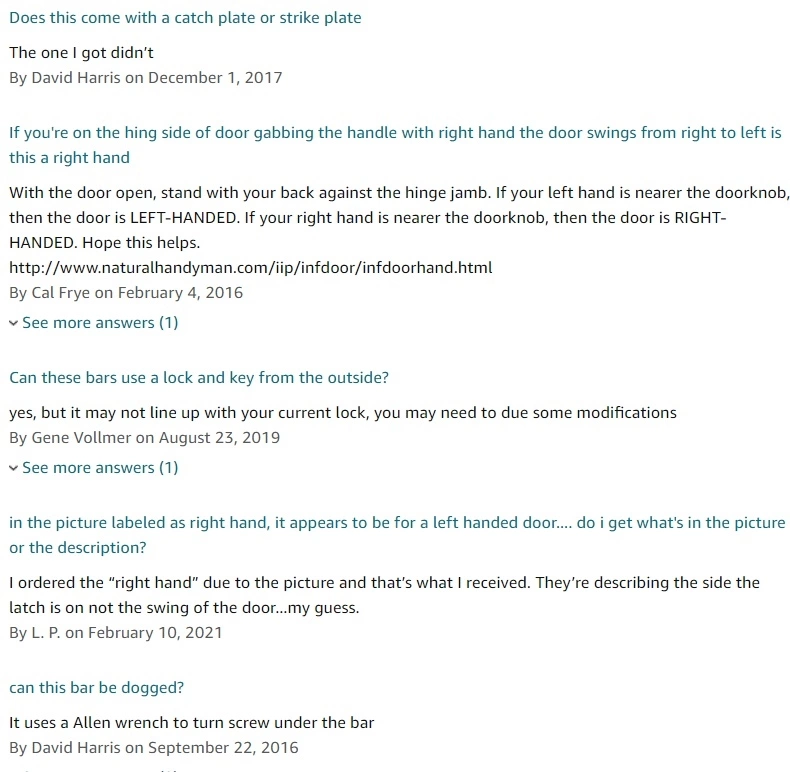
The hand designation refers to which side the hinges are on when you're facing the door from the secure (interior) side. Right-hand means the hinges are on the right; left-hand means hinges are on the left. Getting this wrong means the latch will be on the wrong side of the door frame and won't engage the strike plate correctly. Measure and verify your door's hand before ordering — it's one of the most common ordering mistakes with panic hardware.
What does "reverse bevel" mean on a panic exit device?
Standard bevel describes the angled face of the latch bolt, which is cut to match the standard door-to-frame gap direction. Reverse bevel is needed when your door swings in the opposite direction relative to the frame rabbet — common on some storefront and aluminum-frame door systems. If you're replacing an existing panic device, match the bevel to what was there before. If you're installing new, check your door frame geometry or consult the door manufacturer's specifications.
How long does a CRL aluminum cross bar panic exit device typically last?
Under light to moderate commercial use — a door opened 10 to 30 times daily — a well-maintained CRL cross bar device should last many years without major component failure. The aluminum construction resists corrosion well, which helps on exterior doors. High-cycle applications (100-plus daily operations) will wear the device faster, and in those cases a commercial-grade device like Von Duprin or Sargent with a higher tested cycle rating is a better long-term investment despite the higher upfront cost.
Can I add an alarm to my existing CRL panic exit device?
In many cases, yes — standalone door contact alarms and alarmed exit device add-ons can be retrofitted to an existing installation. Some models also have provisions for a built-in alarm horn. For a simple audible alert when the door opens unexpectedly, a surface-mounted door contact sensor connected to a local alarm panel or standalone sounder is usually the easiest retrofit. For a more integrated solution tied to your access control or security system, consult a licensed security integrator about your specific setup.
Key Takeaways
- A panic bar for business use is often legally required based on your occupancy type and occupant load — check with your local fire marshal before assuming your existing hardware is compliant.
- The CRL aluminum cross bar device is a solid, budget-friendly choice for light to medium commercial applications, but high-traffic, high-cycle doors are better served by Von Duprin or Sargent hardware with higher tested cycle ratings.
- Total installation cost per door typically runs $180–$400, and compliance add-ons like fire-rated listings, ADA adjustments, and door closers should be factored in before budgeting.
- Pairing your panic exit device with exterior keyless entry hardware, security cameras, and regular monthly testing is the most effective way to balance free emergency egress with controlled perimeter security.


About Robert Fox
Robert Fox spent ten years teaching self-defence in Miami before transitioning into home security consulting and writing — a background that gives him an unusually practical, threat-aware perspective on residential security. His experience spans physical security assessment, lock and alarm system evaluation, and the behavioral habits that make homes harder targets. At YourHomeSecurityWatch, he covers home security product reviews, background check and criminal records resources, and practical guides on protecting your property and family.
You can Get FREE Gifts. Furthermore, Free Items here. Disable Ad Blocker to receive them all.
Once done, hit anything below