My neighbor's Labrador bolted through the front door and nearly got hit by a car last spring. The dog knew its name but had never been trained to stop or return on command. That one moment made it clear: mastering dog obedience training commands isn't optional — it's a safety necessity. If you're starting out or starting over, our dog obedience training guide covers everything from fundamentals to advanced work.

According to Wikipedia's overview of dog obedience, formal dog training has existed since the early 20th century — but the four core commands have stayed the same. Sit, Stay, Come, and Down address the exact moments when dogs get into serious trouble: door dashing, ignoring recall, jumping on strangers, or refusing to settle during a confrontation at the front door.
A trained dog is also an asset to your home security setup. An obedient dog that responds reliably sends a clear signal to would-be intruders and gives you genuine control in an emergency. These four commands are where every dog — puppy or adult — needs to start.
Contents
The 4 Core Dog Obedience Training Commands at a Glance
Before you pick up a treat bag, understand what you're working with. These four dog obedience training commands cover position, movement, and recall — the three behavioral pillars that keep a dog safe and manageable in the real world.
Quick Comparison Table
| Command | Difficulty | Primary Use | Key Tool | Avg. Days to Learn |
|---|---|---|---|---|
| Sit | Easy | Calm greetings, door manners | Treat lure | 3–5 days |
| Stay | Medium | Prevent door dashing, hold position | Hand signal + treat | 7–14 days |
| Come | Medium | Recall from danger, off-leash safety | Long lead + high-value treat | 7–21 days |
| Down | Medium-Hard | Settle in public, calm at guests' feet | Treat lure to floor | 7–14 days |
Why These Four?
These commands aren't chosen arbitrarily. Each one targets a specific failure point:
- Sit stops jumping, calms greetings, and creates a default behavior when a dog is unsure what to do.
- Stay prevents door dashing — one of the most dangerous things a dog can do.
- Come gives you the ability to call your dog out of danger at any moment.
- Down teaches a dog to settle, which is invaluable when you have visitors or a tense situation at the front door.
They're also the prerequisites for every obedience class, therapy dog program, and service dog certification. Get these four solid, and advanced training becomes significantly easier.
A well-trained dog pairs well with physical home security measures too. If you're building out your overall protection strategy, review the 11 tips to secure your house from burglars — a trained dog that responds to commands is a genuine layer of that defense.

What Dog Training Really Costs
Cost is one of the biggest reasons people delay training. But the truth is straightforward: you can teach all four core dog obedience training commands at home with treats and 10 minutes a day. Zero equipment required to get started.
DIY vs. Professional Training
- DIY at home: Free to minimal cost. Treats, patience, and consistency are all you need. Works well for the vast majority of healthy dogs.
- Group obedience classes: $100–$200 for a 6-week session. Great for socialization and working around distractions. An instructor catches mistakes you'd miss at home.
- Private trainer: $50–$150 per session. Best for reactive dogs, severe behavioral issues, or owners who want fast, hands-on guidance.
- Board-and-train programs: $1,000–$3,500 for 2–4 weeks. The trainer does the heavy lifting — but you must maintain the commands once the dog comes home, or they fade within weeks.
For most owners, DIY is the right starting point. If your dog shows aggression, extreme fear, or resource guarding, get a professional evaluation first before attempting command training on your own.
Essential Tools and Supplies
- High-value treats: Small (pea-sized), soft, and irresistible. Cooked chicken, cheese, or commercial training treats all work.
- Standard 6-foot leash: For controlled indoor and outdoor sessions.
- Long training lead (15–30 ft): Non-negotiable for teaching Come safely at distance.
- Clicker (optional): Marks the exact moment of correct behavior. Not required, but it speeds things up noticeably.
- Treat pouch: Keeps rewards accessible so you're not fumbling through pockets mid-session.
How to Teach Each Command Step by Step
The method is the same for every command: lure, mark, reward, repeat. Keep sessions short — 5 to 10 minutes maximum. Always end on a successful repetition. Here's the step-by-step breakdown for each of the four dog obedience training commands.
Teaching Sit
Start here. Sit is the easiest command and sets the foundation for everything else.
- Hold a small treat directly at your dog's nose.
- Slowly move your hand upward — the dog's rear naturally lowers as its head follows the treat.
- The instant its backside touches the floor, say "Sit" clearly and deliver the treat.
- Repeat 5–10 times per session.
- Once the dog sits reliably on the hand motion, add the verbal cue before the gesture.
Teaching Stay
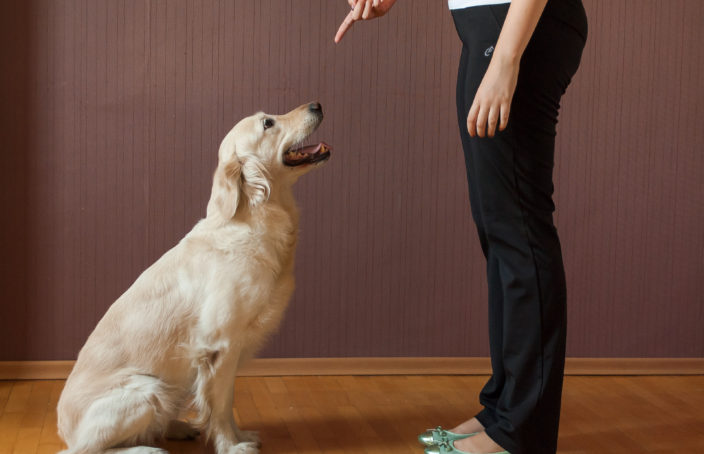
Stay builds directly on Sit. Don't rush the progression — a shaky Stay creates dangerous habits.
- Ask your dog to Sit.
- Hold your open palm toward the dog like a stop sign and say "Stay."
- Take one step back. If the dog holds for 2–3 seconds, step forward and reward.
- Increase distance one step at a time, and duration 2–3 seconds per session.
- Release with a consistent word — "Okay" or "Free" — every single time.
Never punish a dog for breaking Stay. Simply reset and make the challenge slightly easier. Slow progress is still progress.

Teaching Come
Come — also called Recall — is the most critical safety command in this entire list. It can literally save your dog's life.
- Attach a long lead (15–30 ft) to your dog's collar in a safe outdoor space.
- Let the dog roam, then crouch down, open your arms, and call "Come!" in a happy, enthusiastic voice.
- When the dog reaches you, reward heavily. This should feel like the best moment of the dog's day.
- Never call "Come" right before something the dog dislikes — a bath, nail trim, or being put in the crate. That association poisons the cue fast.
- Practice in different environments every week: backyard, street, park.


Teaching Down
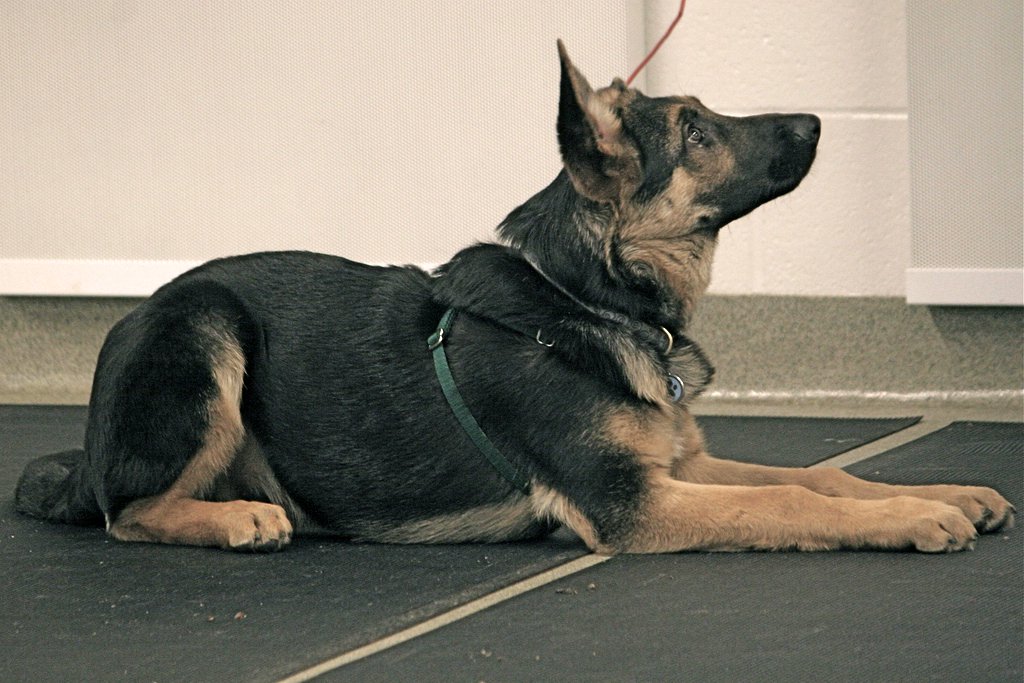
Down is the ultimate settle command. Use it when guests arrive, when you're on the phone, or anytime the dog needs to stop moving and calm down.
- Ask the dog to Sit.
- Hold a treat at its nose, then slowly lower your hand straight to the floor between its front paws.
- As the dog follows the treat, its elbows should touch the ground. Say "Down" the moment both elbows land.
- Reward immediately and release.
- If the dog stands up instead of going down, try on carpet or grass — softer surfaces reduce resistance.

When to Train — and When to Stop
Technique matters, but so does timing. You can have a perfect training method and still get poor results if you're working with your dog at the wrong moment.
Best Times for a Training Session
- Before meals, not after. A slightly hungry dog is a highly motivated dog. Pre-meal training makes treats close to irresistible.
- After a bathroom break. A dog that needs to go outside is distracted and uncomfortable. Always let it relieve itself first.
- Morning or late afternoon. Most dogs are naturally more alert during these windows. Late-night sessions when both of you are tired produce poor results.
- In a low-distraction environment first. Start indoors or in a quiet backyard before moving to high-traffic areas like parks or streets.
Consistent timing turns dog obedience training commands into routine rather than an event. Think of it like your home security habits — just as you follow a checklist for protecting your home while on vacation, a predictable daily training schedule builds reliable behavior over time.
When to Skip the Session
- Your dog is sick, limping, or showing signs of physical discomfort.
- The dog just had intense exercise and is still panting heavily.
- You're frustrated or angry. Dogs read your emotional state. A tense trainer produces a stressed dog — and a stressed dog doesn't retain anything.
- The environment is overwhelming: loud construction, fireworks, thunderstorm.
- The session has already passed 10 minutes and the dog is clearly checking out.
A sharp 5-minute session with full engagement beats a 30-minute grind every time. Knowing when to quit is a genuine skill, not a shortcut.
Keeping Commands Sharp Long-Term
Learning a command once doesn't mean it's locked in forever. Commands fade without consistent reinforcement. Here's how to keep your dog's training solid for the long haul.
Daily Practice Habits
- Weave commands into everyday life. Ask for a Sit before every meal. Ask for a Stay before opening the front door. Call "Come" every time you bring the dog inside. You're reinforcing without adding extra training time.
- Practice in multiple locations. A dog that only knows Sit in the kitchen has learned kitchen-Sit, not Sit. Train in the yard, on walks, at the park, in parking lots.
- Switch to intermittent rewards once a command is reliable. Rewarding every 2nd or 3rd repetition actually strengthens the behavior more than rewarding every time.
Refresher Training for Older Dogs
If your dog is suddenly ignoring commands it used to know reliably, run a refresher rather than assuming the training is lost.
- Go back to basics — treat the command as brand new and rebuild from step one.
- Identify where the breakdown is: does the dog not understand the cue, or is it choosing not to respond?
- Increase your reward value temporarily. Use higher-value treats than usual to rebuild enthusiasm and engagement.
- Reduce distractions to near-zero, then build back up in stages over a week or two.
An obedient dog is a more effective security companion too. A dog that holds position, comes when called, and settles on command is one you can actually control during a nighttime disturbance or an unexpected knock at the door. Pair obedience training with strong physical security — our guide on reasons to install a home security system and our winter home security tips are both worth reading alongside your training work.
Frequently Asked Questions
What age should I start teaching dog obedience training commands?
You can start as early as 8 weeks old. Puppies are capable of learning Sit and Down almost immediately. Keep sessions to 3–5 minutes for young dogs — their attention spans are short, but their capacity to learn is real.
How long does it take to fully train a dog on all four basic commands?
Most dogs learn Sit, Stay, Come, and Down within 4–8 weeks of daily training. "Learned" means consistent performance across multiple environments, not just in one room. Reliable performance under real-world distractions takes longer and requires deliberate practice.
Is positive reinforcement really the most effective training method?
Yes. Reward-based training produces faster learning, fewer behavioral problems long-term, and a stronger bond between you and your dog than punishment-based methods. It's the approach recommended by professional trainers, veterinarians, and animal behavior researchers across the board.
My dog performs commands at home but ignores them outside. What's wrong?
This is called a stimulus control problem — the dog learned the behavior in one context only. The fix is to proof the command by practicing in progressively more distracting environments. Start in the quiet backyard, then the front yard, then the street, then the park. Each step up in distraction is its own training challenge.
Can older dogs learn these commands for the first time?
Absolutely. The saying "you can't teach an old dog new tricks" is a myth. Older dogs can learn all four core commands — they may just take longer to unlearn established habits. Use the same positive reinforcement approach and give them extra time between sessions to consolidate what they've learned.
How does a trained dog actually improve home security?
A dog that responds to commands gives you control in situations where an untrained dog creates chaos. You can direct it away from a door, recall it from the yard, or have it settle calmly while you deal with an unexpected visitor. Pair that with physical deterrents like door security bars and you have a genuinely layered defense.
Do I need a clicker, or can I train without one?
You don't need a clicker. It helps because it marks the exact moment of correct behavior with precision, which speeds up learning — but a consistent verbal marker like "Yes!" works just as well. The key is picking one marker and using it every single time, so the dog always knows exactly what earned the reward.
Key Takeaways
- The four core dog obedience training commands — Sit, Stay, Come, and Down — address the exact scenarios where dogs get into trouble and form the foundation of every advanced skill your dog will learn.
- You can train all four commands at home for free with treats and 5–10 minute daily sessions; professional training is only necessary for dogs with aggression or severe behavioral issues.
- Timing is as important as technique — train before meals, in low-distraction environments, and stop the session the moment either of you loses focus.
- Commands fade without consistent use, so build them into daily life rather than treating training as a separate activity that ends once the dog "knows" the command.


About Robert Fox
Robert Fox spent ten years teaching self-defence in Miami before transitioning into home security consulting and writing — a background that gives him an unusually practical, threat-aware perspective on residential security. His experience spans physical security assessment, lock and alarm system evaluation, and the behavioral habits that make homes harder targets. At YourHomeSecurityWatch, he covers home security product reviews, background check and criminal records resources, and practical guides on protecting your property and family.
You can Get FREE Gifts. Furthermore, Free Items here. Disable Ad Blocker to receive them all.
Once done, hit anything below