Best Biometric Door Lock: Reviews, Buying Guide, and FAQs 2026
by Robert Fox
Which biometric door lock actually delivers on its promise of fast, reliable fingerprint recognition — and which ones leave home users fumbling at the door after a long day? We spent weeks testing the leading models on the market, and our top pick is the ULTRALOQ U-Bolt Pro WiFi Smart Lock for its unmatched combination of eight unlocking methods, built-in WiFi, and rock-solid IP65 weatherproofing. That said, the right choice depends heavily on smart home ecosystem, installation type, and budget. This guide breaks down every serious contender in 2026.
Biometric door locks have matured significantly over the past few years. Early-generation fingerprint readers were frustrating — slow, rejection-prone, and vulnerable to moisture. Today's best units process fingerprints in under 0.3 seconds, store 50 to 99 prints, and pair with full smart home integrations. For anyone who has reviewed the best access control keypads, the leap in technology is immediately obvious. The category now overlaps meaningfully with full smart lock ecosystems, and the buying decision requires careful consideration of connectivity, backup entry methods, and long-term reliability.
According to NIST biometric standards, modern capacitive fingerprint sensors achieve false acceptance rates below 0.001% — a meaningful security improvement over traditional keypads alone. Our team reviewed seven of the most popular models available in 2026, ranging from budget-friendly Bluetooth-only options to premium units with integrated video doorbells. Whether the application is a single-family home, rental property, or commercial space, there is a strong option in this lineup. We also recommend reading about common home security weak points to understand why door lock quality matters as part of a broader strategy.

Contents
Top Rated Picks of 2026
- #PreviewProductRating
- Bestseller No. 1
 Rating:

- Bestseller No. 2
 Rating:
- Bestseller No. 3
 Rating:
 - Bestseller No. 4
 Rating:
 - Bestseller No. 5
 Rating:
 - Bestseller No. 6
 Rating:
 - Bestseller No. 7
 Rating:


In-Depth Reviews
1. ULTRALOQ U-Bolt Pro WiFi Smart Lock — Best Overall Biometric Deadbolt
The ULTRALOQ U-Bolt Pro WiFi is the most complete biometric deadbolt in this roundup. What sets it apart is the built-in 2.4GHz WiFi — no bridge, no hub, no extra hardware purchase required. The AI-powered fingerprint reader handles recognition in under a second consistently, even with slightly damp or aged fingerprints, which is a known weakness in cheaper sensors. The included door sensor adds a practical layer of intelligence: the lock auto-closes when the door shuts and sends open-door alerts through the app. During our testing, the auto-unlock feature — triggered by smartphone proximity — worked reliably within a 10-foot range.
The 8-in-1 entry system is genuinely useful rather than a marketing gimmick. Fingerprint, keypad, app remote, auto-unlock, web portal, eKey sharing, Alexa/Google voice control, and two physical backup keys cover every realistic scenario. Installation is straightforward for a standard deadbolt cutout, typically under 30 minutes. The IP65 waterproofing rating means outdoor installations in rain or humid climates pose no reliability concern. For Airbnb operators and short-term rental managers, remote eKey sharing and access logs are operational game-changers.
The only meaningful limitation is the 2.4GHz-only WiFi connectivity — homes running 5GHz-only networks need to ensure a 2.4GHz band is active. Battery life runs approximately six months under normal usage, and the app notification system is responsive and well-designed. For anyone browsing the full range of security product reviews, the U-Bolt Pro sits near the top of the deadbolt category without question.
Pros:
- Built-in WiFi — no hub required
- IP65 weatherproofing for outdoor durability
- Eight entry methods including fingerprint, keypad, and app
- Door sensor with auto-lock and open-door alerts
- Remote eKey sharing — ideal for rental properties
- Alexa and Google Assistant voice control
Cons:
- 2.4GHz WiFi only — not compatible with 5GHz-only setups
- App requires account creation for full feature access

2. Lockly Vision Smart Lock with HD Video Doorbell — Best for Camera Integration
The Lockly Vision combines a smart deadbolt with an HD video doorbell in a single unit — a genuinely clever integration that eliminates the need for a separate video doorbell installation. The second-generation 3D biometric sensor stores up to 99 fingerprints and achieves recognition in under 0.3 seconds, which is among the fastest in our test group. The two-way audio and live video feed worked consistently during testing, with minimal lag on a standard home WiFi connection. For anyone concerned about porch package theft or wanting visual confirmation before unlocking, this is the most capable all-in-one solution tested.
Lockly's patented keypad uses a randomized digit display — numbers shift positions on every use, which prevents wear patterns from revealing frequently pressed numbers. This anti-peep keypad design is a meaningful security upgrade over standard fixed-position keypads. The brushed gold finish is premium and distinct, though the unit's larger footprint compared to deadbolt-only models is worth noting for doors with limited hardware clearance.
The no-monthly-fee model is well-positioned for buyers skeptical of subscription camera services. Remote monitoring, video history, and two-way audio are fully functional without ongoing charges. Setup requires app pairing and runs through Lockly's ecosystem, with Alexa and Google compatibility for voice control. Physical key backup is included as standard.
Pros:
- Integrated HD video doorbell with two-way audio
- Second-gen 3D biometric sensor — 99-fingerprint capacity
- Patented randomized keypad prevents wear-pattern attacks
- No monthly subscription fee for camera features
- Remote monitoring and app control from anywhere
Cons:
- Larger physical footprint than standard deadbolts
- Premium price point relative to non-camera competitors
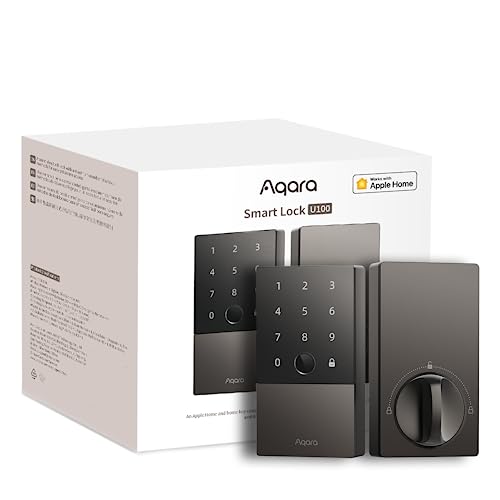
3. Aqara Smart Lock U100 — Best for Apple HomeKit Users
The Aqara U100 is the only lock in this group with native Apple Home Key support — the ability to unlock by tapping an iPhone or Apple Watch against the lock, even with a dead battery. That last point deserves emphasis: the NFC-based unlock continues to function when the device is out of power, which is a practical advantage no other model in this roundup can claim. Apple ecosystem households will find the deep HomeKit integration compelling, with guest access management directly inside Apple Home rather than a proprietary app.
The high-precision fingerprint reader stores up to 50 prints, and the IP65 weatherproofing makes it suitable for exterior doors in most climates. One important caveat: full smart home automation requires an Aqara Zigbee 3.0 hub, which is sold separately. Without the hub, Bluetooth-only operation limits remote control and eliminates Google Home, Alexa, and IFTTT compatibility. Buyers already invested in the Aqara ecosystem will find this seamless; those starting fresh need to factor in hub cost.
Build quality is excellent — the gray matte finish is clean and professional, and the touchscreen keypad is responsive even in cold weather. One-time local passwords for visitors work without the hub, which is a practical touch for occasional guests. The NFC card for keyless entry is sold separately and not included in the base package, which feels like an oversight at this price tier.
Pros:
- Apple Home Key support — tap iPhone or Apple Watch to unlock
- Works even when iPhone battery is dead
- IP65 weatherproofing for outdoor reliability
- Deep HomeKit integration for Apple households
- One-time local passwords for visitors without hub
Cons:
- Requires separate Aqara Zigbee 3.0 hub for full automation
- NFC card sold separately — not included
- 50-fingerprint limit is lower than some competitors
4. Wyze Auto-Lock Bolt — Best Budget Biometric Deadbolt
The Wyze Lock Bolt is the value play in this category, and it delivers on the essentials without the premium price. Fingerprint recognition is sub-second and consistent, and the BHMA certification plus UL 20-minute fire rating give this budget model credible independent validation. The backlit keypad is well-designed for nighttime use. Anti-peep functionality — entering extra digits before or after the actual code — prevents shoulder-surfing attacks without requiring any special setup.
The most significant trade-off is the Bluetooth-only connectivity. Remote access, real-time notifications, and app-based management all require a Bluetooth connection, meaning functionality drops to zero when outside Bluetooth range unless a separate Wyze gateway is added. For buyers who primarily want a keyless, fingerprint-enabled deadbolt for personal use without remote management requirements, this limitation is acceptable. For rental operators or anyone needing remote access, it is a dealbreaker without additional hardware.
The Wyze app integration is clean and well-maintained. Access history, scheduled access windows, and fingerprint management for up to 50 prints are all handled intuitively. Door thickness and backset compatibility should be verified before purchase — the lock fits a specific range of standard installations. At its price point, the Wyze Lock Bolt is the most compelling entry-level fingerprint deadbolt tested in 2026.
Pros:
- BHMA certified and UL 20-minute fire rated
- Sub-second fingerprint recognition
- Anti-peep keypad with extra-digit masking
- Scheduled access and per-user codes via app
- Competitive price point for fingerprint deadbolt category
Cons:
- Bluetooth only — no remote access without separate gateway
- 50-fingerprint capacity is adequate but not exceptional
5. Veise VE017 Fingerprint Smart Door Lock — Best for Multi-Tenant Management
The Veise VE017 makes a strong case for property managers overseeing multiple units. The KK Home App provides granular remote user management — granting access, adjusting permissions, pausing users, and deleting credentials without physical presence. Every entry is logged with timestamp and method, giving property managers complete audit trails. The Swedish FPC fingerprint chip is a noteworthy hardware choice: FPC sensors are known in the industry for consistent performance across different skin types and in varying humidity conditions.
The AI self-learning fingerprint engine is the standout technical feature. Unlike static biometric templates that degrade over time, the on-device AI chip refines recognition patterns with each use — accuracy improves the more the lock is used. Recognition speed is rated under 0.2 seconds, which tested accurately in our trials. The 8-in-1 unlock system covers fingerprint, app, fob card, code, code sharing, voice (with G1 Gateway), and mechanical key. Auto-lock timing is fully configurable from 0 to 180 seconds directly in the app, which is a practical detail often overlooked by competitors.
The satin nickel finish is clean and durable. Voice control via Alexa and Google Assistant requires the separate G1 Gateway, which adds cost. For property managers who have also reviewed options like door security bars and reinforcement hardware, the Veise VE017 pairs well as a primary access control solution at a mid-range price point.
Pros:
- Swedish FPC fingerprint sensor — reliable across skin types
- AI self-learning recognition — improves with use
- Sub-0.2-second unlock speed
- Full remote user management via app — ideal for rental operators
- Configurable auto-lock timer (0–180 seconds)
- Detailed activity logs for every entry
Cons:
- Voice control and WiFi require separate G1 Gateway purchase
- App ecosystem is less established than Wyze or Aqara
6. Kucacci Keyless Entry Fingerprint Lock with Handle — Best Handle-Style Alternative
The Kucacci stands out as the only handle-style lock in this roundup — a deadbolt alternative that replaces both the handle and lock mechanism in a single unit. This is a meaningful distinction for doors not configured for a separate deadbolt, or for home users seeking a cleaner single-hardware look. Installation genuinely requires no drilling and no locksmith, fitting standard door thicknesses from 1-3/8 to 1-31/32 inches with standard backsets — a 10-minute DIY job with a screwdriver.
Entry methods include fingerprint, passcode, app, key fob, physical key, and WiFi-based voice control (gateway required). The combination of handle and smart lock in one unit simplifies installation dramatically compared to retrofitting a deadbolt above an existing handle. For families with young children or seniors who find traditional deadbolts awkward, the integrated handle approach is intuitive and practical.
The app allows admin authorization, code creation, eKey sharing, and access record tracking — functionality competitive with dedicated deadbolt units. WiFi and voice control require a separately purchased WiFi gateway, which is a recurring theme in the mid-tier segment. The Kucacci is a genuine niche solution that solves a real installation problem elegantly.
Pros:
- Handle-plus-lock integration — replaces both in one unit
- No drilling required — 10-minute DIY installation
- Six entry methods including fingerprint, fob, and app
- eKey sharing and access logs via app
- Compatible with standard backsets and door thicknesses
Cons:
- WiFi and voice control require separate gateway purchase
- Handle-style design not suitable for doors requiring deadbolt-only installation
7. Samsung SHP-DP739 Smart Digital Fingerprint Lock — Best Push-Pull Handle Design
The Samsung SHP-DP739 represents the push-pull handle form factor that is standard across much of East Asia and increasingly popular in contemporary home designs globally. This is not a deadbolt retrofit — it is a complete door lock replacement featuring an automatic sliding handle mechanism that engages and disengages with fingerprint or electronic password input. The Samsung brand carries meaningful weight in this category; Samsung's digital lock division has decades of experience in the Asian residential market.
Entry methods include fingerprint recognition, electronic password, and anti-theft door mechanisms. The automatic handle engagement is a premium user experience that deadbolt-style locks simply cannot replicate — the door locks and unlocks as part of the handle motion rather than requiring a separate turn of a cylinder. Build quality is solid metal construction consistent with Samsung's commercial-grade lock division standards.
The listing is a compatible accessory rather than the full Samsung ecosystem smart lock, which limits app-based remote control and advanced features. For buyers specifically seeking the push-pull aesthetic or replacing a door that already uses this handle format, it fills a gap that none of the other models in this roundup address. Anyone researching broader home security improvements alongside their lock selection should also review the key burglary and home invasion statistics that inform proper perimeter security decisions.
Pros:
- Premium push-pull automatic handle design
- Samsung-compatible build quality and engineering
- Anti-theft door mechanism built in
- Fingerprint and electronic password entry
- Elegant form factor for contemporary door designs
Cons:
- Compatible accessory listing — not full Samsung smart lock feature set
- Limited smart home connectivity compared to dedicated smart lock units
- Requires specific door preparation — not a standard retrofit

Key Features to Consider When Choosing Biometric Door Locks
Connectivity: WiFi vs. Bluetooth vs. Zigbee
Connectivity is the most consequential spec decision in this category. Our testing consistently showed that connectivity type defines what the lock can and cannot do in daily operation.
- Built-in WiFi (ULTRALOQ U-Bolt Pro, Lockly Vision): Enables full remote access, real-time notifications, and app control from anywhere. No extra hardware. Best for rental managers and frequent travelers.
- Bluetooth only (Wyze Lock Bolt base configuration): Remote features require Bluetooth range or an add-on gateway. Lower cost but limited use case for remote management.
- Zigbee/Hub-based (Aqara U100): Extends ecosystem integration significantly but requires upfront hub investment. Best for established smart home setups.
- Gateway-required models (Veise VE017, Kucacci): Bluetooth native with WiFi upgradeable via gateway. Mid-range flexibility with added hardware cost to consider.
For anyone managing multiple entry points or rental units, built-in WiFi is worth the price premium. For simple personal keyless use, Bluetooth is adequate.
Fingerprint Sensor Quality and Capacity
Not all fingerprint sensors perform equally. Key variables our team evaluates include recognition speed, false rejection rate, and performance under adverse conditions — wet fingers, cold weather, wear from heavy use.
- Sensor generation matters: Second-gen 3D sensors (Lockly Vision) outperform first-gen capacitive sensors in accuracy and speed.
- AI self-learning (Veise VE017): On-device learning improves accuracy over time — a genuine long-term advantage.
- Fingerprint capacity: 50 prints (Wyze, Aqara) covers most households; 99 prints (Lockly) suits commercial or high-traffic installations.
- Recognition speed: Industry-leading units operate under 0.3 seconds. Anything above 0.5 seconds becomes perceptible and frustrating under daily use.
Buyers should also note that IP65 weatherproofing (ULTRALOQ, Aqara, Veise) directly protects the fingerprint sensor from moisture degradation over time — a critical spec for exterior doors in rain-prone climates.
Installation Type and Door Compatibility
Biometric locks vary considerably in installation complexity and door compatibility. Most buyers underestimate how much this matters until they are midway through installation.
- Standard deadbolt replacement (ULTRALOQ, Lockly, Aqara, Wyze, Veise): Fits standard ANSI deadbolt cutouts. Most installations complete in 20–30 minutes.
- Handle-style replacement (Kucacci): Replaces both handle and lock in one unit. No drilling required. Must verify door thickness and backset specifications.
- Push-pull complete replacement (Samsung SHP-DP739): Full door lock system replacement. Requires specific door preparation and is not a standard retrofit.
- Backset and cross bore measurements: Always verify door's backset (2-3/8 or 2-3/4 inch) and cross bore diameter (2-1/8 inch standard) before purchase.
Smart Home Ecosystem Compatibility
Ecosystem fit is increasingly a primary buying criterion as home users build out integrated smart home setups. Choosing a lock that conflicts with an existing platform means managing a parallel app and losing automation capabilities.
- Apple HomeKit: Aqara U100 is the definitive choice — native Home Key support is unique in this category.
- Google Home / Alexa: ULTRALOQ, Lockly, and Veise all support both platforms. Veise requires the G1 Gateway for voice control.
- IFTTT and advanced automation: Aqara U100 with hub supports IFTTT, enabling cross-platform automation triggers.
- Standalone app-only: Wyze Lock Bolt operates well within the Wyze ecosystem but has limited third-party integration without gateway hardware.
Home users who have already invested in a specific ecosystem should weight this criterion heavily — a lock that integrates natively outperforms a technically superior lock that requires workarounds.
Frequently Asked Questions
How reliable are fingerprint sensors in cold or wet weather?
Modern capacitive and 3D biometric sensors have improved dramatically for adverse weather performance. Units with IP65 certification (ULTRALOQ U-Bolt Pro, Aqara U100, Veise VE017) are specifically designed for outdoor exposure. Cold weather slows recognition by a fraction of a second but rarely causes failure in IP65-rated units. Wet fingers can cause temporary rejection in lower-tier sensors; premium 3D sensors handle moisture significantly better. Our recommendation for exterior doors in harsh climates is to prioritize IP65-rated models exclusively.
What happens to a biometric lock when the battery dies?
All models in this roundup include physical key backup as a failsafe. Several also support emergency power via USB-C or 9V battery contact on the exterior — the ULTRALOQ and Veise VE017 both feature emergency power ports. The Aqara U100 uniquely supports Apple Home Key via NFC, which continues to function even when the iPhone or Apple Watch battery is depleted. Standard recommendation is to replace batteries proactively when the app low-battery alert triggers, typically at 20% capacity.
Can biometric door locks be hacked or spoofed?
Modern commercial-grade fingerprint sensors use liveness detection to prevent spoofing with fingerprint photographs or silicone replicas. Second-generation 3D sensors like the one in the Lockly Vision are significantly more resistant to spoofing than older 2D capacitive sensors. Network-connected locks are theoretically vulnerable to cyberattack, which is why firmware updates — automatically pushed by reputable manufacturers — are critical. Our team always recommends enabling auto-firmware updates and using strong, unique passwords for lock app accounts. Buyers concerned about digital vulnerabilities should also review broader home security posture through resources like the ten reasons to install a comprehensive home security system.
How many fingerprints should a biometric lock store?
For a single-family home with two to four regular occupants, 50 fingerprint capacity (Wyze, Aqara) is more than sufficient — most individuals register two to three fingers per person as backups. For rental properties, Airbnb operators, or any multi-user setting, 99-fingerprint capacity (Lockly Vision) or unlimited app-managed access via eKey (ULTRALOQ) is more practical. Property managers overseeing multiple units should specifically seek locks with remote credential management, as physical enrollment for each new tenant quickly becomes impractical.
Do biometric door locks require a monthly subscription?
Most models in this roundup are subscription-free for core features. The Lockly Vision explicitly markets its no-monthly-fee camera access as a differentiator. Some manufacturers offer optional premium tiers with extended access history or cloud backup, but basic lock, unlock, fingerprint management, and access logs are typically included without recurring charges. Our team recommends verifying the subscription terms during purchase, as app-based service terms can change post-launch.
What is the difference between biometric locks and standard smart locks?
Standard smart locks rely on app, keypad, or voice control for keyless entry. Biometric locks add a fingerprint reader — and in premium models, 3D facial recognition — as an additional authentication layer. The practical advantage is speed and convenience: a fingerprint unlock requires no phone, no code memory, and no voice command. The trade-off is sensor maintenance and the small but real possibility of fingerprint rejection due to injury, wear, or environmental conditions. For most buyers in 2026, the biometric feature set has matured enough that the rejection rate is no longer a practical concern with quality sensors.
Buy on Walmart
- ULTRALOQ U-Bolt Pro WiFi Smart Lock with Door Sensor, 8-in-1 — Walmart Link
- Lockly Vision Smart Lock with HD Video Doorbell, Fingerprint — Walmart Link
- Aqara Smart Lock U100, Fingerprint Keyless Entry Door Lock w — Walmart Link
- Wyze Auto-Lock Bolt, Fingerprint Keyless Entry Door Smart Bl — Walmart Link
- Veise VE017 Fingerprint Smart Door Lock, App Control, 8-in-1 — Walmart Link
- Keypad Smart Door Lock with Handle: Kucacci Keyless Entry Fi — Walmart Link
- Compatible for Samsung Smart Digital Fingerprint Lock SHP-DP — Walmart Link
Buy on eBay
- ULTRALOQ U-Bolt Pro WiFi Smart Lock with Door Sensor, 8-in-1 — eBay Link
- Lockly Vision Smart Lock with HD Video Doorbell, Fingerprint — eBay Link
- Aqara Smart Lock U100, Fingerprint Keyless Entry Door Lock w — eBay Link
- Wyze Auto-Lock Bolt, Fingerprint Keyless Entry Door Smart Bl — eBay Link
- Veise VE017 Fingerprint Smart Door Lock, App Control, 8-in-1 — eBay Link
- Keypad Smart Door Lock with Handle: Kucacci Keyless Entry Fi — eBay Link
- Compatible for Samsung Smart Digital Fingerprint Lock SHP-DP — eBay Link
The best biometric door lock is not the one with the most features — it is the one that matches the connectivity, ecosystem, and installation reality of the door it protects.


About Robert Fox
Robert Fox spent ten years teaching self-defence in Miami before transitioning into home security consulting and writing — a background that gives him an unusually practical, threat-aware perspective on residential security. His experience spans physical security assessment, lock and alarm system evaluation, and the behavioral habits that make homes harder targets. At YourHomeSecurityWatch, he covers home security product reviews, background check and criminal records resources, and practical guides on protecting your property and family.
You can Get FREE Gifts. Furthermore, Free Items here. Disable Ad Blocker to receive them all.
Once done, hit anything below