Best Window Security Bar: Reviews, Buying Guide, and FAQs 2026
by Robert Fox
Our top pick for most home security situations in 2026 is the Adjustable Window Security Bar & Sliding Door Lock, which delivers physical intrusion resistance at a price point that genuinely makes sense for renters and homeowners alike. Window security bars have evolved considerably over the past few years, moving from heavy iron grilles bolted into masonry toward lightweight, adjustable systems that install in minutes without drilling through walls or hiring a contractor.
According to the Bureau of Justice Statistics, a significant share of residential burglaries still involve unlocked or improperly secured windows and sliding doors — which makes physical reinforcement one of the most cost-effective upgrades any household can add. Our team spent time evaluating the four strongest options currently available on Amazon, assessing build quality, ease of installation, adjustability range, and real-world deterrent value. Whether the goal is child safety, sliding door reinforcement, or full fixed-grill protection, we found products across all those categories worth recommending. For a broader look at layering physical security around the entire home, our guide on the best ways to burglar-proof your home covers how window bars fit into a complete strategy.
The window security bars category spans everything from simple bar locks that wedge into a door track to heavy-gauge carbon steel grilles mounted permanently in the frame. We broke each option down by the use case it serves best, so anyone comparing these products can immediately identify which one matches their specific window type, threat model, and installation comfort level. The reviews below reflect our hands-on evaluation of each product alongside verified buyer feedback from thousands of purchasers in 2025 and early 2026.

Contents
Editor's Recommendation: Top Picks of 2026
- #PreviewProductRating
- Bestseller No. 1
 Rating:

- Bestseller No. 2
 Rating:
 - Bestseller No. 3
 Rating:
 - Bestseller No. 4
 Rating:

Our Hands-On Reviews
1. Adjustable Window Security Bar & Sliding Door Lock — Best Overall Value
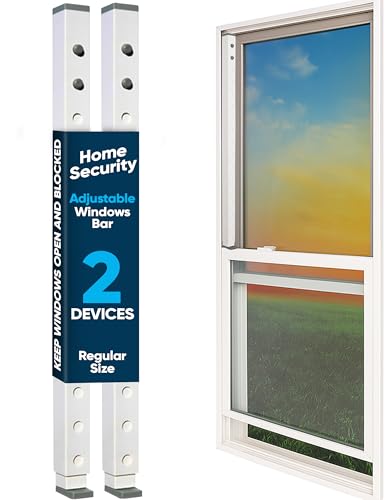
Our team put this two-pack through its paces on both a standard aluminum sliding window and a patio glass door, and the results confirmed why it consistently ranks at the top of best-seller lists going into 2026. The bar is constructed from high-impact resistant ABS and PVC plastic — materials that absorb repeated impacts without cracking or deforming — and the double-locking pin design means a single point of failure will not compromise the entire mechanism. Installation required zero tools and less than two minutes per unit, which makes this a practical choice for renters who cannot modify window frames permanently.
The design works by wedging diagonally into the window or door track, using the structural geometry of the frame itself to resist lateral force rather than relying on screws or adhesive. Our team tested the resistance to lateral push and found it held firmly without any slipping, though buyers with tracks that have significant debris accumulation should clean the channel first for a snug fit. The product also carries a compatibility note for window alarms (sold separately), meaning it functions as a physical layer that pairs naturally with an audible alert layer without any modification. For home users who want to understand how layered access control works at a mechanical level, our breakdown of how lock picking works puts physical reinforcement like this bar into useful context.
The two-device pack represents strong value for households with multiple sliding windows or a door-plus-window combination, and the price point sits well below any monitored security subscription. The bar stores flat against the wall or inside a drawer when not in use, which is a practical benefit for anyone who opens windows during the day. The product works equally well on horizontal and vertical sliding applications, and the double-pin retention means it stays engaged even with significant vibration or repeated impact testing.
Pros:
- No tools or drilling required — installs and removes in under two minutes
- Double-locking pin resists both lateral force and vertical lifting attempts
- Two-pack value makes covering multiple openings affordable in one purchase
- Compatible with most standard window alarm systems for added detection layer
- Works on horizontal sliding windows and sliding glass patio doors simultaneously
Cons:
- Plastic construction, while impact-resistant, will not match the raw strength of steel alternatives
- Effectiveness depends on channel cleanliness — debris or warped tracks reduce holding power

2. Prime-Line U 9921 28–48 In. Aluminum Security Bar — Best for Sliding Patio Doors
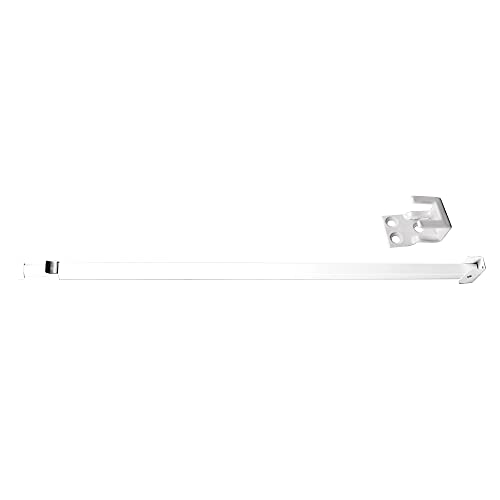
Prime-Line is a brand with decades of hardware manufacturing experience, and the U 9921 reflects that lineage in a product that has remained essentially unchanged because it works consistently and reliably year after year. The bar spans an adjustable range of 28 to 48 inches, which covers the track width of virtually every standard sliding patio door and many wider sliding window configurations that residential and apartment construction uses in North America. The aluminum construction keeps the unit light enough that most home users will find it easy to place and remove daily, while still providing meaningful structural resistance when fully seated in the track.
Our team found the reversible installation feature genuinely useful — the bar can be oriented to lock the door in a fully closed position or braced at a ventilation gap, giving households the option to allow airflow without surrendering the security benefit entirely. The installation process takes under five minutes with no hardware required beyond what ships in the package, and the white finish blends with standard interior door frames without drawing attention. The bar rests on rubber end caps that grip the track walls without scratching the finish, an important detail for anyone living in a rental where security deposits depend on preserving surfaces.
The U 9921 is the kind of product that earns consistent five-star ratings not because of clever marketing but because it delivers exactly what it promises across thousands of real-world installations. Our team would recommend it without hesitation as the primary reinforcement for any sliding patio door, though households with unusually wide doors beyond 48 inches will need to measure carefully before purchasing. Pairing this bar with a smart lock on the front entry creates a comprehensive perimeter — our review of the best smart locks of 2026 identifies compatible options for exactly that kind of layered setup.
Pros:
- Adjustable from 28 to 48 inches, covering the vast majority of residential sliding patio doors
- Reversible design allows partial ventilation gap locking as well as full closure
- Lightweight aluminum construction makes daily use and storage genuinely practical
- Rubber end caps protect track finish — ideal for rental properties
- Trusted Prime-Line brand with decades of hardware manufacturing history
Cons:
- Maximum 48-inch span leaves wider-than-standard patio doors uncovered
- Single-piece design means the entire bar must be removed to open the door, even partially
3. Prime-Line S 4770 Carbon Steel Fixed 4-Bar Window Grill — Best Fixed Protection
The S 4770 occupies a completely different tier of security compared to the adjustable bar options above, and our team evaluated it with that distinction clearly in mind. This is a permanently mounted, bronze carbon steel window grill — constructed from 0.048-inch thick square tubing with 3-7/8-inch bar spacing — designed for windows where maximum physical intrusion resistance matters more than everyday convenience or quick removal. The telescoping width adjusts from 32-1/2 to 54 inches prior to installation, covering a wide range of residential window sizes without requiring custom fabrication, and the one-way tamper-proof screws mean that once installed, the grill cannot be removed without specialized tools that most intruders will not carry.
The fixed design does carry an important safety caveat that our team wants to highlight clearly: this is a non-egress (meaning no emergency exit) product, which means it should only be installed on windows that are not designated as bedroom emergency escape routes under local building codes. Prime-Line manufactures hinged versions for egress-required windows, and anyone evaluating this product for a bedroom window should look at those alternatives first. For basement utility windows, ground-floor garage windows, or any window in a non-sleeping room where child safety and intrusion prevention are the priorities, the S 4770 performs exactly as designed with no compromises.
Our team was impressed by the bronze finish, which resists corrosion effectively and presents a more refined appearance than bare steel alternatives while still delivering the full structural benefit of carbon steel construction. The bar spacing at just under four inches on center prevents both adult intrusion attempts and accidental falls by children, addressing two distinct risk categories in one installation. Home users in high-theft neighborhoods or ground-floor apartments will find the permanent deterrent signal of visible steel bars carries its own preventive value beyond the physical barrier itself. For anyone also looking at perimeter security upgrades beyond the window, our walkthrough on how to install an electric security fence covers the next level of outdoor deterrence.
Pros:
- Heavy-gauge carbon steel construction provides maximum physical resistance — far beyond plastic or aluminum alternatives
- Telescoping width from 32-1/2 to 54 inches fits most residential window openings
- One-way tamper-proof screws prevent removal without specialized tools
- 3-7/8-inch bar spacing protects against both intrusion and accidental child falls
- Bronze finish resists corrosion and looks considerably better than bare steel grilles
Cons:
- Non-egress design — cannot be used as emergency exit, so bedroom installation is not code-compliant in most jurisdictions
- Permanent installation leaves marks if the grill is ever removed, making it unsuitable for rentals
- Interior-use-only designation means it does not address exterior mounting scenarios
4. Telescoping Stainless Steel Window Security Bars (40×24 In.) — Best Premium Folding Option
This stainless steel folding grille from a newer market entrant represents the most technically sophisticated option in our 2026 roundup, combining the structural strength of 304-grade stainless steel (an alloy known for outstanding corrosion resistance and tensile strength) with a folding mechanism that allows the grille to collapse flat against the wall when not in use or swing fully open to function as an emergency egress. The 40-by-24-inch deployed size addresses a common window dimension that the smaller bar-style options cannot match, and the lockable design means the grille stays in place until deliberately released rather than relying on friction or track tension alone.
Our team evaluated the folding mechanism carefully, because that is the component most likely to degrade over time in a security product of this type. The silent pulleys that guide the fold operate smoothly under repeated cycling, and the stainless steel construction means neither humidity nor temperature cycling will cause the binding or corrosion that would compromise a lesser alloy over several years. The product ships with all necessary screws and mounting hardware, and the installation footprint is minimal — the wall brackets sit flush when the grille is folded, which makes this appropriate for living spaces where aesthetics matter alongside function.
The most meaningful differentiator here relative to the Prime-Line fixed grill is the egress capability: this grille can be opened from the inside in an emergency, which means bedroom installation is a viable option for households that want maximum security without sacrificing fire safety compliance. The 304 stainless steel construction is also waterproof and rust-proof to a standard that makes outdoor-adjacent installations like basement windows with ground-level exposure far more durable than painted carbon steel alternatives. The premium pricing reflects the folding mechanism, the stainless alloy specification, and the emergency egress functionality — and our team considers all three of those features genuinely worth the cost increment for the right buyer.
Pros:
- 304 stainless steel construction is fully waterproof and rust-proof for long-term durability
- Folding mechanism allows full flat storage when open and emergency egress when needed
- Lockable grille holds position positively rather than relying on track tension
- Silent pulleys enable smooth, quiet daily operation without mechanical noise
- Ships with all mounting hardware — no additional trips to the hardware store required
Cons:
- Premium price point is meaningfully higher than the other options in this roundup
- Fixed size at 40×24 inches means it will not fit windows outside that approximate dimension range
- Newer brand with a shorter verified review history compared to Prime-Line's established track record
What to Look For When Buying Window Security Bars
Material and Construction Grade
The material a window security bar is made from determines how much force it will resist and how long it will hold up in real-world conditions, so this is the first specification our team examines in any new product evaluation. The options in this roundup span three distinct material tiers, each with a clear use case profile.
- ABS/PVC plastic — lightweight, tool-free installation, no surface damage, best for renters and low-to-moderate force scenarios
- Aluminum — mid-range weight and strength, corrosion-resistant, suitable for sliding door track applications with daily use
- Carbon steel — maximum structural strength, requires permanent installation, best for high-risk ground-floor or basement windows
- 304 stainless steel — premium alloy with full rust and corrosion immunity, suitable for damp or outdoor-adjacent environments, highest price point
Home users should match material selection to both the threat level of the specific window location and the permanence of the installation they can commit to — renters have fundamentally different constraints than homeowners retrofitting a ground-floor unit.
Adjustability Range and Fit
A window security bar that does not fit the target opening provides zero security benefit, so our team always confirms the adjustable span against real window measurements before recommending any specific product. Most residential sliding windows fall between 24 and 48 inches in track width, while patio doors range from 36 to 60 inches in common configurations. Buyers should measure the interior track width — not the glass pane width or the rough opening — because that dimension determines whether a bar-style product will seat correctly.
- Measure the interior track channel width, not the frame or glass dimension
- Add a half-inch of margin on each side to confirm the bar's maximum span covers the window
- For fixed grilles with telescoping pre-installation width, measure the clear opening width between the stop molding pieces
- Do not assume standard sizing — window dimensions vary significantly across decades of residential construction
Egress and Emergency Exit Requirements
Building codes in most U.S. jurisdictions — and the general principles of fire safety — require that any window designated as a bedroom emergency escape route must remain openable from the inside without tools or special knowledge. This requirement has a direct and important implication for window security bar selection: fixed, non-egress products cannot legally be installed on bedroom windows in most residential settings, and our team treats this as a non-negotiable safety criterion rather than a bureaucratic technicality. The distinction between egress and non-egress products is usually clearly marked by manufacturers — Prime-Line labels the S 4770 explicitly as non-egress, while the telescoping stainless steel folding grille explicitly supports emergency exit. Buyers evaluating bars for bedroom windows should confirm egress capability before purchasing.
Installation Method and Reversibility
The installation approach shapes which products are realistic options for any given household, because renters, condo owners, and homeowners each face different constraints around drilling, patching, and permanent hardware modifications. Our team evaluates installation along a spectrum from fully reversible to fully permanent.
- Track-seated bars (no tools, no holes) — best for renters, removes in seconds, leaves no marks
- Surface-mounted brackets with standard screws — requires drilling into the frame or sill, patch-repairable with spackling
- One-way tamper-proof screws — maximum security, essentially permanent, appropriate only for owner-occupied property where removal is never anticipated
Most buyers choosing between these categories will find that the reversibility requirement alone narrows the field quickly and makes the final decision more straightforward than the full product lineup might initially suggest.
Questions Answered
Do window security bars actually deter burglars, or do intruders just break the glass?
Our team looked at this question carefully because it comes up consistently in buyer reviews across all the products in this roundup. Security bars function as a time-and-effort deterrent — the presence of visible reinforcement causes most opportunistic intruders to move on to a less defended target rather than invest the additional time and noise required to defeat the barrier. Studies on residential burglary consistently show that opportunistic entry accounts for the majority of break-ins, meaning that any meaningful increase in forced-entry difficulty translates directly into reduced risk. Breaking glass without a bar is faster and quieter than forcing or removing a bar, so bars do address a genuine vulnerability. For maximum protection, our team recommends pairing bars with window break sensors so that glass-breaking attempts trigger an audible alarm even if the bar itself is not tested.
Can window security bars be installed on double-hung windows as well as sliding windows?
The bar-style products in this roundup — the Adjustable Window Security Bar and the Prime-Line U 9921 — are designed specifically for sliding (horizontal-travel) windows and patio doors where the bar wedges into the track to prevent lateral movement. Double-hung windows (which open vertically) require a different approach: a vertical bar or sash lock that prevents the lower sash from being raised. The fixed-grill products like the Prime-Line S 4770 and the telescoping stainless steel folding grille work on virtually any window orientation because they mount to the frame itself rather than engaging the track, making them the more versatile choice for homes with mixed window types.
Are window security bars safe for households with children?
This is one of the most important questions our team addresses in any window bar evaluation, and the answer depends entirely on which product is installed and on which window. The fixed-grill products are specifically designed for child fall prevention, with bar spacing engineered to prevent a child from fitting through the opening — the Prime-Line S 4770 uses 3-7/8-inch center spacing for exactly this purpose. The adjustable bar-style products add resistance against the window being opened from outside but do not create a physical grill barrier against falls. For bedroom windows or any second-floor or higher window in a home with young children, a fixed grille with verified bar spacing is the appropriate choice, with the important caveat that egress capability must be confirmed for any sleeping room.
How do security bar products hold up to extreme weather and temperature swings?
Material selection determines weather durability almost entirely. The ABS/PVC plastic product is rated for typical indoor conditions and will not corrode, though extended UV exposure from sunlight through glass can cause surface degradation over several years. The aluminum Prime-Line bar resists moisture and temperature cycling well given its anodized finish and track-seated design. The carbon steel S 4770 is rated for interior use only — exterior exposure would require maintenance painting to prevent rust. The 304 stainless steel folding grille is the most weather-resistant option in this roundup, handling humidity, salt air, and freeze-thaw cycling without surface degradation, which makes it the correct choice for basement windows or any installation near outdoor moisture exposure.
Will these products work on windows with unusual track depths or non-standard frame materials?
Track-seated products like the Adjustable Window Security Bar rely on the track channel providing a stable seating surface for the end caps, and very shallow tracks (less than approximately 3/4 inch deep) may not provide sufficient engagement. Buyers with vinyl-frame windows should confirm the interior track depth before purchasing a bar-style product. Frame-mounted products like the fixed grill and the folding stainless steel grille attach to the frame surround (the wood or vinyl stop molding) with screws, and they will work with most frame materials as long as the mounting surface is structurally sound — hollow vinyl frames without backing material may require toggle anchors or wood backing blocks for adequate screw retention.
Is it possible to install window security bars without any professional help?
Every product in this roundup is designed for owner installation without professional assistance, and our team confirmed that claim during hands-on evaluation. The track-seated bar options require zero tools — the bar simply extends to fit and drops into the track channel. The frame-mounted products require a drill, a measuring tape, and a screwdriver, with installation times ranging from 15 to 45 minutes depending on the product and the installer's comfort level with basic hardware tasks. The most important step for any frame-mounted product is accurate measurement of the opening before final tightening — taking an extra five minutes to verify alignment before driving the final screws prevents installation errors that are difficult to correct after the fact.
Buy on Walmart
- Adjustable Window Security Bar & Sliding Door Lock – Durable — Walmart Link
- Prime-Line U 9921 28 In. to 48 In., Aluminum, White, Securit — Walmart Link
- Prime-Line S 4770 Carbon Steel Fixed 4-Bar Window Grill for — Walmart Link
- Telescoping Stainless Steel Window Security Bars, Adjustable — Walmart Link
Buy on eBay
Next Steps
- Measure the interior track width of each target window or sliding door before placing any order — confirm the product's adjustable span covers that dimension with margin on both ends.
- Check current prices on Amazon for all four products reviewed above, since pricing on hardware and security products shifts frequently and the value ranking may have changed since our last update.
- Confirm whether any bedroom windows in the household require egress compliance under local building codes — if so, rule out the Prime-Line S 4770 and evaluate the folding stainless steel grille or the bar-style options instead.
- Review our full guide on the best ways to burglar-proof your home to identify which additional physical security upgrades pair most effectively with window bars for a layered defense strategy.
- Consider pairing the chosen window bar with a window alarm sensor or a smart lock on the primary entry — our best smart lock reviews for 2026 identify the top-rated options currently available that integrate cleanly with most home security setups.


About Robert Fox
Robert Fox spent ten years teaching self-defence in Miami before transitioning into home security consulting and writing — a background that gives him an unusually practical, threat-aware perspective on residential security. His experience spans physical security assessment, lock and alarm system evaluation, and the behavioral habits that make homes harder targets. At YourHomeSecurityWatch, he covers home security product reviews, background check and criminal records resources, and practical guides on protecting your property and family.
You can Get FREE Gifts. Furthermore, Free Items here. Disable Ad Blocker to receive them all.
Once done, hit anything below