Best Budget Gun Safe under $500: Reviews, Buying Guide, and FAQs 2026
by Robert Fox
Which budget gun safe actually keeps your firearms secure without draining your wallet — and is there one model that rises above the rest? Finding a reliable safe under $500 isn't as straightforward as it sounds. The market is flooded with options that look identical on paper but perform very differently when it matters most. Whether you need quick bedside access in the middle of the night or a portable case for travel, the right safe depends heavily on how and where you store your firearm. The good news is that in 2026, the sub-$500 category has never been stronger — manufacturers are packing in biometric readers, steel construction, and smart features at price points that were unthinkable just a few years ago.
If you're already familiar with the broader category, you might want to check out our comprehensive guide to the best gun safes for options across all price ranges. But if your budget is firmly under $500, you're in the right place. We've tested and researched seven of the most popular models available right now, from compact pistol boxes to full-size rifle safes, to help you find the one that fits your home, your lifestyle, and your security needs. We've also dug into biometric gun safe technology in depth, so if fingerprint access is your priority, that guide pairs well with this one.
According to the Bureau of Alcohol, Tobacco, Firearms and Explosives, millions of firearms are sold in the United States each year — and responsible storage is more important than ever. A quality gun safe at any price point should balance rapid access with meaningful resistance to unauthorized entry. The seven safes below cover a wide range of use cases, entry methods, and storage needs. Let's break them down.
Contents
- Standout Models in 2026
- Product Reviews
- SentrySafe QAP1BLX — Best Bedside Biometric Safe
- Fort Knox PB1 — Best Mechanical Lock Safe
- Hornady Rapid Safe Night Guard — Best Nightstand Safe
- GunVault SpeedVault SV500 — Best Wall-Mounted Safe
- VAULTEK LifePod 20 — Best Portable Travel Safe
- Barska Biometric Rifle Safe — Best for Long Guns
- Stack-On Drawer Safe — Best Ultra-Compact Safe
- Key Features to Consider When Choosing
- Frequently Asked Questions
- Next Steps
Standout Models in 2026
- #PreviewProductRating
- Bestseller No. 1
 Rating:

- Bestseller No. 2
 Rating:
 - Bestseller No. 3
 Rating:
 - Bestseller No. 4
 Rating:
 - Bestseller No. 5
 Rating:
 - Bestseller No. 6
 Rating:
- Bestseller No. 7
 Rating:


Product Reviews
1. SentrySafe QAP1BLX Biometric Gun Safe — Best Bedside Biometric Safe
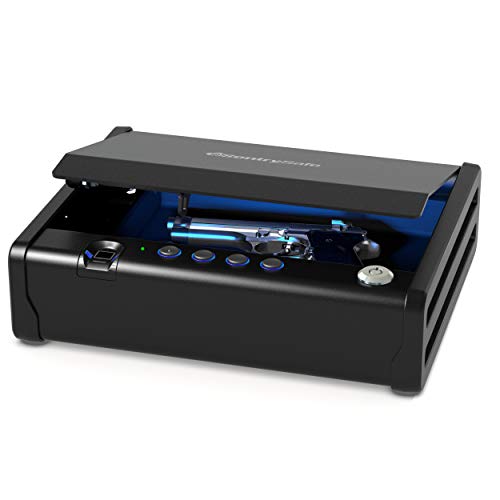
The SentrySafe QAP1BLX is one of the most recognized names in the budget pistol safe category, and the updated 2026 version gives you some meaningful improvements over earlier iterations. The upgraded fingerprint scanner is the headline feature — it registers more reliably and reads wet or slightly dirty fingers better than the older sensor, which was a common complaint. Setup is straightforward: you register up to two fingerprints, and the door pops open within about a second. For a nightstand safe, that's exactly what you want when your heart is pounding and your hands aren't at their steadiest.
The interior light is a genuinely useful addition rather than a gimmick. In a dark bedroom, being able to see the interior clearly saves precious seconds. The safe is built from solid steel with a pry-resistant door, and the gas strut keeps the door open hands-free so you can reach in without juggling. It fits a single full-size handgun comfortably, with a small shelf area for a spare magazine. It's California DOJ certified, which gives you some peace of mind about the build standards. You also get a digital keypad and an override key as backup — so even if your fingerprint doesn't register, you're not locked out.
Where the SentrySafe falls short is size. It holds one handgun — period. If you want to store a second firearm, you'll need another safe or a different model altogether. The mounting hardware is included for bolt-down installation, which is strongly recommended to prevent the entire unit from being walked off. At this price point, the trade-offs are reasonable, but power users will find themselves wanting more storage capacity fairly quickly.
Pros:
- Reliable updated fingerprint scanner with fast access
- Interior light for low-visibility situations
- California DOJ certified build quality
- Bolt-down kit included for secure mounting
Cons:
- Single handgun capacity only
- Biometric sensor can occasionally require a second scan

2. Fort Knox Original Pistol Box PB1 — Best Mechanical Lock Safe
Fort Knox has a reputation that goes well beyond budget safes, and the PB1 Pistol Box brings that reputation to the sub-$500 tier in a compelling way. The defining characteristic of this safe is its mechanical Simplex lock — no batteries, no electronics, no fingerprint sensor. You punch in a code using a series of buttons, and the door opens. It sounds simple because it is, and that's exactly why many experienced gun owners swear by it. There are no batteries to die, no circuit boards to malfunction, and no firmware to fail at 2 a.m. The Simplex lock is rated for an enormous number of cycles and rarely needs servicing.
The construction here is tank-level for a pistol safe. The body is 10-gauge steel — heavier than many safes at double the price — and the gas-strut-assisted door swings open with authority. Dimensions come in at roughly 12.5 inches wide by 10.4 inches deep, which gives you room for a full-size pistol and some accessories. It's California DOJ certified and has been manufactured in the USA, which matters to a lot of buyers. The PB1 isn't the fastest option on this list when compared to biometric safes, but the code entry becomes muscle memory quickly.
The mechanical nature of the lock does mean you can't change access patterns dynamically the way you can with a keypad or RFID system. You can reprogram the combination, but it takes a bit of practice. The safe is also on the heavier side, which is a minor inconvenience during setup but a benefit for security. If you're the type who doesn't trust electronics — and there are plenty of valid reasons not to — the Fort Knox PB1 is likely your best option in this price range.
Pros:
- Mechanical Simplex lock — no batteries ever needed
- Heavy 10-gauge steel construction, USA-made
- Gas-strut door for smooth, one-handed operation
- California DOJ certified
Cons:
- Slower access compared to biometric or RFID models
- Combination reprogramming requires some effort
3. Hornady Rapid Safe Night Guard — Best Nightstand Safe
Hornady's Rapid Safe Night Guard is one of the most creative takes on the bedside gun safe concept in 2026. It's designed to look like a nightstand clock — and it genuinely does. The integrated digital clock and dual USB charging ports mean it blends seamlessly into your bedroom without announcing itself as a gun safe. That's a meaningful security benefit in its own right: a safe that doesn't look like a safe is harder for a curious intruder — or a visiting child — to identify and target. RFID-based access is the primary entry method, and it's the fastest technology on this list. You can swipe a wristband or key fob across the reader and have the safe open in under half a second.
Hornady includes four RFID tags with the purchase, and each can be programmed individually — so you can give one to a partner while revoking access to others. The safe is built from 14-gauge steel with two internal hardened locking lugs, and it comes with a heavy-duty 1,500-pound steel security cable for anchoring to furniture or a wall stud. It's not as heavy-duty as the Fort Knox in terms of raw gauge, but the combination of locking lugs and security cable makes forcible entry genuinely difficult. The interior comfortably fits a full-size handgun plus a spare magazine.
The RFID system is fast and elegant, but it does have a dependency: the RFID tags. If you lose all four tags and forget the keypad backup code, you've got a problem. Hornady does provide a keypad as a secondary entry method, which helps. Some users have also reported that the clock display can occasionally flicker with certain power sources — a minor annoyance but worth noting. Overall, if a discreet, ultra-fast bedside safe is your priority, this is arguably the most refined option under $500.
Pros:
- RFID access is the fastest entry method available
- Discreet nightstand design with clock and USB ports
- Four individually programmable RFID tags included
- 1,500 lb. steel security cable for anchoring
Cons:
- Access depends on having RFID tags nearby
- 14-gauge steel is thinner than some competitors
4. GunVault SpeedVault SV500 — Best Wall-Mounted Quick-Access Safe
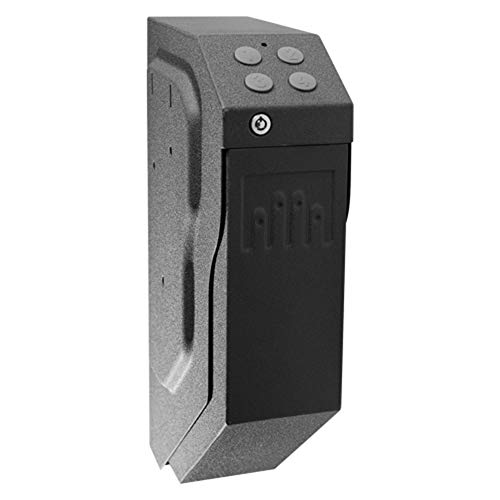
The GunVault SpeedVault SV500 solves a problem that a flat-top safe can't: how do you get to your firearm when you're already sitting down or lying in bed? The SV500 mounts vertically on a wall or the side of furniture, and the drop-down drawer gives you gravity-assisted access — press the keypad, the drawer drops open, and your handgun is right there in a natural draw position. The drop-down mechanism is the SV500's killer feature and it's genuinely faster in real-world conditions than a traditional lid-opening safe, especially when you're groggy or stressed.
The digital keypad is the primary entry method. It allows rapid code entry and includes a lockout feature after repeated failed attempts — so if someone is trying to guess their way in, they won't get far. A tamper indicator lights up if there have been unauthorized entry attempts since you last checked, which adds a useful layer of monitoring. The construction is solid enough for a home safe, though it's worth being clear: the SpeedVault prioritizes quick access over maximum security. It's not a burglary-resistant safe — it's a quick-access safe designed to keep curious hands out while getting your firearm to you fast.
One practical consideration: the mounting position matters a lot for ergonomics. Take time to plan the height and angle before you drill. The keypad works reliably, but like all electronic locks, it depends on batteries — check them regularly. If you're looking at mounting options for different rooms, you might also find our guide on best under-bed gun safes useful for comparison. The SV500 hits a sweet spot for anyone who wants wall-accessible firearm storage with fast electronic entry.
Pros:
- Drop-down drawer provides natural draw position access
- Tamper indicator shows unauthorized entry attempts
- Compact vertical footprint — mounts almost anywhere
- Keypad lockout after repeated failed attempts
Cons:
- Not designed for high-security burglary resistance
- Electronic lock requires regular battery checks
5. VAULTEK LifePod 20 — Best Portable Travel Safe
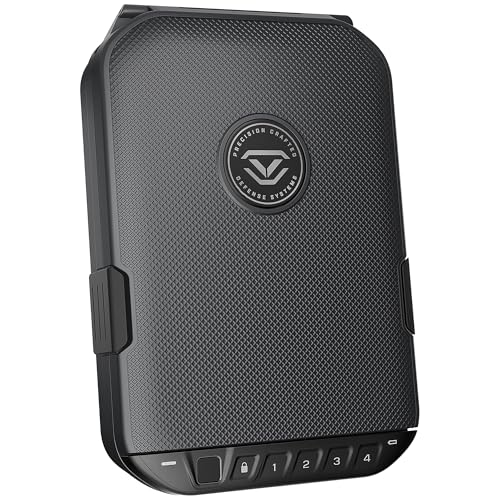
Most gun safes on this list are designed to stay put. The VAULTEK LifePod 20 is built to move with you. It's a weatherproof, TSA-compliant handgun case with a biometric fingerprint reader, a Smart Sense backlit keypad, and backup manual keys — giving you three distinct entry methods in one portable package. The exterior is designed to resist impacts and moisture, making it a legitimate option for travel, camping, and vehicle storage. The LifePod 20 can store a full-size handgun up to 9.25 inches long, which covers most common pistols including full-size 1911s and Glock 17s.
The biometric reader is water-resistant, which is a notable upgrade from many competitors. The Smart Sense keypad backlight activates automatically in low light, so fumbling in a dark car or tent is less of an issue. One of the more thoughtful design details is the removable interior tray — it gives you two layers of storage, letting you keep the firearm on the lower level and accessories or documentation on top. The anti-impact latch design prevents accidental opening under stress, and the included steel security cable lets you anchor it to a car seat rail or hotel bed frame.
The trade-off with portability is capacity and rigidity. The LifePod 20 is not a burglary-resistant home safe — it's a travel case with meaningful security features. A determined person with the right tools could defeat it, but that's true of virtually everything in this price range. What you're buying here is convenience, weatherproofing, and compliance: it meets TSA requirements for checked firearm transport, which matters if you fly with your firearm regularly. For a safe you can actually take with you, it's genuinely impressive in 2026.
Pros:
- Three entry methods: biometric, keypad, and manual key
- Weatherproof and TSA-compliant for travel
- Removable interior tray for two-layer storage
- Water-resistant fingerprint reader
Cons:
- Not a substitute for a fixed home safe — portability limits rigidity
- Interior dimensions can be tight for accessories alongside a full-size pistol
6. Barska Biometric Rifle Safe — Best Budget Safe for Long Guns
Every other safe on this list is designed for handguns. The Barska Biometric Rifle Safe is the outlier — a full cabinet-style safe that can hold four to five long guns, making it a genuinely different proposition for rifle owners. At under $500, there aren't many options for long gun storage that include biometric access, which is one of the reasons the Barska stands out in its niche. The safe is California DOJ approved, which means it meets state-level standards for firearm storage — a baseline that provides some confidence in the build quality.
The biometric fingerprint reader registers up to 120 fingerprints, which is significantly more than any pistol safe on this list. That makes it practical for a household with multiple authorized users. Silent mode is a standout feature — you can disable the audible beeps so the safe opens without sound, which matters for nighttime access when you don't want to wake the house. The removable shelf adds flexibility for mixed storage: rifles below, handguns or accessories on the shelf. At 1.83 cubic feet of interior space, you get meaningful room without the safe becoming a room-dominating piece of furniture.
The trade-off is build robustness. The Barska is not a high-security safe by any stretch — the steel gauge and locking mechanism are entry-level. It will deter opportunistic access from children or casual intruders, but a motivated adult with basic tools can defeat it given enough time. Think of it as a responsible storage solution rather than a theft-prevention vault. For rifle owners who want organized, code-accessible storage at a budget price, it fills a gap that most competitors don't address until you spend considerably more. Check the broader security reviews section for context on how gun safes compare to other home security products.
Pros:
- Holds 4-5 long guns — rare at this price point
- Up to 120 fingerprint registrations for multiple users
- Silent mode for noise-free nighttime access
- California DOJ approved
Cons:
- Entry-level steel gauge — not burglary-resistant
- Large footprint requires dedicated floor space
7. Stack-On Small Drawer Safe — Best Ultra-Compact Safe
The Stack-On Small Drawer Safe earns its place on this list not through flashy features but through sheer practicality. It's a compact, no-nonsense electronic keypad safe designed to fit inside a nightstand drawer, a desk drawer, or a closet shelf — places where other safes simply won't fit. The dimensions make it genuinely discreet, which has its own security value. If an intruder doesn't see a safe, they won't spend time trying to crack one. Welded 16-gauge steel construction with concealed hinges and two live-action steel bolts gives it solid resistance to prying for a safe of this size and price.
The electronic keypad is straightforward — program your code, punch it in, and the drawer opens. It's not the fastest system on this list, but it's reliable and the backup key ensures you're never permanently locked out. The Stack-On is honest about what it is: a personal safe for smaller valuables and a single handgun, not a primary security safe for a serious firearm collection. It fits a compact or mid-size pistol comfortably, though a full-size handgun with a larger frame may be a tight fit — worth measuring before you buy.
Installation is simple. You can bolt it down using the provided hardware, or slide it inside a drawer where it's already reasonably secured by the furniture itself. Battery life on the keypad is good, and the indicator warns you when replacement is needed. For apartment dwellers, college students, or anyone who needs responsible handgun storage in a small footprint, the Stack-On offers real value. It pairs well with a secondary alarm system — see our roundup of home invasion statistics for context on why layered security still matters even with a good safe in place.
Pros:
- Compact enough to fit inside furniture drawers
- 16-gauge steel with concealed hinges and two live-action bolts
- Electronic keypad plus backup key access
- Easy bolt-down installation
Cons:
- Tight interior — may not fit full-size pistols with accessories
- Not suitable as a primary safe for multiple firearms
Key Features to Consider When Choosing a Budget Gun Safe
Entry Method: Biometric, RFID, Keypad, or Mechanical?
Your entry method is arguably the most important decision you'll make when selecting a gun safe, because it determines how fast and reliably you can access your firearm under pressure. Biometric safes like the SentrySafe and VAULTEK LifePod 20 offer hands-free speed, but fingerprint readers can occasionally misfire — wet fingers, cuts, or extreme temperatures all affect performance. RFID systems like the Hornady Night Guard are the fastest of all when functioning correctly, but you're dependent on having your tag or wristband within reach. Mechanical locks like the Fort Knox PB1 eliminate battery and electronics failure entirely at the cost of slightly slower access. Keypad locks are the most common and represent a middle ground: reliable, fast enough for most situations, and not dependent on biometrics. Think about your specific scenario — if you're storing a bedside firearm, speed matters most; if you're storing rifles in a closet, access time is less critical than capacity and cost.
Steel Gauge and Build Quality
Steel gauge is one of the most meaningful indicators of how resistant a safe is to physical attack. Lower gauge numbers mean thicker steel — 10-gauge (Fort Knox) is significantly heavier and harder to defeat than 16-gauge (Stack-On) or 14-gauge (Hornady). At sub-$500 price points, you're not getting a true burglary-resistant vault regardless of what the marketing says, but thicker steel meaningfully increases the time and effort required for forced entry. Concealed hinges prevent hinge-pin attacks. Pry-resistant doors and hardened locking bolts add further resistance. For quick-access bedside safes, the priority is deterrence and child resistance rather than defeating determined burglars — but for closet or long-term storage, invest in the thickest gauge your budget allows.
Mounting and Portability
A gun safe that isn't bolted down is a gun safe that can be carried away and defeated at leisure. Every safe on this list includes either mounting hardware or an anchor cable, and you should use it. For bedside safes, bolt-down installation into a nightstand, floor, or wall stud is the most secure option. Wall-mounted safes like the GunVault SV500 are inherently anchored. The exception is the VAULTEK LifePod 20, which is intentionally portable — but even there, the security cable should be used whenever you're stationary. If you're thinking about securing valuables in other contexts, the principles from our guide on biometric gun safes translate directly to other secure storage needs.
Capacity and Use Case Fit
Be honest with yourself about what you actually need to store. A compact bedside safe like the SentrySafe or Stack-On is purpose-built for a single handgun and perhaps a spare magazine — nothing more. The Hornady Night Guard and GunVault SV500 follow the same single-pistol formula with different form factors. The VAULTEK LifePod 20 adds travel versatility. Only the Barska steps into multi-firearm territory for long guns. If your collection grows — or if you anticipate it growing — think about that trajectory when you buy. It's cheaper to buy the right capacity once than to replace a safe that's already been installed and bolted down. Also consider whether you need to store documents, medications, or other valuables alongside your firearm, as some of these safes offer better interior organization than others.
Frequently Asked Questions
What is the best entry method for a bedside gun safe?
For bedside use, RFID and biometric entry methods are generally the fastest — the Hornady Night Guard's RFID system is the quickest on this list. However, biometric readers are the most common balance of speed and accessibility since they don't require a separate tag or fob. If you're concerned about electronics failing, the mechanical Simplex lock on the Fort Knox PB1 is slower but completely battery-independent. Your best choice depends on how much you value speed versus absolute reliability in the entry system.
Are budget gun safes actually secure enough?
Budget gun safes under $500 are designed to prevent unauthorized access by children, deter casual theft, and comply with storage laws — not to resist a determined burglar with tools. For the vast majority of home scenarios, a quality safe in this price range provides meaningful protection. For maximum security against break-ins, you'd need a significantly heavier, thicker safe rated by UL. That said, proper bolt-down installation dramatically increases resistance even for budget safes, since a portable safe is much easier to defeat than a mounted one.
Do gun safes need to be bolted down?
Yes, strongly recommended. A gun safe that isn't secured to a wall, floor, or piece of heavy furniture can simply be carried away and forced open elsewhere. Most safes under $500 are light enough for one or two adults to move without difficulty. Every safe on this list either includes mounting hardware or an anchor cable — use it. Even if you're renting and can't drill into walls or floors, anchoring to a stud through a closet rod bar or furniture leg significantly reduces the risk of the safe being removed entirely.
What does California DOJ certification mean for gun safes?
California Department of Justice certification means the safe has been tested to meet California's minimum standards for firearm storage devices. To qualify, a safe must pass tests including lock-picking resistance, pry resistance with specified force, and key duplication resistance. It's not the same as a UL burglary rating, but it provides a meaningful baseline assurance that the safe isn't a purely cosmetic product. Several safes on this list carry this certification, including the SentrySafe QAP1BLX, Fort Knox PB1, and Barska rifle safe.
Can I store more than one handgun in a budget safe?
Most dedicated pistol safes in this price range are designed for one handgun. The SentrySafe, Hornady Night Guard, GunVault SV500, and Stack-On Drawer Safe all fit a single pistol comfortably. The VAULTEK LifePod 20 may accommodate two compact pistols depending on their size, though it's optimized for one with accessories. The Barska biometric safe is the only model on this list designed for multiple firearms, holding four to five long guns. If two-handgun storage is your goal, consider a slightly larger keypad pistol safe or a small stack-on shelf unit.
How do I maintain a gun safe's biometric reader?
Biometric readers in budget safes require minimal but important maintenance. Keep the sensor clean and dry — a soft cloth wipe every few weeks prevents oil and dust buildup that degrades scan accuracy. Register your fingerprint in multiple orientations (center, slightly rotated left, slightly rotated right) so the reader has more reference data to work with. If you live in a region with extreme humidity or cold, test the reader periodically since these conditions affect sensor performance. Always register at least one backup entry method (keypad or override key) so you're never locked out if the biometric fails.
Buy on Walmart
- SentrySafe Biometric Gun Safe for Handgun or Pistol, Fingerp — Walmart Link
- Fort Knox Original Pistol Box (PB1), Security for pistols, h — Walmart Link
- Hornady Rapid Safe Night Guard – Nightstand Gun Safe with RF — Walmart Link
- GunVault SpeedVault SV500 Quick Access Handgun Safe with Dro — Walmart Link
- VAULTEK LifePod 20 Full-Size Biometric Lockable Weatherproof — Walmart Link
- Barska Quick and Easy Access Biometric Rifles, Firearms and — Walmart Link
- Stack-On Small Drawer Safe with Electronic Lock – Compact Pe — Walmart Link
Buy on eBay
- SentrySafe Biometric Gun Safe for Handgun or Pistol, Fingerp — eBay Link
- Fort Knox Original Pistol Box (PB1), Security for pistols, h — eBay Link
- Hornady Rapid Safe Night Guard – Nightstand Gun Safe with RF — eBay Link
- GunVault SpeedVault SV500 Quick Access Handgun Safe with Dro — eBay Link
- VAULTEK LifePod 20 Full-Size Biometric Lockable Weatherproof — eBay Link
- Barska Quick and Easy Access Biometric Rifles, Firearms and — eBay Link
- Stack-On Small Drawer Safe with Electronic Lock – Compact Pe — eBay Link
Next Steps
- Check the current price on Amazon for your top one or two picks — prices in the sub-$500 category shift frequently, and sales can bring premium models into easier reach.
- Measure your storage location before purchasing — verify the safe's exterior dimensions fit your nightstand, drawer, or closet space, and confirm the interior fits your specific firearm model.
- Decide on your entry method priority — if speed is critical (bedside defense), lean toward RFID or biometric; if battery-free reliability matters more, consider the mechanical Fort Knox; if portability is your need, go VAULTEK.
- Plan your mounting strategy — identify the nearest wall stud, floor anchor point, or furniture leg before the safe arrives so you can bolt it down immediately rather than leaving it unsecured.
- Read extended owner reviews for your shortlisted model — particularly from verified purchasers who've had the safe for 6–12 months, since long-term reliability data on biometric sensors and electronic locks is the most useful signal at this price point.


About Robert Fox
Robert Fox spent ten years teaching self-defence in Miami before transitioning into home security consulting and writing — a background that gives him an unusually practical, threat-aware perspective on residential security. His experience spans physical security assessment, lock and alarm system evaluation, and the behavioral habits that make homes harder targets. At YourHomeSecurityWatch, he covers home security product reviews, background check and criminal records resources, and practical guides on protecting your property and family.
You can Get FREE Gifts. Furthermore, Free Items here. Disable Ad Blocker to receive them all.
Once done, hit anything below