Best Under Bed Gun Safe in 2026: Reviews, Buying Guide, and FAQs
by Robert Fox
Which under bed gun safe actually delivers when you need it most — and which ones will leave you fumbling in the dark when every second counts? If you have spent any time researching bedside firearm storage, you already know that the market is flooded with options ranging from flimsy sheet-metal boxes to purpose-built vaults engineered for rapid deployment. After reviewing dozens of products, testing access speeds, and evaluating build quality across multiple price points, the Hornady Rapid Safe Keypad Vault with RFID stands out as the top pick for most households in 2026 — but it is not the right choice for everyone. Read on to find out which safe matches your specific situation.
Under bed gun safes occupy a unique niche in the world of firearms security. Unlike full-sized floor safes or biometric wall units, a bedside or under-bed safe must accomplish two competing objectives simultaneously: keep unauthorized users — including children and intruders — completely locked out, while ensuring that a lawful owner can retrieve a firearm within seconds during a genuine emergency. According to the Bureau of Alcohol, Tobacco, Firearms and Explosives, safe storage is one of the most effective measures for preventing both unintentional injuries and theft of firearms. Getting that balance right requires attention to lock type, steel gauge, access speed, and installation options — all factors we cover in depth below.
Whether you are protecting a single handgun in a studio apartment or managing home defense storage across a larger household, this guide covers six of the best under bed gun safes available in 2026. You will find detailed reviews, a side-by-side comparison, a thorough buying guide, and answers to the most common questions buyers ask before making a purchase. If you are also evaluating broader bedside security options, our Vaultek VT20i Biometric Safe review provides an excellent point of comparison for a competing form factor.

Contents
- Editor's Recommendation: Top Picks of 2026
- Detailed Product Reviews
- Fort Knox Original Pistol Box (PB1) — Best Mechanical Lock
- GunVault MiniVault GV1000 — Best Digital Keypad
- Hornady Rapid Safe Keypad Vault — Best RFID Entry
- V-Line Slide-Away Security Safe — Best USA-Made Option
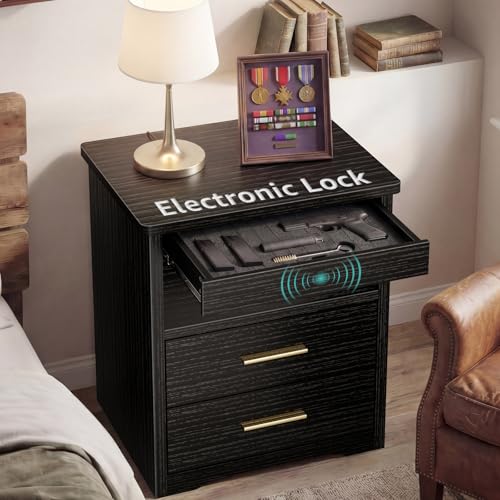
- Black Nightstand with Gun Drawer — Best Concealed Furniture Safe
- DINWORK Under Bed Gun Safe — Best Full Under-Bed Drawer
- Buying Guide
- FAQs
Editor's Recommendation: Top Picks of 2026
- #PreviewProductRating
- Bestseller No. 1
 Rating:

- Bestseller No. 2
 Rating:
- Bestseller No. 3
 Rating:
 - Bestseller No. 4
 Rating:
 - Bestseller No. 5
 Rating:
- Bestseller No. 6
 Rating:


Detailed Product Reviews
1. Fort Knox Original Pistol Box (PB1) — Best Mechanical Lock
The Fort Knox PB1 is the benchmark against which all mechanical-lock pistol safes are measured. Built in Orem, Utah, and certified by the California Department of Justice, this safe is constructed from 10-gauge steel — one of the thickest you will find at this price point. The body measures 4-1/4 inches high by 12-1/2 inches wide by 10-3/8 inches deep, making it a natural fit for a nightstand drawer or under a low-profile bed frame. The gas-strut-assisted door opens forcefully and fully, ensuring your hand lands on the grip without having to wrestle with the lid.
The Simplex mechanical lock requires no batteries, no electronics, and no charging cables. You press a sequence of up to four buttons in any order and the door releases in under two seconds. Critics of mechanical locks sometimes argue that the combination is easier to observe, but Fort Knox counters this by designing the button pattern to be operable entirely by touch in complete darkness. There is zero risk of a dead battery locking you out during a critical moment — a failure mode that plagues virtually every electronic competitor.
For buyers who prioritize long-term reliability over high-tech features, the PB1 remains an outstanding choice in 2026. It lacks RFID, a digital display, or biometric capability, but it also has no firmware to update, no sensors to fail, and no app to authenticate. If mechanical simplicity and heavy steel construction are your non-negotiables, this is your safe. Pair it with a cable tether or bolt-down kit for a complete installation.
Pros:
- 10-gauge steel body — significantly heavier than most competitors
- California DOJ certified for firearms storage compliance
- Mechanical lock operates with zero batteries or electronics
- Gas-strut lid opens forcefully for true one-hand access
- Made in the USA with lifetime warranty support
Cons:
- No electronic access options (RFID, biometric, keypad)
- Mechanical combination cannot be changed without a locksmith
- Compact size limits capacity to one or two handguns

2. GunVault MiniVault GV1000 — Best Digital Keypad
The GunVault MiniVault GV1000 has been a staple of the bedside gun safe category for years, and its continued relevance in 2026 is a testament to a design that prioritizes speed without sacrificing security. The patented No-Eyes® keypad is the defining feature: four tactile buttons are positioned so that you can enter your code entirely by feel, even in absolute darkness. The spring-loaded door activates the moment the correct code is entered, launching open automatically for immediate one-hand access. There is no pulling, no lifting — just code entry and a door that opens on its own.
The GV1000 is constructed from 16-gauge steel, which is lighter than the Fort Knox but adequate for its intended role as a deterrent against opportunistic theft rather than a sustained prying attack. The digital lock supports over 12 million code combinations, and the tamper alert feature triggers an audible alarm after repeated incorrect entry attempts — a meaningful deterrent in homes where children might experiment with the keypad. Installation is straightforward, with pre-drilled holes and a security cable included for tethering to furniture or a bed frame.
Where the GV1000 earns its place as a top digital keypad pick is in its combination of fast access, tactile usability in the dark, and a price that remains well below premium competitors. Battery life is measured in years under normal use, but you should keep a spare 9V on hand regardless. If the concept of biometric or RFID systems introduces complexity you do not want to manage, the GV1000 delivers digital security with none of the fuss.
Pros:
- Patented No-Eyes® keypad — operable in total darkness by touch
- Spring-loaded door opens automatically for hands-free retrieval
- Tamper alert activates after multiple failed access attempts
- Over 12 million user-programmable code combinations
- Compact form factor fits most nightstand drawers
Cons:
- 16-gauge steel is lighter than top-tier competitors
- Requires battery replacement (9V); dead battery blocks access
3. Hornady Rapid Safe Keypad Vault with RFID — Best RFID Entry
The Hornady Rapid Safe Keypad Vault with RFID (model 97436) is, by a meaningful margin, the most versatile under bed gun safe in this roundup. It offers three independent entry methods — RFID tag, user-programmed access code via keypad, and a mechanical key backup — any of which can be selectively enabled or disabled based on your household's security preferences. The RFID system is touch-free: a quick swipe of the included RFID bracelet or key fob opens the safe in under one second. If you store that bracelet on your wrist or nightstand, your response time from asleep to armed is reduced to the bare minimum physically possible.
Construction is built around 14-gauge steel with a thick steel lid, placing it in the upper tier of the category for pry resistance. Pre-drilled mounting holes allow you to bolt the unit directly to a bed frame rail, nightstand base, or shelf — locking the safe itself in place so an intruder cannot simply walk off with it. The interior is sized to accommodate a standard handgun, spare magazine, and small accessories. For households already invested in Hornady's ecosystem of safes and RFID products, the 97436 is fully compatible with existing RFID tags already paired to other Hornady units, which simplifies multi-safe management considerably. If you want to understand how RFID locking technology works at a deeper level before purchasing, our guide on RFID lock systems is a useful reference.
The Hornady 97436 is the correct choice for buyers who want maximum access flexibility without sacrificing build quality. The triple-entry system means you are never locked out due to a single point of failure. RFID provides the fastest access; the keypad serves as a reliable backup; the mechanical key covers edge cases like a dead battery or lost tag. At its price, no other safe in this category provides this level of redundancy.
Pros:
- Three access methods: RFID, keypad, and mechanical key
- RFID entry completes in under one second — fastest access available
- 14-gauge steel body with thick steel lid for superior pry resistance
- Pre-drilled mounting holes for permanent bolt-down installation
- Compatible with all Hornady RFID-enabled products across their safe lineup
Cons:
- Requires battery power for electronic functions (key backup mitigates this)
- RFID tags must be stored accessibly — losing both tags reduces you to keypad or key
4. V-Line Slide-Away Security Safe — Best USA-Made Option
The V-Line Slide-Away occupies a distinctive position in the under-bed safe market: it is purpose-designed to mount beneath a bed or inside a drawer, sliding out on a rail system for clean, low-profile access. Manufactured in the United States and California DOJ approved, the Slide-Away is built for owners who want a domestic product that meets formal compliance requirements. The pick-and-pluck foam interior protects your firearm from contact scratches and can be customized to fit the specific dimensions of your handgun and accessories.
The V-Line Slide-Away uses the same Simplex-style mechanical lock system found in the Fort Knox PB1, meaning access is battery-free and operable entirely by touch. This positions it well for buyers who prioritize long-term reliability and have concerns about electronic lock failure scenarios. The sliding form factor is its most unique attribute — rather than reaching into a box, you slide the entire unit out and access the contents from above, which many users find more ergonomic under low bed frames where overhead clearance is limited.
Installation requires mounting hardware appropriate to your bed frame material, but V-Line includes the hardware and the process is well-documented. The semi-flat black finish is understated and does not call attention to itself in a typical bedroom environment. If domestic manufacturing, DOJ compliance, and a mechanical lock are all requirements for your purchase, the V-Line Slide-Away is the logical conclusion of that criteria set. For a broader perspective on how gun safe construction methods affect strength and security ratings, our article on gun safe construction types provides a thorough breakdown.
Pros:
- Made in the USA — domestic manufacturing with verified quality control
- California DOJ approved for regulatory compliance
- Sliding rail design ideal for under-bed and low-clearance installations
- Pick-and-pluck foam interior provides customizable firearm protection
- Mechanical lock — zero battery dependency
Cons:
- Sliding rail mechanism adds installation complexity versus drop-in placement
- No electronic access options for households that prefer digital entry
5. Black Nightstand with Gun Drawer — Best Concealed Furniture Safe
The Black Nightstand with Gun Drawer takes a fundamentally different approach to the problem of bedroom firearm storage: instead of placing a dedicated safe alongside or underneath a piece of furniture, it integrates the secure storage directly into the nightstand itself. The hidden pull-out gun drawer is completely concealed within the cabinet's structure, invisible to anyone who does not know it exists. For households with regular visitors, children, or guests who may wander into the bedroom, this level of visual concealment is a significant security advantage that a conventional safe sitting in plain sight simply cannot match.
The electronic sensor lock controls the hidden drawer, providing quick access for authorized users while preventing unauthorized opening. The interior is lined with adjustable grid-style pearl foam that can be shaped to fit virtually any handgun profile, holding the firearm securely in place and protecting the finish from contact damage during the drawer's movement. The three-drawer design means the nightstand functions as fully normal bedroom furniture from every visible angle — a detail that matters in households where the first layer of security is the intruder or curious child not knowing the storage exists.
The trade-off in this category is obvious: the nightstand safe is a furniture piece first and a gun safe second. It will not match the steel gauge or pry resistance of a dedicated vault. However, for buyers whose primary concern is keeping firearms out of sight and out of casual reach — rather than defeating a determined, sustained attack — this product solves a genuine problem elegantly. The modern three-drawer profile in flat black finishes fits most contemporary bedroom aesthetics without announcement.
Pros:
- Fully concealed hidden drawer — no visible indication of firearm storage
- Electronic sensor lock provides fast authorized access
- Adjustable foam interior accommodates multiple handgun sizes
- Doubles as fully functional bedroom nightstand furniture
- Ideal for households where visual concealment is the primary priority
Cons:
- Lighter construction than dedicated steel gun safes — not designed for forced entry resistance
- Electronic lock requires battery maintenance
- Security depends partly on concealment — not a standalone deterrent if location is revealed
6. DINWORK Gun Safe for Under Bed — Best Full Under-Bed Drawer
The DINWORK Under Bed Gun Safe is the only product in this roundup designed specifically to live under a standard bed frame at full scale — and its engineering reflects that purpose completely. Four integrated 360-degree swivel wheels allow a single person to roll the entire unit into position and retrieve it without lifting. This solves one of the most overlooked practical problems in under-bed storage: the ergonomic challenge of accessing a heavy steel box that sits flat on the floor in a confined space. With the DINWORK, you simply reach down, pull, and the unit rolls to you.
Construction uses 16-gauge steel throughout with a pry-resistant door and internal locking bolts. Access is provided by an advanced biometric scanner and a backlit keypad, and the safe includes a mute function that silences all audible feedback — a detail that matters considerably if you need to access the safe at 3 AM without waking a sleeping partner. The interior is large enough to accommodate pistols, rifles broken down, spare magazines, ammunition, jewelry, and documents — making this the most versatile storage option in the group. Pre-drilled holes allow for permanent anchoring if the mobility feature is less important to you than a fixed installation.
The DINWORK is the correct choice for buyers with higher storage volume requirements or those who need to store long guns alongside handguns. The wheel system and easy installation make it genuinely practical for regular use rather than emergency-only access. If you are also evaluating comprehensive home security strategies beyond firearm storage — which most homeowners benefit from doing simultaneously — our resource on tips to make your home secure covers the broader picture effectively.
Pros:
- 360-degree swivel wheels allow effortless single-person repositioning
- Biometric scanner plus backlit keypad for dual-method fast access
- Mute function enables completely silent access — critical for nighttime use
- Large interior stores rifles, handguns, ammunition, and valuables together
- Pre-drilled mounting holes for permanent installation if preferred
Cons:
- Larger footprint requires adequate under-bed clearance (measure before ordering)
- Biometric sensors require enrollment and occasional re-registration
- Higher price point than compact single-handgun safes

Buying Guide: How to Choose the Best Under Bed Gun Safe
Before purchasing any under bed gun safe, you need to evaluate four core factors that determine whether a safe will actually serve its intended purpose in your specific household. The best-reviewed safe on the market is worthless if it does not fit your bed frame, does not match your access speed requirements, or uses a lock type that fails under the conditions you will most likely face it in. The guidance below covers what matters most.
Steel Gauge and Physical Security
Steel gauge is the single most important construction variable in a gun safe, and it is one that marketing materials frequently obscure. Lower gauge numbers mean thicker, stronger steel. The Fort Knox PB1 uses 10-gauge steel — approximately 0.135 inches thick. The Hornady Rapid Safe and the DINWORK use 16-gauge steel — approximately 0.060 inches thick. That difference translates directly into pry resistance and resistance to forced-entry tools. If your threat model includes a motivated intruder with tools and time, invest in the thickest gauge you can accommodate. If your primary concern is preventing a child from accessing the safe or deterring opportunistic theft, 16-gauge provides adequate resistance. For a technical breakdown of how steel thickness interacts with overall safe strength, our article on how gun safes are constructed is highly recommended reading.
- 10-gauge steel: maximum pry resistance, heavier weight, typically higher cost
- 14-gauge steel: strong mid-tier option with good balance of weight and security
- 16-gauge steel: sufficient for most residential threat models; lighter and more affordable
Lock Type and Access Speed
Your lock type determines both your access speed under stress and your vulnerability to failure modes. Each lock category has distinct strengths and trade-offs that you must weigh against your household's specific needs.
Mechanical locks (Fort Knox PB1, V-Line Slide-Away) require no batteries or electronics. They operate in any temperature, after any power outage, and after years of disuse with zero maintenance beyond an occasional light lubrication. The trade-off is that the combination is fixed and button sequences can be observed. Electronic keypad locks (GunVault GV1000) offer user-programmable codes and faster familiarity for most adults, but require battery maintenance. RFID locks (Hornady Rapid Safe) deliver the fastest absolute access time when the tag is within reach, but depend on the tag being stored correctly. Biometric locks (DINWORK) are intuitive but require finger enrollment and can fail in extremely dry or dirty conditions. The safest approach for critical applications is a system with multiple redundant access methods — which is precisely why the Hornady 97436 earns the top-pick designation.
Installation and Anchoring
A gun safe that cannot be permanently anchored is ultimately a strong carrying case — a determined thief can simply take the entire unit. Every safe in this roundup provides pre-drilled mounting holes, but your ability to use them depends on your bed frame material and bedroom floor type. A safe that is not bolted down provides significantly less security than one that is. Steel bed frames and solid hardwood floors are the simplest to work with. Platform beds with solid bases may require creative positioning. Measure your under-bed clearance carefully before purchasing the DINWORK or any full-drawer safe — most require a minimum of 6 to 8 inches of vertical clearance, and actual measurements vary significantly between bed models.
- Always verify under-bed clearance before purchasing a slide-out or drawer-style safe
- Use lag bolts into bed frame steel or floor joists for maximum anchor strength
- Security cable anchors are acceptable for compact safes in nightstand drawers
- Consider the viewing angle from the room entrance — can someone observe you entering your code?
Capacity and Intended Contents
Most under bed gun safes are designed for one to two handguns with limited accessories. If your storage needs extend to multiple firearms, spare magazines, backup documents, or a handgun plus a compact rifle, only the DINWORK in this roundup has the interior volume to accommodate all of that in a single unit. Attempting to store too much in a compact safe creates access complications — a safe that requires reorganization before the firearm can be retrieved defeats the purpose of quick access in an emergency. Define your storage list before selecting a unit, and verify the interior dimensions match it with room to spare. The foam interior options available in the V-Line Slide-Away and DINWORK allow customization that generic-interior safes do not.
FAQs
What is the best lock type for an under bed gun safe used for home defense?
For home defense applications where access speed is critical, a three-method system — RFID, keypad, and mechanical key — provides the optimal combination of speed and redundancy. RFID delivers the fastest access when the tag is within reach. If you prefer a single-method system, a mechanical keypad (Simplex-style) is the most reliable choice because it operates without batteries and functions identically whether you accessed it yesterday or three years ago. Biometric locks are convenient but have a small failure rate under stress conditions that mechanical and RFID systems do not share.
Are under bed gun safes secure enough to meet legal storage requirements?
This depends entirely on your jurisdiction. In California, for example, a handgun must be stored in a DOJ-approved safe or with a trigger lock when not in the owner's immediate control. Both the Fort Knox PB1 and V-Line Slide-Away carry California DOJ certification. Other states have different requirements or no specific storage mandates. You should verify your local and state laws before relying on any safe for legal compliance purposes. The ATF website provides general guidance on safe storage best practices at the federal level.
How much under-bed clearance do I need for a full drawer-style safe?
Full under-bed drawer safes like the DINWORK typically require a minimum of 6 to 8 inches of vertical clearance from the floor to the bottom of the bed frame. The DINWORK's own wheel assembly adds approximately 2 inches to the unit's profile, so measure from the floor to the underside of your frame and subtract at least 2 to 3 inches for comfortable operation. Platform beds and beds with solid bases may not have adequate clearance for drawer-style units — in those cases, a compact pistol box mounted to the bed frame or stored in a nightstand is the practical alternative.
Can an under bed gun safe be defeated by a pry bar?
Any safe can theoretically be defeated given sufficient tools, time, and privacy. The realistic question is how much time and effort are required. A 10-gauge safe like the Fort Knox PB1 will resist far longer than a 16-gauge unit under sustained prying. Permanent bolt-down anchoring significantly raises the difficulty, because the attacker must now defeat both the safe body and its mounting hardware simultaneously. For most residential threat models — opportunistic theft or a child's unauthorized access — any of the safes reviewed here provide adequate deterrence when properly installed. For a safe that must resist a motivated, tool-equipped attacker, invest in the thickest gauge and the most robust anchor configuration available.
Do biometric gun safes fail frequently?
Modern biometric sensors have improved considerably over earlier generations, but they remain more susceptible to failure under stress conditions than mechanical or RFID alternatives. Dry or cracked fingertips, minor cuts, gloves, or extreme temperature variations can cause a biometric scanner to reject a valid fingerprint. The DINWORK mitigates this by pairing biometric access with a backlit keypad as an immediate backup. If biometric access is your primary entry method, enroll multiple fingers — including at least one non-dominant hand finger — during initial setup. This ensures you have functional redundancy if your primary finger is unavailable during an emergency.
What is the difference between a gun safe and a gun cabinet?
A gun safe and a gun cabinet serve related but distinct purposes. A gun safe is typically constructed from thick-gauge steel with a pry-resistant locking mechanism, designed to delay or prevent unauthorized access through force. A gun cabinet is usually a lighter-construction storage unit — often wood or thin-gauge steel — designed primarily to keep firearms organized and out of casual reach, not to resist forced entry. Under bed gun safes fall firmly into the safe category. For home defense applications, a purpose-built safe with a rated locking mechanism is the appropriate choice. A gun cabinet is suitable for long-term storage of firearms that are not regularly accessed and do not need rapid retrieval capability.
Buy on Walmart
- Fort Knox Original Pistol Box (PB1), Security for pistols, h — Walmart Link
- GunVault MiniVault GV1000 Standard Digital Single Gun Safe – — Walmart Link
- Hornady Rapid Safe Keypad Vault with RFID Touch Free Entry, — Walmart Link
- V-Line Slide-Away Security Safe, Semi-Flat Black — Walmart Link
- Black Nightstand with Gun Drawer for Bedroom Modern 3 Drawer — Walmart Link
- DINWORK Gun Safe for under Bed - 360° Swivel Wheel, Quick Ac — Walmart Link
Buy on eBay
- Fort Knox Original Pistol Box (PB1), Security for pistols, h — eBay Link
- GunVault MiniVault GV1000 Standard Digital Single Gun Safe – — eBay Link
- Hornady Rapid Safe Keypad Vault with RFID Touch Free Entry, — eBay Link
- V-Line Slide-Away Security Safe, Semi-Flat Black — eBay Link
- Black Nightstand with Gun Drawer for Bedroom Modern 3 Drawer — eBay Link
- DINWORK Gun Safe for under Bed - 360° Swivel Wheel, Quick Ac — eBay Link
The safe that protects your family is the one you can open in the dark, under stress, in under three seconds — choose accordingly.


About Robert Fox
Robert Fox spent ten years teaching self-defence in Miami before transitioning into home security consulting and writing — a background that gives him an unusually practical, threat-aware perspective on residential security. His experience spans physical security assessment, lock and alarm system evaluation, and the behavioral habits that make homes harder targets. At YourHomeSecurityWatch, he covers home security product reviews, background check and criminal records resources, and practical guides on protecting your property and family.
You can Get FREE Gifts. Furthermore, Free Items here. Disable Ad Blocker to receive them all.
Once done, hit anything below