The Schlage Camelot BE365 is our top pick for EZ keypads in 2026 — it combines bulletproof mechanical reliability with a clean, no-fuss keypad that works every time, no app required. If you've been fumbling for keys at the front door or handing out spare copies to every contractor and dog walker, a quality keypad deadbolt solves that problem permanently.
Keypad deadbolts have come a long way. The category now spans from dead-simple push-button models with no Bluetooth or Wi-Fi to fingerprint locks with remote access and smart home integration. What they share: you never need a physical key to get inside your home. That's a bigger quality-of-life upgrade than most homeowners expect until they've lived with one for a month. You can check the full spectrum of options at our product reviews section.
For 2026, the best EZ keypads hit a sweet spot between security certification, ease of installation, and long battery life. Whether you're managing an Airbnb rental, setting up access for elderly parents, or just tired of lock bumping vulnerabilities on your current hardware — understanding how traditional locks can be compromised is a good reason to upgrade now. This guide covers seven of the best options across every use case and price point, with hands-on insight on what separates the contenders from the rest.

Standout Models in 2026
- #PreviewProductRating
- Bestseller No. 1
 Rating:

- Bestseller No. 2
 Rating:
 - Bestseller No. 3
 Rating:
 - Bestseller No. 4
 Rating:
- Bestseller No. 5
 Rating:
 - Bestseller No. 6
 Rating:
 - Bestseller No. 7
 Rating:


Our Hands-On Reviews
1. Schlage Camelot BE365 Keypad Deadbolt — Best Overall
Schlage has been building residential deadbolts for over a century, and the Camelot BE365 shows exactly why the brand still commands the top shelf at hardware stores. The Grade 2/AAA dual certification means this lock has passed independent strength testing from two different standards bodies — it resists kick-in, picking, and drilling at a level most competing keypad locks don't reach. The satin nickel finish is machined from solid metal, not plated plastic, and it shows in how the components feel when you turn the interior thumbturn.
Setup is genuinely fast. Schlage ships the BE365 with two pre-programmed codes so you can get through your door within minutes of installation. After that, you can program up to 19 unique codes — enough for family members, cleaners, dog walkers, contractors, and a backup code you've memorized. Each code can be deleted individually without resetting the entire lock. The 9V battery powers the unit for up to two years of typical use, and a dedicated low-battery indicator gives you advance warning before you're stuck outside. No app, no hub, no internet dependency — it either works or it doesn't, and in testing it always works.
The Camelot deadbolt also includes a physical key backup, which is more important than it sounds. If a guest accidentally drains the battery or you're locked out during a power-related reset scenario, a key gets you in. It's not something you'll use often, but you'll be glad it's there. For anyone wanting to understand Schlage's broader engineering philosophy, Allegion's dedication to innovation is worth reading — it explains why their locks consistently outperform competitors at equivalent price points.
Pros:
- Grade 2/AAA dual-certified — top-tier security rating in its class
- Up to 19 programmable codes, individually deletable
- Physical key backup included for emergency access
- Up to 2 years battery life on a single 9V
- Low-battery indicator prevents unexpected lockouts
- Solid metal construction, not plastic-heavy
Cons:
- No auto-lock feature — you must manually engage the deadbolt
- No smart home or Bluetooth connectivity
- Backset and door thickness must match — measure before ordering

2. Kwikset SmartCode 260 Keypad Deadbolt — Best Auto-Lock
If you're the type who walks out the door and immediately wonders whether you remembered to lock it, the Kwikset SmartCode 260's configurable auto-lock eliminates that anxiety permanently. You can set the lock to engage automatically at 30 seconds, 1 minute, 3 minutes, 5 minutes, or 10 minutes after the door closes — your choice based on your household's habits. It's a feature that sounds small until you've lived without it. Families with young kids, pet owners going out for walks, and rental hosts all report this as the single most-used feature on their keypad lock.
Kwikset's BHMA Grade 2 certification means the SmartCode 260 is up to 2.5x stronger than Grade 3 locks — a meaningful gap when you look at the independent testing methodology. The traditional satin nickel styling fits virtually any door hardware and pairs cleanly with existing Kwikset levers or knobs if you're doing a coordinated upgrade. Programming custom user codes takes about two minutes with the included instructions, and Kwikset's SmartKey technology on their broader lineup (though not present here) speaks to the brand's long-term commitment to rekeying flexibility.
The SmartCode 260 sits at the practical midpoint of the keypad category. It's not trying to be a smart lock with app control, and that's a deliberate design decision. Fewer components means fewer failure points. The keypad is backlit for low-light entry, and the buttons have a satisfying tactile click that gives you confidence you've hit the right digit. Battery life runs on standard AA batteries, which are easier to find in a pinch than a 9V.
Pros:
- Five configurable auto-lock intervals (30 sec to 10 min)
- BHMA Grade 2 certified — significantly stronger than entry-level locks
- Backlit keypad for nighttime use
- Traditional styling fits most existing door hardware
- Simple programming without requiring a smartphone
Cons:
- No physical key backup in the standard package
- No fingerprint or smart home integration
- Code capacity is limited compared to some competitors
3. Yale Black Code Keypad Deadbolt YED210 — Best Budget Pick
Yale has earned a reputation in the access control space that goes well beyond the consumer market — their commercial-grade products are installed in hospitals, government buildings, and universities worldwide. The Yale Code YED210 brings that brand credibility to an entry-level price point without cutting corners on core functionality. The matte black finish looks sharp against modern door hardware, and it's the kind of understated design that doesn't clash with the rest of your entryway.
The YED210 is explicitly designed for buyers who don't want or need an app. Every function — adding codes, removing codes, enabling auto-lock, adjusting sound settings — happens directly on the lock itself and takes seconds to complete. There's real value in that simplicity. No firmware updates, no pairing issues, no account to create. You press buttons on the keypad and the lock responds. Yale's long history in lock manufacturing gives them a deep understanding of what residential users actually need versus what looks good in a product listing.
For first-time keypad lock buyers or anyone replacing an aging deadbolt on a secondary door — a garage entry, a back door, a rental unit — the YED210 hits every essential checkbox. It adds auto-lock, keyless entry, and code sharing without requiring you to learn an app or subscribe to any service. The black finish does show fingerprints slightly more than brushed metal finishes, which is worth noting if aesthetic maintenance matters to you.
Pros:
- Clean matte black finish suits modern door aesthetics
- 100% app-free operation — all programming done on the lock
- Auto-lock feature included at this price point
- Beginner-friendly setup and daily use
- Yale brand reliability at an approachable cost
Cons:
- Matte black surface shows fingerprints more visibly
- No smart home connectivity or remote access
- No physical key backup
4. Amazon Basics Electronic Keypad Deadbolt — Best Value
The Amazon Basics keypad deadbolt doesn't carry a legacy brand name, but it delivers the core keypad lock experience competently and consistently. The touch-control keypad with matte black finish looks cleaner than many locks twice its price, and the auto-lock timer — configurable from 10 to 99 seconds — gives you fine-grained control over how quickly the door secures after entry. That 99-second window is notably generous compared to most competitors, which max out at 30 or 60 seconds.
The security code system supports six permanent user codes plus temporary single-use codes for guests — a practical combination for households where you want regular family members to have stable codes while giving contractors or visitors one-time access that expires after a single use. You're not managing an app, not dealing with Bluetooth pairing, just entering codes on a keypad. The touch-sensitive surface is responsive even with slightly damp hands, which is more than you can say for some competing models.
Build quality is respectable for the price bracket. The deadbolt throw feels solid, and the keypad housing is flush-mounted without the rattling that plagues cheaper alternatives. If you're outfitting multiple doors on a budget — a rental property, a vacation home, a workshop — this is the lock that makes financial sense without leaving you worried about security. Pair it with a good door and window sensor system for comprehensive perimeter coverage.
Pros:
- Touch-control keypad works reliably, including with damp hands
- Auto-lock timer configurable from 10 to 99 seconds
- Single-use guest codes that expire after one entry
- Clean matte black finish at a budget price
- Straightforward programming with no app required
Cons:
- Only six permanent user codes — limiting for larger households
- No physical key backup
- No smart home integration or remote management
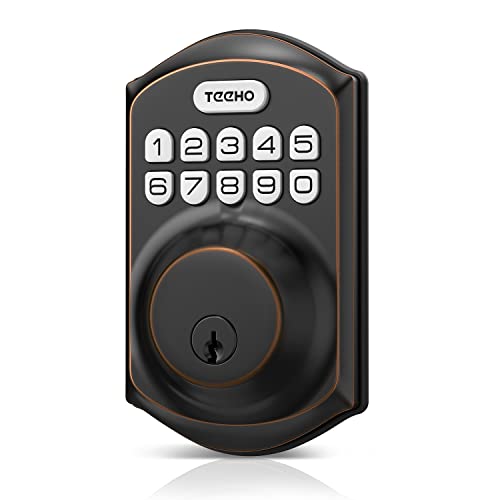
5. TEEHO TE001 Keypad Deadbolt — Best for Large Households
The TEEHO TE001 stands out in the code-capacity department: 20 access codes plus one-time PIN functionality puts it well ahead of most competitors at this price. For a busy household — multiple family members, regular housekeepers, rotating contractors — having that many individual codes means you can assign and delete access on a per-person basis without bumping someone else off the list. The oil-rubbed bronze finish is a welcome change from the sea of satin nickel and matte black alternatives, and it coordinates naturally with traditional and transitional door hardware.
TEEHO's one-time PIN implementation is particularly well designed. You set a temporary code, it works once for a single door opening, and then it automatically deletes itself. No manual cleanup, no worrying about whether a delivery driver still has access to your home. The auto-lock timer runs from 10 to 99 seconds and is off by default — you activate and configure it intentionally. There's also a one-touch exterior lock feature: press and hold any key for two seconds and the deadbolt engages from outside, which is useful when you're leaving in a hurry and don't want to wait for auto-lock to kick in.
Physical key backup is included with two keys, which puts the TE001 ahead of several competitors that omit mechanical backup entirely. Installation uses standard ANSI backset dimensions and takes under 30 minutes with a screwdriver. TEEHO's instructions are notably clear compared to some competing brands, and the included hardware covers most standard residential door configurations. The oil-rubbed bronze finish does require occasional wiping to maintain its appearance, but that's true of any dark hardware finish in high-traffic areas.
Pros:
- 20 permanent access codes — most in class at this price
- One-time PIN codes auto-delete after a single use
- One-touch exterior locking by holding any key
- Two physical key backups included
- Oil-rubbed bronze finish stands out aesthetically
- Auto-lock timer up to 99 seconds
Cons:
- No fingerprint or smart home connectivity
- Oil-rubbed bronze shows wear and fingerprints over time
- No remote access or app management
6. Fingerprint Smart Door Lock with Handle — Best Smart Integration
This fingerprint lever lock is the most feature-rich option in this roundup, and it's the right choice when you need remote access management and smart home integration alongside keypad entry. Five unlock methods — fingerprint, keypad code, mobile app, key fob, or physical key — means virtually anyone in your household can get in without friction, including elderly parents or young kids who struggle with phone apps. The lever handle design also eliminates the need to replace your existing knob separately, making it a cleaner all-in-one installation.
The Airbnb and short-term rental use case is where this lock genuinely earns its price premium. You can generate guest access codes remotely via the app or web dashboard, set expiration windows for those codes, and review an access log showing who entered and when — all without being on-site. For hosts managing multiple properties, that remote visibility is invaluable. It also pairs with Alexa and Google Assistant, so you can include it in automations like "lock all doors when I say goodnight." This kind of integration pairs naturally with a comprehensive home security setup — check our guide to the best biometric smart locks for Airbnb for a deeper comparison of the connected lock category.
Installation is designed for DIY without extra drilling on standard doors, and the handle is reversible for both left- and right-handed door configurations. The fingerprint sensor registers multiple prints per person over time, which means recognition accuracy actually improves with use rather than degrading. The one honest caveat: this lock requires a stable Wi-Fi connection and a smartphone for its advanced features. If either of those dependencies concerns you, a simpler keypad-only model will serve you more reliably.
Pros:
- Five unlock methods including fingerprint, app, FOB, keypad, and key
- Remote access code generation — ideal for Airbnb and rentals
- Access logs show entry history by user
- Alexa and Google Assistant compatible
- DIY installation, reversible handle for left/right doors
- Fingerprint sensor improves recognition accuracy over time
Cons:
- Requires Wi-Fi and smartphone for remote features
- More complex setup than basic keypad-only locks
- Higher price point than purely mechanical alternatives
7. TEEHO TE002 Fingerprint Deadbolt — Best Fingerprint Deadbolt
If you want fingerprint access without the complexity of Wi-Fi, apps, or smart home integration, the TEEHO TE002 is the deadbolt that delivers. The AI-powered fingerprint sensor reads and unlocks in under one second — 0.3-second recognition followed by immediate deadbolt actuation. That speed difference compared to slower biometric locks is noticeable every time you approach the door with your hands full. The sensor also adapts to your fingerprint pattern over time, so recognition becomes more reliable as it learns the natural variations in your print.
The TE002 supports four unlock methods: up to 20 stored fingerprints, up to 20 passcodes, two physical backup keys, and one-time PINs that auto-delete after use. That combination handles virtually every access scenario without requiring internet connectivity. Houseguests get a temporary PIN. Regular family members use fingerprint or a permanent code. Emergency access uses the physical key. The matte black finish is clean and modern, and the deadbolt format — rather than a lever — keeps it compatible with doors where you already have a separate lever or knob you want to keep. For a broader look at the biometric deadbolt category, our best biometric door lock reviews cover the full competitive landscape.
Auto-lock is configurable from 10 to 99 seconds, and one-touch locking from the exterior is available by holding a key on the pad. Build quality is solid for the price — the deadbolt throw is firm and the housing doesn't flex under lateral pressure. The two backup keys included mean you have a fallback if the battery dies unexpectedly, though in practice the low-battery warning gives you ample time to replace the cells. This is the fingerprint lock for buyers who want biometric convenience without the ongoing dependency on a connected ecosystem.
Pros:
- Sub-one-second fingerprint unlock — among the fastest in class
- AI sensor adapts to fingerprint variations over time
- 20 fingerprints + 20 passcodes + one-time PINs + 2 physical keys
- No Wi-Fi or app required — fully standalone operation
- Configurable auto-lock up to 99 seconds
- Matte black finish suits modern door aesthetics
Cons:
- No remote access or smart home connectivity
- Fingerprint registration takes a few minutes per person at setup
- No activity log without connected hub
Choosing the Right EZ Keypad: A Buying Guide
Security Grade and Certification
Security grades are not marketing language — they're independent certifications from BHMA (Builders Hardware Manufacturers Association) and ANSI. Here's what the grades mean in practice:
- Grade 1: Commercial-grade. Highest resistance to physical attack, cycling, and environmental stress. Overkill for most residential doors, but appropriate for high-risk environments.
- Grade 2: Residential and light commercial. The sweet spot for front doors. Schlage BE365 and Kwikset SmartCode 260 both hit this level. Resists standard kick-in and manipulation attacks.
- Grade 3: Basic residential. Adequate for interior doors or low-risk secondary entries. Not recommended as your primary front door lock in 2026.
A dual certification (like the Schlage BE365's Grade 2/AAA rating) means the lock has been tested by multiple independent bodies — not just the manufacturer's own quality control. That matters when you're making a decision that affects your family's safety.
Connectivity: Standalone vs. Smart vs. Connected
The single biggest decision in the EZ keypad category is whether you want internet connectivity. The trade-offs are direct:
- Standalone keypad locks (Schlage BE365, Yale YED210, Amazon Basics): No Wi-Fi, no app, no account. They work when the internet goes down, when your phone battery dies, when your smart home hub is offline. Maximum reliability, zero remote management.
- Fingerprint + keypad without connectivity (TEEHO TE001/TE002): Biometric convenience without network dependency. Ideal if you want faster entry but no cloud exposure.
- Connected smart locks (Fingerprint Smart Lock with Handle): Remote access, access logs, guest code management via app, smart home integration. Higher capability ceiling, but dependent on Wi-Fi uptime and the manufacturer's cloud service continuing to operate.
For primary residence front doors, standalone or fingerprint-only locks are the more robust choice. For rental properties or Airbnbs where remote code management is essential, the connected option justifies its complexity.
Code Capacity and Access Management
Think about everyone who will need regular or occasional access to your home before choosing a code capacity:
- 6 codes or fewer: Amazon Basics. Fine for a single household with no outside help.
- 19–20 codes: Schlage BE365 or TEEHO TE001/TE002. Accommodates large families, housekeepers, dog walkers, contractors, and guests simultaneously.
- One-time PINs: TEEHO TE001/TE002 and Amazon Basics offer single-use codes that auto-expire. Critical for Airbnb check-ins or one-time contractor visits.
Always choose a code capacity at least 30% higher than your current estimated need. Households expand, and resetting a lock to add one more user is time-consuming and disruptive.
Installation Considerations
All seven locks in this guide are designed for standard residential door prep. But measure before you buy:
- Backset: Distance from the door edge to the center of the borehole. Standard is 2-3/8" or 2-3/4". Most locks accommodate both, but confirm before ordering.
- Cross bore diameter: Standard 2-1/8" works with all locks in this guide.
- Door thickness: Standard residential doors are 1-3/8" to 1-3/4". If you have a thicker commercial-style door, check the manufacturer's spec sheet.
- Handing: Deadbolts are typically handing-neutral. Lever locks (like the Fingerprint Smart Lock with Handle) are often reversible — confirm before installation.
If you're not confident in the installation process, our guide to the best door lock installation kits covers the tools that make the job cleaner and faster.
FAQs
What is an EZ keypad door lock?
An EZ keypad door lock is a deadbolt or lever lock that replaces a traditional keyed cylinder with a numeric keypad for entry. You enter a PIN code to unlock the door instead of inserting a physical key. Most models also include a mechanical key backup for emergencies. The "EZ" designation refers to ease of use — no key to carry, no lock to pick with a standard bump key attack, and the ability to share access by giving out a code rather than duplicating a physical key.
Are keypad deadbolts as secure as traditional keyed deadbolts?
Yes — and in several ways more secure. A Grade 2 or Grade 2/AAA certified keypad deadbolt like the Schlage BE365 meets the same physical resistance standards as the best keyed deadbolts. Keypad locks are also immune to lock bumping, a common technique used by burglars to defeat pin tumbler locks. The primary security consideration unique to keypad locks is code management: use codes of 6 digits or longer, change codes when someone's access needs to be revoked, and avoid predictable sequences like birth years or 1234.
How many codes do I need on a keypad lock?
Start by counting everyone who needs regular access — household members, regular housekeepers, dog walkers, a trusted neighbor. Then add a buffer for contractors, guests, and emergency use. A household of four with a housekeeper and occasional guests typically needs 8–12 codes. The TEEHO TE001 and TE002 offer 20 codes, which handles virtually any residential scenario. The Schlage BE365 offers 19. Only consider a 6-code lock if your household is small and you have no need for temporary guest access.
What happens if the battery dies on a keypad lock?
Most keypad locks include a low-battery indicator that alerts you weeks before the battery actually fails. If the battery does die completely, all locks in this guide include either a physical key backup or a 9V battery terminal on the exterior that lets you press a standard 9V battery against the contacts to get enough power for one entry. Schlage, TEEHO TE001, and TEEHO TE002 all include physical backup keys. The Yale YED210, Kwikset SmartCode 260, and Amazon Basics rely on the exterior terminal method. Change batteries annually as a preventive measure regardless of the indicator.
Can someone guess my keypad code by looking at fingerprint smudges on the buttons?
This is a real concern and worth addressing directly. If you use a 4-digit code with four distinct digits, smudge patterns can narrow the possibilities significantly. Two countermeasures work well together: use 6-digit codes (which dramatically increase combinations even if the attacker knows which keys you press), and enable a "scramble pad" feature if your lock has one — it randomizes the digit positions on the touchscreen before each entry so the smudge pattern reveals nothing. Also, make a habit of lightly pressing other buttons after entering your code to smear the pattern.
Should I buy a smart connected keypad or a standalone model?
It depends entirely on your use case. If you're managing a primary residence where reliability matters above all else, a standalone keypad like the Schlage BE365 or Yale YED210 is the better choice — no internet dependency, no account to maintain, works during outages. If you manage a rental property or Airbnb, the connected Fingerprint Smart Lock with Handle earns its complexity through remote guest code management and access logs. For most homeowners in 2026, a standalone fingerprint + keypad lock like the TEEHO TE002 hits the ideal balance: biometric speed without cloud dependency.
Buy on Walmart
- Schlage Camelot Electronic Keypad Deadbolt Lock, Keyless Fro — Walmart Link
- Kwikset SmartCode 260 Keyless Entry Electronic Keypad Deadbo — Walmart Link
- Yale Black Code Keypad Deadbolt Front Door Lock for Keyless — Walmart Link
- Amazon Basics Electronic Keypad Deadbolt Door Lock with Auto — Walmart Link
- TEEHO TE001 Keyless Entry Door Lock with Keypad - Smart Dead — Walmart Link
- Fingerprint Smart Door Lock with Handle & Keypad – No More L — Walmart Link
- TEEHO TE002 Fingerprint Door Lock - Keyless Entry Electronic — Walmart Link
Buy on eBay
- Schlage Camelot Electronic Keypad Deadbolt Lock, Keyless Fro — eBay Link
- Kwikset SmartCode 260 Keyless Entry Electronic Keypad Deadbo — eBay Link
- Yale Black Code Keypad Deadbolt Front Door Lock for Keyless — eBay Link
- Amazon Basics Electronic Keypad Deadbolt Door Lock with Auto — eBay Link
- TEEHO TE001 Keyless Entry Door Lock with Keypad - Smart Dead — eBay Link
- Fingerprint Smart Door Lock with Handle & Keypad – No More L — eBay Link
- TEEHO TE002 Fingerprint Door Lock - Keyless Entry Electronic — eBay Link
Next Steps
- Measure your door's backset (2-3/8" or 2-3/4"), cross bore diameter, and thickness before placing any order to confirm compatibility with your chosen lock.
- Check the current price on Amazon for your top pick — keypad lock prices shift frequently, and the best-value options in this category often see meaningful discounts.
- Decide on your connectivity requirement first: if you need remote access for a rental property, go with the Fingerprint Smart Lock with Handle; if reliability and simplicity matter most, start with the Schlage BE365 or TEEHO TE002.
- Review our best access control keypads guide if you're securing a commercial space or multi-unit property that requires more advanced user management features.
- After installation, immediately program all your household codes, test each one, and store your backup physical keys somewhere accessible but secure — not in the same location where you keep the lock's instruction manual.


About Robert Fox
Robert Fox spent ten years teaching self-defence in Miami before transitioning into home security consulting and writing — a background that gives him an unusually practical, threat-aware perspective on residential security. His experience spans physical security assessment, lock and alarm system evaluation, and the behavioral habits that make homes harder targets. At YourHomeSecurityWatch, he covers home security product reviews, background check and criminal records resources, and practical guides on protecting your property and family.
You can Get FREE Gifts. Furthermore, Free Items here. Disable Ad Blocker to receive them all.
Once done, hit anything below