Best Gun Safe for Pistols: Reviews, Buying Guide, and FAQs 2026
by Robert Fox
The VAULTEK MX Series leads this list as the most feature-rich option for multi-pistol households, combining biometric access with WiFi-enabled live alerts and a modular interior that grows with your collection. Choosing the right pistol safe in 2026 requires more than simply picking a steel box — it demands careful evaluation of access speed, locking mechanisms, build quality, and how well the safe integrates into your daily routine. Whether you are securing a single bedside handgun or organizing an entire personal collection, the market offers more specialized solutions than ever before.
Responsible firearm ownership begins with secure, quick-access storage that keeps your pistol away from unauthorized hands while remaining accessible to you within seconds of need. According to the Bureau of Alcohol, Tobacco, Firearms and Explosives, safe storage is one of the most effective measures for preventing both theft and accidental discharge in the home. The seven products reviewed here represent the strongest performers across categories including biometric technology, RFID entry, smart connectivity, and traditional mechanical locking. You will find options suited to nightstand placement, vehicle carry, closet mounting, and high-capacity household storage throughout the home security reviews section.

The seven safes reviewed below range from compact single-pistol units with interior lighting to WiFi-connected multi-gun vaults with cloud monitoring dashboards. Each product has been evaluated on construction grade, access reliability, backup entry options, mounting hardware, and overall value proposition. If biometric technology is your primary access method, you may also benefit from reading the comprehensive guide to best biometric gun safes, which covers a wider range of fingerprint scanner technologies in greater depth. Regardless of your budget or specific storage need, the guide below will help you identify which unit belongs in your home in 2026.
Top Rated Picks of 2026
- #PreviewProductRating
- Bestseller No. 1
 Rating:

- Bestseller No. 2
 Rating:
 - Bestseller No. 3
 Rating:
 - Bestseller No. 4
 Rating:
 - Bestseller No. 5
 Rating:
 - Bestseller No. 6
 Rating:
 - Bestseller No. 7
 Rating:

Product Reviews
1. VAULTEK MX Series High Capacity Smart Handgun Safe — Best for Multi-Pistol Smart Storage
The VAULTEK MX Series is positioned at the top of the performance tier for 2026, offering a high-capacity interior that accommodates up to eight handguns alongside magazines, passports, cash, and everyday carry essentials. The 14-gauge carbon steel body and 12-gauge steel door represent a meaningful step up from entry-level safes, and the powdercoat finish resists corrosion in humid bedroom or closet environments. Anti-pry bars and dual anti-impact latches reinforce the door frame, while the built-in impact detection system triggers an alarm upon detecting unusual vibration or force, adding a layer of deterrence that basic units simply cannot provide.
The ViSN (Vaultek Intelligent Safe Network) platform elevates this unit well beyond conventional pistol storage by connecting it to a cloud-based iOS and Android app that delivers live alerts and real-time safe monitoring. Every door open, failed access attempt, and battery status update can be tracked remotely, which is particularly valuable for households with multiple users or parents managing access for adult children. Setup is guided through the app with an intuitive step-by-step process. Note that WiFi functionality is designed exclusively for use within the United States, and international buyers should factor this limitation into their decision. The pre-drilled mounting holes and included hardware allow secure anchoring to a nightstand, closet wall, or any stationary surface, preventing the safe itself from being removed during a burglary.
The biometric scanner provides rapid one-touch access, and the modular interior can be reconfigured to accommodate different firearm sizes or combinations of pistols and accessories. For households that need to store multiple handguns with modern smart-home connectivity, the MX Series delivers the most complete feature set in this review.
Pros:
- Stores up to eight handguns with a reconfigurable modular interior layout
- WiFi-enabled ViSN platform with live alerts, remote monitoring, and guided app setup
- Heavy-gauge steel construction with anti-pry bars and dual anti-impact latches
- Impact detection alarm adds active deterrence against forced-entry attempts
- Pre-drilled mounting holes with included hardware for nightstand or closet anchoring
Cons:
- WiFi features are restricted to US use only and will not function internationally
- Premium smart features are reflected in a higher price point than non-connected alternatives

2. SentrySafe Biometric Gun Safe QAP1BLX — Best Single-Handgun Bedside Option
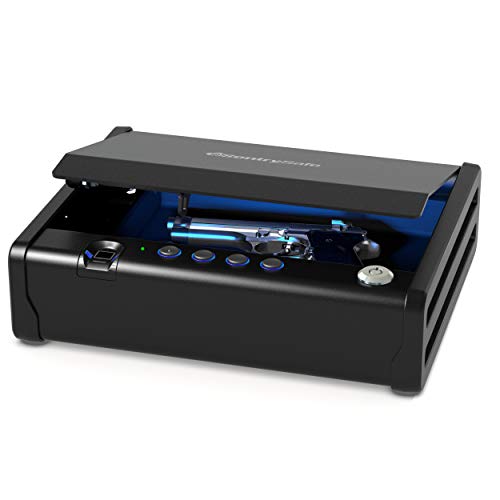
The SentrySafe QAP1BLX is one of the most widely trusted single-handgun safes on the market, and its updated design for 2026 includes a refined fingerprint scanner, an interior LED light for low-visibility access, and an improved gas strut mechanism for consistent, one-handed door deployment. The solid steel construction and pry-resistant door deliver reliable protection without unnecessary complexity, making this unit an excellent choice for someone who wants a dedicated bedside safe with a straightforward, proven access system. California DOJ certification further validates the build quality and safety standards for buyers in regulated states.
The combination of biometric entry, a digital keypad, and a physical override key provides three independent access paths, which is a meaningful redundancy for a primary home-defense firearm. The single-handed opening mechanism is specifically engineered for speed in a defensive scenario — the door swings clear of the firearm path so you can retrieve your handgun without repositioning your hand or grip. The interior LED illuminates the chamber immediately upon opening, ensuring visibility in total darkness without requiring a separate flashlight or additional device. This is a compact, purpose-built unit that does not try to serve multiple roles, and that focused design philosophy is part of what makes it consistently reliable.
If you are building out a complete home security system and want to pair your bedside safe with additional entry security, reviewing the available best electronic safe lock options can help you understand how digital locking mechanisms compare across different security tiers.
Pros:
- Three independent access methods: biometric scanner, digital keypad, and override key
- Interior LED light provides immediate illumination upon door opening in any lighting condition
- Gas strut-assisted door enables fast, single-handed retrieval
- California DOJ certified, meeting recognized standards for firearm storage
- Compact footprint fits cleanly on a nightstand, in a drawer, or in a closet
Cons:
- Single-handgun capacity limits usefulness for collectors or multi-firearm households
- No WiFi or smart connectivity features for remote monitoring
3. Hornady Rapid Safe Night Guard — Best Nightstand Safe with Clock and USB Charging
The Hornady Rapid Safe Night Guard takes a fundamentally different approach to bedside firearm storage by disguising the safe as a functional nightstand accessory that features a built-in clock display and USB charging ports. From the perspective of a casual observer, this unit blends seamlessly into any bedroom without advertising its contents, a consideration that becomes significant in households with visitors, renters, or extended family members who should not have visual cues about firearm storage. The 14-gauge steel construction provides a solid security foundation, and the heavy-duty 1,500-pound test steel lock-down security cable allows the entire unit to be anchored to a bed frame, nightstand leg, or any fixed point.
The patented RFID technology is the standout feature here, unlocking the safe faster than either fingerprint scanners or keypads by eliminating the need for precise finger positioning in a dark or high-stress environment. The four included RFID tags can each be programmed independently and are compatible with other Hornady RFID safes you may own, enabling a unified access ecosystem across multiple storage locations. Two internal hardened locking lugs reinforce the door against prying, and the tamper-resistant design is validated through independent testing. The USB charging ports mean your phone and devices remain charged on the same surface that secures your handgun, reducing bedside clutter without sacrificing functionality.
The Night Guard is particularly effective for users who have found biometric scanners unreliable in emergency situations due to dry skin, moisture, or anxiety-related grip changes — the RFID bracelet or card simply needs to pass near the reader to grant immediate access under any physical condition.
Pros:
- RFID entry is faster and more reliable than fingerprint or keypad in low-light or high-stress conditions
- Four programmable RFID tags compatible with other Hornady safes in your collection
- Clock display and USB charging ports provide functional cover and bedside utility
- 1,500 lb. security cable and two internal locking lugs prevent portability-based theft
- 14-gauge steel construction with tamper-resistant design
Cons:
- RFID tags must be physically nearby during access — misplaced tags create an access gap
- Larger footprint than minimalist single-pistol units due to clock and USB housing
4. VAULTEK Slider Series Essential — Best for Drawer or Desk Mounting
The VAULTEK Slider Series Essential introduces a horizontal sliding door mechanism that addresses one of the most common complaints about traditional top-opening pistol safes — the door swinging upward into objects stored on nightstands or shelves above the unit. The auto-open sliding design clears space efficiently and delivers the handgun in a straight forward motion that is intuitive and fast under stress. The backlit 5-digit Smart Sense keypad is legible in darkness without compromising your night vision, and two backup keys accompany the unit for situations where battery power is unavailable.
The battery life is rated at up to one year on four AAA batteries, which is competitive with other keypad-access safes in this category, and the included power cable allows permanent plug-in operation that eliminates battery management entirely. The optics-ready interior design is a notable practical feature — the high-density foam holster accommodates compact pistols up to full-size handguns measuring 8.875 inches in overall length, and the fitted channel allows storage with a mounted optic such as a red dot sight installed, which saves you the step of removing your optic setup before storage. Interior LED lighting illuminates the firearm automatically upon opening, confirming safe retrieval before you physically reach inside.
For a non-biometric option that prioritizes mechanical reliability and ergonomic design over smart connectivity, the Slider Series Essential offers a polished and well-considered package at a mid-range price point.
Pros:
- Auto-open sliding door eliminates upward swing clearance issues common with top-opening designs
- Optics-ready foam holster accommodates pistols with mounted red dot sights installed
- Backlit keypad for dark environments combined with two physical backup keys
- Flexible power: up to one year on four AAA batteries or continuous operation via included cable
- Interior LED lighting confirms firearm position before retrieval
Cons:
- Single-pistol plus one magazine capacity is insufficient for multi-firearm storage needs
- No biometric scanner — keypad entry requires memorized PIN under stress conditions
5. awesafe Biometric Gun Safe — Best Value for Dual-Pistol Storage
The awesafe biometric pistol safe delivers a compelling combination of capacity, access flexibility, and portability at a price point that makes it accessible to a wide range of buyers. UL1037 safety certification confirms that the construction has met independent testing standards for resistance to forced entry, which is a meaningful assurance beyond manufacturer claims. The reinforced solid steel body and pry-resistant door are engineered to deter casual forced entry, and the high-strength locking mechanism provides dependable resistance for a safe in this size and weight class. Storage capacity supports two standard pistols along with additional ammunition, making it more practical than single-handgun units for households with a primary and backup firearm.
Three access modes — upgraded fingerprint recognition, a responsive backlit digital keypad, and backup manual keys — provide the redundancy necessary for a reliable primary safe. The fingerprint scanner stores multiple user profiles, allowing authorized household members to register their prints individually without sharing a PIN code. The gas strut mechanism ensures that the door opens swiftly and fully, clearing the path for immediate one-handed retrieval. The portable form factor is also suitable for vehicle use as a car gun safe, which is a practical consideration for concealed carry permit holders who need secure storage during transit. For more comprehensive guidance on carry-adjacent products, the review of best concealed carry purses provides useful context on the broader personal carry ecosystem.
The awesafe unit occupies a practical middle ground between budget minimalism and premium smart-home integration, providing solid daily-use performance without unnecessary complexity or cost.
Pros:
- UL1037 certified construction with pry-resistant door and high-strength locking system
- Dual-pistol capacity plus ammunition storage exceeds most comparably priced single-gun alternatives
- Three access methods: fingerprint, backlit keypad, and manual key backup
- Gas strut door mechanism for rapid, one-handed access during emergencies
- Portable design suitable for both home bedside use and vehicle storage
Cons:
- No smart connectivity or remote monitoring capabilities
- Fingerprint scanner performance may vary under very dry or damp skin conditions
6. Fort Knox Original Pistol Box PB1 — Best Mechanical Lock Safe
The Fort Knox PB1 occupies a unique position in the pistol safe market as a product that has earned its reputation through decades of consistent quality rather than feature accumulation. 10-gauge steel body construction — heavier than the 14-gauge standard used by most competitors in this category — provides measurably superior resistance to deformation and forced entry, and the gas-strut-assisted heavyweight door delivers a satisfying, authoritative open that reflects the unit's overall build character. California DOJ certification confirms that the unit meets recognized safety thresholds for authorized storage in regulated environments.
The quick-access mechanical lock requires no batteries, no WiFi connection, and no fingerprint scanner to fail under pressure — a deliberate design philosophy that has made Fort Knox safes a reference product among firearms instructors and defensive shooting professionals who prioritize mechanical reliability above all other considerations. The Simplex-style lock opens with a memorized button sequence that can be actuated in complete darkness without visual confirmation. Dimensions of 4.25 inches high, 12.5 inches wide, and 10.375 inches deep allow the unit to accommodate a full-size pistol with room for a spare magazine. The absence of electronic components also means there are no software updates, connectivity requirements, or electronic component failures to anticipate over the product's extended service life.
If your concern is long-term dependability without electronics management, the PB1 represents a mature, refined product that has addressed every mechanical variable over many years of iteration and customer feedback.
Pros:
- 10-gauge steel body is heavier and more resistant than the 14-gauge standard used by most competitors
- Mechanical Simplex lock requires no batteries and functions reliably without electronics
- Gas-strut door provides rapid, one-handed access with predictable mechanical action
- California DOJ certified for compliance in regulated storage environments
- No software dependencies, firmware updates, or connectivity requirements
Cons:
- No biometric, RFID, or smart features for users who prefer technology-assisted access
- Higher price point relative to electronically equipped alternatives at similar capacity
7. Liberty Safe HDV-250X Biometric Handgun Vault — Best for Wireless Connectivity and Fingerprint Speed
Liberty Safe has built a long-standing reputation as one of the most trusted names in American safe manufacturing, and the HDV-250X Biometric Handgun Vault brings that institutional credibility to the personal pistol safe category with a design that combines fingerprint scanner access, wireless connectivity, and interior LED illumination in a compact unit. The quick-access fingerprint sensor is engineered for fast recognition with minimal false rejection, which is the technical challenge that separates dependable biometric safes from units that fail to recognize a print during the elevated stress response of an actual defensive situation. The wireless connectivity feature enables status monitoring and access management for users who want remote awareness of their safe's condition.
The interior LED lighting activates immediately upon opening, providing instant visual orientation in a dark room without requiring any secondary light source. Liberty Safe products are manufactured with the brand's well-documented commitment to American quality standards, and the HDV-250X reflects that heritage through its overall construction fit, finish, and hardware quality. The unit is positioned as a premium single-safe solution for buyers who want the Liberty Safe brand assurance combined with contemporary access technology in a format appropriate for nightstand, closet, or office installation.
For households evaluating whether a handgun vault is sufficient or whether a larger fireproof safe might better serve long-term storage needs, the guide to best budget gun safes under $500 provides useful comparison points across size and protection tiers.
Pros:
- Liberty Safe brand heritage and quality standards applied to a personal pistol vault format
- Quick-access fingerprint sensor engineered for fast, accurate recognition under stress
- Wireless connectivity for remote status monitoring and access management
- Interior LED lighting activates automatically upon door opening
Cons:
- Feature specifications are more limited in published detail compared to competitors in the same tier
- Premium brand positioning results in a higher price relative to comparable specifications
How to Pick the Best Gun Safe for Pistols
Access Method and Reliability Under Stress
The access method you choose will determine how quickly and reliably you can retrieve your handgun when you need it most. Biometric scanners offer the fastest average access time when functioning correctly, but are susceptible to read failures caused by dry skin, moisture, dirt, or the physiological effects of an adrenaline response including vasoconstriction and tremor. RFID access through a wearable bracelet or card is generally the most reliable technology for nightstand use because it requires no precise physical positioning and performs consistently regardless of hand condition. Mechanical combination locks such as the Simplex-style system used by Fort Knox eliminate battery dependency entirely, offering predictable performance over decades without any electronic component management. Keypad entry remains a solid middle-ground option for users who can maintain PIN recall under pressure. Evaluate which method you can operate most reliably in a dark room at three in the morning while experiencing elevated heart rate — that is the scenario your access method must accommodate.
Steel Gauge and Construction Quality
Safe manufacturers specify steel gauge using the counterintuitive convention where a lower gauge number indicates thicker, heavier steel. 10-gauge steel, as used in the Fort Knox PB1, represents a meaningfully more resistant body than the 14-gauge standard common among mid-range safes. The door and body gauges are often specified separately — a safe with a 12-gauge door and 14-gauge body reflects a design decision to concentrate material where prying attacks are most likely to succeed. Anti-pry bars and reinforced locking lug arrangements add mechanical resistance beyond raw steel thickness. Powdercoat finishes protect against corrosion in high-humidity environments such as garages, basements, or bathrooms. When evaluating construction claims, prioritize independent certifications such as California DOJ approval or UL ratings over unverified manufacturer assertions, as these standards require third-party testing against defined performance thresholds.
Mounting and Physical Anchoring
A portable pistol safe that is not anchored to a fixed surface can be physically removed by an intruder in seconds, rendering all other security features irrelevant. Pre-drilled mounting holes with included hardware are a minimum expectation for any unit you intend to use as a primary storage solution rather than a travel safe. Lag bolt mounting into a nightstand frame, closet floor, or wall stud provides the most secure anchoring, while security cables offer a lighter-weight portable option for vehicle use or rental situations where drilling is not feasible. Consider the specific mounting location before purchasing — units with bottom-mount holes are suited to drawer or shelf installation, while side-mount configurations work better for vertical surfaces. Verify that the mounting hardware included with the safe is appropriate for your specific installation material, as wood, metal, and concrete each require different fastener specifications.
Capacity, Interior Configuration, and Storage Flexibility
Single-handgun safes represent the simplest and most cost-effective solution for a dedicated bedside unit, but they create a significant constraint if your firearm collection or storage needs evolve. Multi-pistol safes such as the VAULTEK MX Series offer modular interior configurations that accommodate different combinations of handguns, magazines, and valuables, providing flexibility that single-unit safes cannot match. Interior LED lighting is a practical feature that affects real-world usability more than marketing materials typically suggest — retrieving a dark-colored handgun from an unlit interior in a dark room is a slower and less reliable process than the marketing images imply. Foam holster configurations that accommodate pistols with optics mounted are increasingly important as red dot sights become standard components of defensive handgun setups. Evaluate the interior dimensions against your specific handgun and any attached accessories before purchasing rather than relying solely on stated capacity figures.
FAQs
What is the most reliable access method for a bedside pistol safe?
RFID technology is generally the most reliable access method for nightstand or bedside use because it requires no precise hand positioning, functions in total darkness, and performs consistently regardless of skin condition or physical stress response. Biometric scanners are fast under normal conditions but can experience read failures when your hands are dry, damp, or affected by the physiological changes that accompany an emergency situation. Mechanical combination locks are fully battery-independent and extremely reliable over time, though they require PIN memorization. The most secure configuration combines a primary electronic method with at least one physical backup such as an override key or memorized code.
What steel gauge should I look for in a pistol safe?
For a primary home storage unit, 12-gauge steel or heavier represents a meaningful security threshold, while 14-gauge is an acceptable standard for mid-range safes in low-to-moderate threat environments. The Fort Knox PB1 uses 10-gauge steel for its body, which is noticeably heavier and more resistant than most competitors in the personal pistol safe category. Door gauge is equally important — many manufacturers use heavier steel for the door than the body because prying attacks concentrate on the door and frame junction. Independent certifications such as California DOJ approval or UL1037 ratings require third-party testing and provide more reliable assurance of construction quality than unverified gauge claims alone.
Do I need to bolt down my pistol safe?
Yes — anchoring your safe to a fixed surface is essential for preventing theft by physical removal, which is the most common method used to defeat portable gun safes during residential burglaries. A safe that is not anchored can be carried out in seconds regardless of its steel gauge or locking mechanism. Pre-drilled mounting holes with included hardware are a standard feature on quality safes, and most manufacturers provide lag bolts appropriate for wood installation. For rental situations or vehicle use, a 1,500 lb. rated security cable such as the one included with the Hornady Night Guard provides a portable anchoring alternative that prevents removal without requiring permanent fasteners.
Can I store two pistols in a single-pistol safe?
Most safes marketed as single-handgun units are designed with a foam interior specifically molded or sized for one firearm, and attempting to store a second pistol will typically result in damage to the finish of both firearms and compromised interior organization. Units such as the awesafe biometric safe are explicitly designed for dual-pistol storage and are built with appropriately sized interiors and locking mechanisms to accommodate the additional weight. If your storage needs exceed a single handgun, select a safe with rated multi-pistol capacity and a modular or configurable interior rather than attempting to exceed the design capacity of a single-firearm unit.
Are WiFi-connected gun safes secure against hacking?
WiFi-enabled safes such as the VAULTEK MX Series use cloud-based security architectures that encrypt communications between the safe, the server, and your smartphone application. The primary attack surface for a connected safe is the same as any IoT device — weak account passwords, unsecured home networks, and outdated firmware. Using a strong, unique password for your safe's associated account, keeping firmware updated through the manufacturer's app, and ensuring your home network uses WPA3 or WPA2 encryption are the most effective measures for maintaining digital security. Physical access to the safe itself remains independent of the WiFi connection, so a network compromise does not automatically grant physical access to the unit.
What is the difference between a pistol safe and a full-size gun safe for long-term storage?
Pistol safes are optimized for quick access, compact footprint, and bedside or vehicle installation, prioritizing retrieval speed over maximum security or fire protection. Full-size gun safes and fireproof rated safes are designed for long-term storage of multiple firearms with higher resistance to forced entry and thermal protection during a structure fire. If you own both handguns and long guns, or if you need fire protection for documents and valuables alongside your firearms, a dedicated fireproof safe provides substantially greater protection than any pistol vault. For a comprehensive evaluation of fire-rated options, the guide to best fireproof gun safes covers the full range of fire-rated storage solutions available in 2026.
Buy on Walmart
- VAULTEK MX Series High Capacity Smart Handgun Safe Multiple — Walmart Link
- SentrySafe Biometric Gun Safe for Handgun or Pistol, Fingerp — Walmart Link
- Hornady Rapid Safe Night Guard – Nightstand Gun Safe with RF — Walmart Link
- VAULTEK Slider Series Rugged Handgun Safe Quick Auto-Open Sl — Walmart Link
- awesafe Biometric Gun Safe for Pistol, 3 Ways Quick Access H — Walmart Link
- Fort Knox Original Pistol Box (PB1), Security for pistols, h — Walmart Link
- Liberty Safe HDV-250X Biometric Handgun Vault — Walmart Link
Buy on eBay
- VAULTEK MX Series High Capacity Smart Handgun Safe Multiple — eBay Link
- SentrySafe Biometric Gun Safe for Handgun or Pistol, Fingerp — eBay Link
- Hornady Rapid Safe Night Guard – Nightstand Gun Safe with RF — eBay Link
- VAULTEK Slider Series Rugged Handgun Safe Quick Auto-Open Sl — eBay Link
- awesafe Biometric Gun Safe for Pistol, 3 Ways Quick Access H — eBay Link
- Fort Knox Original Pistol Box (PB1), Security for pistols, h — eBay Link
- Liberty Safe HDV-250X Biometric Handgun Vault — eBay Link
The safe that protects your family is the one you can open in the dark, under pressure, without hesitation — choose your access method before you choose your steel.


About Robert Fox
Robert Fox spent ten years teaching self-defence in Miami before transitioning into home security consulting and writing — a background that gives him an unusually practical, threat-aware perspective on residential security. His experience spans physical security assessment, lock and alarm system evaluation, and the behavioral habits that make homes harder targets. At YourHomeSecurityWatch, he covers home security product reviews, background check and criminal records resources, and practical guides on protecting your property and family.
You can Get FREE Gifts. Furthermore, Free Items here. Disable Ad Blocker to receive them all.
Once done, hit anything below