Best High Security Door Lock: Reviews, Buying Guide and FAQs 2026
by Robert Fox
The Schlage B60N single cylinder deadbolt is our top pick for 2026 — it delivers Grade 1/BHMA-certified security at a price point that makes it accessible to every homeowner serious about protecting their front door. Choosing the right high-security door lock is one of the most consequential decisions you can make for your home or business. A weak deadbolt is an open invitation: the data on forced-entry break-ins is sobering, and most successful burglaries exploit a single point of failure at the primary entry door.
The market for high-security deadbolts in 2026 ranges from battle-tested mechanical locks engineered in Swiss and Israeli factories to American-made classics certified under ANSI and UL standards, all the way to Wi-Fi-connected smart deadbolts that let you manage access from your phone. What separates a truly secure lock from a hardware-store bargain bin option comes down to a handful of measurable factors: pick resistance, bump resistance, drill resistance, and the structural integrity of the bolt and strike plate assembly. Understanding those factors before you buy is what this guide is for.
We've evaluated seven of the strongest performers across residential, commercial, and smart-home categories. Whether you're hardening a single-family home, a rental property, or a small business entry, you'll find a clear recommendation here. You can also browse the full door locks review category for additional options beyond this roundup. Read on for complete breakdowns, a targeted buying guide, and answers to the most common questions buyers ask.
Contents
- Standout Models in 2026
- Full Product Breakdowns
- Medeco Deadbolt Single Cylinder — Best for Commercial-Grade Security
- Schlage B60N Deadbolt — Best Overall Residential
- Kwikset 980 Deadbolt — Best for Easy Rekeying
- Abloy Protec2 Single Cylinder Deadbolt — Best Disc Detainer Lock
- Mul-T-Lock MT5+ Hercular Deadbolt — Best for Maximum Pick Resistance
- Schlage B62N Double Cylinder Deadbolt — Best Double Cylinder
- Yale Security Assure Lock 2 — Best Smart Deadbolt
- How to Pick the Best
- Questions Answered
- Final Thoughts
Standout Models in 2026
- #PreviewProductRating
- Bestseller No. 1
 Rating:

- Bestseller No. 2
 Rating:
 - Bestseller No. 3
 Rating:
 - Bestseller No. 4
 Rating:
 - Bestseller No. 5
 Rating:
 - Bestseller No. 6
 Rating:
 - Bestseller No. 7
 Rating:

Full Product Breakdowns
1. Medeco Deadbolt, Single Cylinder — Best for Commercial-Grade Security
Medeco is not a brand you stumble across at a big-box store, and that exclusivity is part of the point. The Medeco Series 11 single cylinder deadbolt is built in the United States from brass and stainless steel, meeting both ANSI A156.36 and UL listing standards — a combination that puts it in rarefied company. The 5-pin cylinder uses Medeco's patented rotating and elevating pin technology, which means a standard pick set simply does not work the way a lockpicker expects. The keyway is Schlage C compatible, but the internal geometry is Medeco's own.
The hardware speaks for itself: Grade 1 construction, a 1-inch throw bolt, and a faceplate measuring 1-1/8" x 2-1/4" with a rounded corner strike. The satin chrome finish holds up under hard commercial use — this lock is rated for commercial, industrial, institutional, and residential locations, and the fit quality reflects that. Door thickness compatibility runs from 1-3/4" to 2", which covers most heavy-duty commercial door setups. Key control is tight; Medeco keys are not duplicated at hardware stores without proper authorization, which is a genuine long-term security advantage for anyone managing multiple users.
The backset is fixed at 2-3/8", so verify your door prep before ordering. This is not a lock for a quick Saturday installation — Medeco products reward careful preparation and professional installation. The two keys included are high-security blanks you won't find at a kiosk. For anyone requiring the highest tier of mechanical security for a critical entry point, the Medeco sets the standard.
Pros:
- ANSI A156.36 and UL certified for commercial-grade security
- Patented rotating pin technology resists standard picking and bumping
- US-made brass and stainless steel construction with excellent durability
- Restricted key duplication provides strong long-term key control
Cons:
- Fixed 2-3/8" backset limits compatibility with some residential door preps
- Premium price point and best results require professional installation

2. Schlage B60N 619 Deadbolt — Best Overall Residential
The Schlage B60N is the lock that every other residential deadbolt gets compared against. It carries a Grade 1/AAA BHMA certification — the highest residential rating for security, durability, and finish — and it backs that up with a hardened steel spinning pin that defeats drill attacks, plus anti-pick pins in the cylinder. The 1-inch deadbolt throw is industry-leading for residential hardware, and the satin nickel finish is a genuine workhorse rather than a cosmetic choice. This is a lock for exterior entry doors where you need real protection, not the appearance of it.
Installation is straightforward for anyone comfortable with a screwdriver. Schlage designs the B60N to fit standard US door preps with two bore holes, and the hardware included covers the essentials. Measure your door's backset and cross bore carefully before ordering — Schlage offers multiple backset configurations, so matching your existing prep is simple. The pick and bump resistance built into this lock reflects decades of Schlage engineering, and the Allegion-backed innovation pipeline behind the brand continues to push the B-series forward.
Two keys ship with the lock, and Schlage key blanks are widely available for duplication at authorized dealers. The cylinder accepts aftermarket restricted keyways if you want to upgrade key control down the road. For the overwhelming majority of homeowners who want the best balance of certified security, ease of installation, and long-term reliability, the B60N is the correct choice in 2026. It is the benchmark.
Pros:
- Grade 1/AAA BHMA certified — highest residential security rating
- Hardened steel spinning pin and anti-drill plates resist mechanical attacks
- Anti-pick pins defeat standard and security pick sets
- Straightforward DIY installation on standard US door preps
Cons:
- Key control is less restricted than Medeco or Mul-T-Lock options
- No smart or connected features for remote access
3. Kwikset 980 Deadbolt — Best for Easy Rekeying
The Kwikset 980 addresses a real problem that most lock buyers overlook: what happens when you lose a key, move into a previously occupied home, or want to change who has access without calling a locksmith? SmartKey Security technology lets you rekey this lock yourself in under 30 seconds using a simple tool included in the box. That is a genuine operational advantage for landlords, Airbnb hosts, and anyone who has ever faced the cost and hassle of a locksmith rekey job. The matte black finish on this particular variant is a premium touch that holds up well against daily handling.
Beyond the rekeying story, the 980 delivers meaningful security credentials. It is rated for exterior-facing doors and uses a turn-piece interior alongside a keyed exterior cylinder. The SmartKey technology also incorporates advanced pick resistance and protection against bump key attacks — both legitimate concerns for anyone who has done their research on how lock picking works. Microban antimicrobial protection on the finish is a practical addition that matters in high-touch environments. Installation is genuinely DIY-friendly; all hardware is included and the process takes minutes with a standard screwdriver.
Where the 980 lands relative to Schlage and Medeco comes down to the security tier you need. For most residential applications — especially any situation where key control flexibility is important — the 980 is a well-priced, well-engineered answer. If you manage rental properties, this lock solves a recurring headache. For maximum mechanical security at a fixed installation, the Schlage B60N edges it out. But for adaptable everyday security, the Kwikset 980 earns its place on this list.
Pros:
- SmartKey rekeying takes under 30 seconds with no locksmith required
- Pick-resistant and bump-resistant cylinder technology
- Microban antimicrobial finish protection
- Full DIY installation with included hardware
Cons:
- Security ceiling is below Medeco, Mul-T-Lock, and Abloy options
- SmartKey mechanism, while secure, is a proprietary system with its own failure modes
4. Abloy Protec2 Single Cylinder Deadbolt — Best Disc Detainer Lock
Abloy operates on an entirely different mechanical principle than every other lock on this list. Where pin tumbler locks — even the best of them — remain theoretically vulnerable to picking given enough skill and time, Abloy's disc detainer mechanism has no springs and no pins to pick. The rotating discs inside the Protec2 cylinder must align to specific angles for the lock to open, and the tolerances are tight enough that defeating this lock with standard or even advanced picking tools is exceptionally difficult. This is why Abloy locks are the standard in high-security European installations and are widely respected among serious security professionals.
The Protec2 single cylinder deadbolt ships with a lockable thumbturn — a critical feature that prevents an intruder from reaching through a broken window or mail slot to turn the interior release. The sleek, modern design integrates cleanly into contemporary door hardware setups. Installation is straightforward for a single cylinder application, and the thumbturn mechanism gives you the same quick interior egress you'd expect from any standard deadbolt. Key blanks for Abloy are tightly restricted; you won't find them at a hardware kiosk.
The trade-off with Abloy is primarily cost. The Protec2 sits at a premium price point that reflects its engineering, its Finnish manufacturing heritage, and its genuinely unique security architecture. For a critical entry point — a home office, a server room door, or a front entry in a high-risk environment — this is a defensible investment. For a standard residential front door where the Schlage B60N already provides excellent protection, the Abloy may be more lock than the application demands. But if you want the mechanical pinnacle, this is it.
Pros:
- Disc detainer mechanism is fundamentally pick-resistant by design — no springs or pins
- Lockable thumbturn prevents interior manipulation from outside
- Tightly restricted key blanks for superior key control
- Finnish engineering with exceptional build quality and tight tolerances
Cons:
- Premium price is the highest on this list for the base lock
- Replacement keys and service require authorized Abloy dealers
5. Mul-T-Lock MT5+ Hercular Single Cylinder Deadbolt — Best for Maximum Pick Resistance
Mul-T-Lock is an Israeli security brand with a reputation built in some of the most demanding security environments on earth. The MT5+ cylinder represents the top of their residential and light commercial line, combining a pin-in-pin mechanism with telescoping pins that create an extraordinarily complex picking challenge. The Hercular deadbolt body adds a hardened steel insert into the bolt itself, resisting sawing and cutting attacks that a standard deadbolt bolt cannot survive. This is a lock designed from the ground up against motivated, skilled adversaries.
The satin chrome finish on this model is clean and professional, appropriate for both residential and commercial settings. Each Mul-T-Lock purchase comes with two keys and a key code ID card — a thoughtful detail that matters when you need to order additional keys through authorized channels. Key duplication for MT5+ keyways is strictly controlled; you cannot walk into a hardware store and copy these. The thumbturn provides standard interior egress, and the single cylinder configuration means exterior key operation only, which is the right choice for most applications.
Installation follows standard single cylinder deadbolt procedures, though the Hercular body's robust construction means you're working with a heavier, more substantial unit than a mass-market deadbolt. If you're comparing the Mul-T-Lock MT5+ to the Abloy Protec2, the question comes down to security philosophy: Abloy eliminates pin vulnerabilities by design, while Mul-T-Lock raises the pin complexity to a level that effectively achieves the same real-world result. Both are legitimate choices at the apex of mechanical security. The Mul-T-Lock is also worth pairing with a good installation kit — see our guide to the best door lock installation kits to make sure your prep work matches the lock's quality.
Pros:
- Pin-in-pin MT5+ cylinder offers industry-leading pick and bump resistance
- Hardened steel bolt insert resists sawing and cutting attacks
- Strictly controlled key duplication through authorized channels only
- Includes key code ID card for future key ordering
Cons:
- Higher price point than mainstream Grade 1 options
- Key replacement requires an authorized Mul-T-Lock dealer
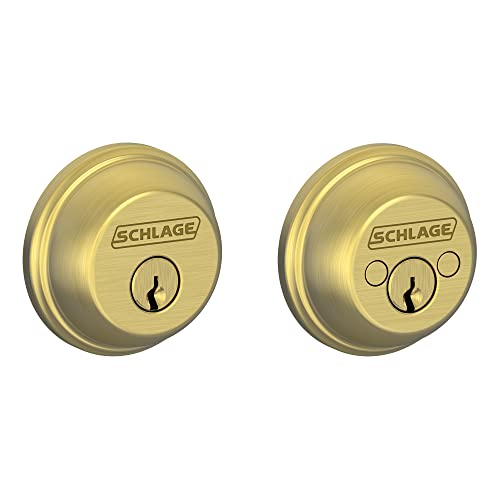
6. Schlage B62N Double Cylinder Deadbolt — Best Double Cylinder
The Schlage B62N is functionally identical to the B60N in terms of cylinder security, but it replaces the interior thumbturn with a second keyed cylinder. That single change transforms how you think about this lock. A double cylinder deadbolt requires a key to open from both sides, which eliminates the standard attack vector of breaking a nearby window or glass door panel and reaching in to turn the thumbturn. For doors with glazing within arm's reach of the lock, this is a legitimate security upgrade. The satin brass finish is a classic look that suits traditional and transitional door hardware without looking dated.
Schlage's Snap & Stay design holds the deadbolt body in position while you tighten the mounting screws — a small engineering detail that makes a real difference during solo installation. The same Grade 1 construction as the B60N applies here: hardened steel components, anti-drill protection, and Schlage's well-documented durability. With more than 95 years of manufacturing behind it, the B-series deadbolt has been proven in tens of millions of installations across North America.
One critical point you must understand before installing a double cylinder deadbolt: in a fire or emergency, you need a key to exit the building from the inside. This is a genuine safety concern, and some local building codes restrict or prohibit double cylinder deadbolts in residential applications. Check your local regulations before purchasing, and if you install one, always keep a key accessible near the door for emergency egress. For the right application — a door with a large window or sidelight — the B62N is the correct security answer. For standard solid-core doors, the B60N with thumbturn is a better all-around choice.
Pros:
- Eliminates the reach-through attack on doors with nearby glazing
- Same Grade 1 Schlage security as the B60N — proven and certified
- Snap & Stay design simplifies single-person installation
- Classic satin brass finish suits a wide range of architectural styles
Cons:
- Requires a key for interior exit — a real safety risk in emergencies
- Some local codes prohibit double cylinder deadbolts in residential settings
7. Yale Security Assure Lock 2 Deadbolt — Best Smart Deadbolt
The Yale Assure Lock 2 represents the smart home security segment done correctly. It replaces your existing deadbolt on most standard US entry doors without requiring a professional installation, and it delivers keypad access, smartphone control via the Yale Access App, and Apple Watch compatibility in a single package. The black suede finish is a premium option that coordinates well with contemporary door hardware. Auto-Lock through DoorSense — Yale's door position detection system — means the lock engages automatically once the door closes, eliminating the most common user error in home security: forgetting to lock the door.
The 2.4 GHz Wi-Fi integration is direct — no hub required. That means remote access, access code management, and lock/unlock history are available from your phone without adding a separate smart home hub to your network. The keypad allows for multiple user codes, which is useful for families, housekeepers, dog walkers, and short-term rental guests. Voice assistant compatibility adds another layer of operational convenience. The Auto-Unlock feature, triggered by your phone's location, is the kind of thoughtful detail that separates a well-engineered smart lock from a gimmicky one.
Where smart locks generally and the Yale Assure Lock 2 specifically require honest evaluation is on the mechanical security side. The core deadbolt mechanism provides solid residential security, but it does not carry the Grade 1 mechanical certifications of the Schlage B60N or the pick resistance credentials of the Mul-T-Lock and Abloy options. The smart features also introduce a digital attack surface — though Yale's security record in this area is respectable. If smart access management is your priority and you understand the trade-offs, the Assure Lock 2 is the clearest recommendation in its category. Pair it with good perimeter awareness, and consider supplementing with door and window sensors for a complete entry monitoring setup.
Pros:
- Built-in Wi-Fi eliminates the need for a separate smart home hub
- DoorSense Auto-Lock automatically secures the door after entry
- Multiple access methods: keypad, app, Apple Watch, voice assistant
- DIY installation on standard US door preps with just a screwdriver
Cons:
- Mechanical security tier is below the top-rated pin tumbler and disc detainer options
- Requires 2.4 GHz Wi-Fi — not compatible with 5 GHz only networks
- Battery dependency means you must maintain power or carry a backup plan
How to Pick the Best High Security Door Lock
ANSI/BHMA Grade Ratings: What They Actually Mean
The ANSI/BHMA grading system is the most reliable objective measure when comparing deadbolts. Grade 1 is the highest residential and light commercial rating — it requires a lock to withstand 250,000 open/close cycles, resist 10 door strikes at 75 pounds of force, and pass specific pick and bump resistance tests. Grade 2 is sufficient for interior doors and light exterior use. Grade 3 is the baseline, found in many budget residential locks. For any primary entry door, Grade 1 is the minimum you should accept. Every lock on this list that carries Grade 1 certification is a legitimate security investment. Do not let price or aesthetics push you below that threshold.
Cylinder Type and Attack Resistance
The cylinder is where most attacks happen. Standard pin tumbler cylinders — the kind found in every residential lock for the past century — are vulnerable to picking, bumping, and impressioning given enough skill and time. High-security cylinders address this through various mechanisms: Medeco's rotating pins raise the complexity of pick attacks dramatically; Mul-T-Lock's telescoping pin-in-pin design compounds the challenge further; Abloy's disc detainer eliminates pins entirely. For most residential applications, a Grade 1 pin tumbler with anti-pick pins provides adequate protection. For environments with elevated risk, stepping up to Medeco, Mul-T-Lock, or Abloy is a rational decision. Also consider drill resistance — look for hardened steel inserts in both the cylinder and the bolt body.
Single vs. Double Cylinder Configuration
A single cylinder deadbolt uses a key on the exterior and a thumbturn on the interior. This is the standard configuration for solid-core doors without adjacent glazing, and it provides safe emergency egress. A double cylinder requires a key on both sides, which eliminates the reach-through attack vector on glazed doors but introduces a genuine fire safety risk. Never install a double cylinder deadbolt without a clear emergency egress plan — keep a key within reach of the interior cylinder at all times, and verify that your local building code permits double cylinder use. For most residential applications, single cylinder with a quality deadbolt bolt is the right answer.
Smart Features vs. Mechanical Security Trade-offs
Smart deadbolts add genuine operational value: remote access, access code management, automatic locking, and integration with home automation systems. The trade-off is that every connected device introduces a digital attack surface alongside the physical one. In 2026, the mature smart lock platforms from Yale, Schlage, and August have solid security track records, but battery failure remains a real operational concern. If you go smart, always maintain a backup access method — whether that's a physical key cylinder backup or a keypad code — and keep the batteries fresh. The best approach for high-risk entry points is often a high-security mechanical deadbolt combined with a smart secondary lock or a separate access control system. For most residential entries, a quality smart lock from a reputable brand provides a net security improvement over a basic deadbolt because of automatic locking and access monitoring. For a deeper dive into keypad-based options, the EZ keypad guide covers that category specifically.
Questions Answered
What makes a door lock "high security"?
A high-security door lock is one that meets ANSI/BHMA Grade 1 certification and incorporates at least two of the following: pick-resistant cylinder, bump-resistant design, drill-resistant components, and restricted key duplication. Locks like the Medeco, Mul-T-Lock MT5+, and Abloy Protec2 go further by using advanced cylinder mechanisms that fundamentally resist the techniques standard pin tumbler locks are vulnerable to. The physical hardware — bolt throw length, strike plate strength, door prep — matters equally to the lock itself.
Is a deadbolt enough to secure my front door?
A quality Grade 1 deadbolt is the most important single element, but the full security chain includes the door itself (solid core), the door frame and jamb, the strike plate (use 3-inch screws anchored into the stud, not just the trim), and the hinges. A Medeco lock on a hollow-core door with a 3/4-inch strike plate is significantly weaker than a Schlage B60N installed correctly on a solid-core door with a reinforced strike. The lock is the lock; the installation is the system.
Are smart locks less secure than traditional deadbolts?
Not necessarily — it depends on the brand, the specific product, and the threat model. Smart locks introduce digital attack surfaces alongside physical ones, but the major platforms in 2026 use strong encryption and have good security track records. The more practical concern is battery failure, which can leave you locked out. A smart lock with a physical key cylinder backup, maintained batteries, and auto-lock enabled is often more secure in practice than a traditional deadbolt because it eliminates the human failure of forgetting to lock the door.
What is bump key resistance and why does it matter?
A bump key is a specially cut key that, when struck while turning, causes the pins in a standard lock cylinder to jump momentarily to the shear line, allowing the lock to open without the correct key. Bump attacks are fast — under 30 seconds for a practiced operator — and require no skill to learn. Bump-resistant locks use security pins (spool, serrated, or mushroom shaped) that catch at the shear line when bumped rather than releasing cleanly. Every Grade 1 lock on this list incorporates some form of bump resistance, but the Mul-T-Lock MT5+ and Abloy Protec2 offer the highest levels.
Should I choose single or double cylinder deadbolt for a door with glass panels?
For a door with glass within 40 inches of the lock, a double cylinder deadbolt is the logical security choice — it prevents the reach-through attack. However, you must plan for emergency egress: local fire codes in many jurisdictions restrict double cylinder deadbolts in residences, and the safety risk of being unable to exit quickly in a fire is real. Always check your local building code first. If double cylinder is permitted and you install one, keep a key on a hook near the door and ensure every household member knows where it is.
How often should I replace my door locks?
High-quality deadbolts do not have a fixed replacement schedule the way consumable products do. Replace your locks when you move into a new home or rental, when keys are lost or stolen, when you experience a break-in attempt, or when a lock shows signs of wear or failure — stiff operation, worn keyway, visible damage. For smart locks, plan for a hardware refresh every 5–7 years as firmware support cycles end. Key control is often the more pressing concern: if you're not sure who holds keys to your current locks, rekeying is faster and less expensive than full replacement.
Buy on Walmart
- Medeco Deadbolt, Single, 2-3/8 in. Backset, 5 Pins, Satin Ch — Walmart Link
- Schlage B60 N 619 Deadbolt, Keyed 1 Side, Highest Residentia — Walmart Link
- Kwikset 980 Deadbolt Lock, Matte Black Round Exterior Keyed — Walmart Link
- Abloy Protec2 Single Cylinder Deadbolt with Lockable Thumbtu — Walmart Link
- Mul-t-lock MT5+ Hercular Single Cylinder deadbolt w/Thumb Tu — Walmart Link
- SCHLAGE Double Cylinder Deadbolt, Satin Brass (B62 N 608) — Walmart Link
- Yale Security Assure Lock 2 Deadbolt, Black Suede Keyed Smar — Walmart Link
Buy on eBay
- Medeco Deadbolt, Single, 2-3/8 in. Backset, 5 Pins, Satin Ch — eBay Link
- Schlage B60 N 619 Deadbolt, Keyed 1 Side, Highest Residentia — eBay Link
- Kwikset 980 Deadbolt Lock, Matte Black Round Exterior Keyed — eBay Link
- Abloy Protec2 Single Cylinder Deadbolt with Lockable Thumbtu — eBay Link
- Mul-t-lock MT5+ Hercular Single Cylinder deadbolt w/Thumb Tu — eBay Link
- SCHLAGE Double Cylinder Deadbolt, Satin Brass (B62 N 608) — eBay Link
- Yale Security Assure Lock 2 Deadbolt, Black Suede Keyed Smar — eBay Link
Final Thoughts
The right high-security door lock for you depends on your specific entry situation, your risk tolerance, and whether you want mechanical security, smart access management, or both — but every front door deserves at minimum a Grade 1 certified deadbolt properly installed in a reinforced door frame. Start with the Schlage B60N if you want the best all-around residential lock for the money, move up to the Medeco or Mul-T-Lock MT5+ if your threat model demands the highest mechanical security tier, or go with the Yale Assure Lock 2 if keyless access and remote management are your priority. Browse the full door lock reviews section for additional comparisons, pick the lock that matches your door and your life, and install it correctly — because a great lock installed poorly is just an expensive decoration.


About Robert Fox
Robert Fox spent ten years teaching self-defence in Miami before transitioning into home security consulting and writing — a background that gives him an unusually practical, threat-aware perspective on residential security. His experience spans physical security assessment, lock and alarm system evaluation, and the behavioral habits that make homes harder targets. At YourHomeSecurityWatch, he covers home security product reviews, background check and criminal records resources, and practical guides on protecting your property and family.
You can Get FREE Gifts. Furthermore, Free Items here. Disable Ad Blocker to receive them all.
Once done, hit anything below