Over 70 million smart locks were installed in U.S. homes by the end of 2025, and the number continues to climb as homeowners discover how dramatically a connected deadbolt changes daily life. If you are deep in the Apple ecosystem, a HomeKit-compatible lock is the obvious choice — it integrates natively with the Home app, responds to Siri, participates in automations, and, on newer models, supports the tap-to-unlock Apple Home Key standard that turns your iPhone or Apple Watch into a physical credential. The market has exploded with options at every price point, so choosing the right lock in 2026 takes more than a quick spec comparison.
The best HomeKit door lock for your front door depends on what you prioritize most: raw security credentials, invisible design, fingerprint access, Thread-based reliability, or wide platform compatibility beyond Apple. Our HomeKit door lock reviews have tested all seven finalists in this guide across installation ease, real-world responsiveness, battery life, and app quality. Whether you want the most polished Apple experience available or a versatile lock that also works with Alexa and Google Home, you will find a clear recommendation here. For context on the broader landscape of physical security, our best high-security door lock guide covers deadbolts that prioritize pick resistance and ANSI grading alongside smart features.
We have organized everything below — from quick picks to deep dives on each model — so you can move through the guide at your own pace. The buying guide section breaks down the specs that matter most, and the FAQ tackles the questions we hear most often from HomeKit newcomers. Let's get into it.

Contents
Best Choices for 2026
- #PreviewProductRating
- Bestseller No. 1
 Rating:

- Bestseller No. 2
 Rating:
 - Bestseller No. 3
 Rating:
 - Bestseller No. 4
 Rating:
 - Bestseller No. 5
 Rating:
 - Bestseller No. 6
 Rating:
 - Bestseller No. 7
 Rating:

In-Depth Reviews
1. Schlage Encode Plus Smart Wi-Fi Lock — Best Overall HomeKit Lock
The Schlage Encode Plus earns the top spot on this list because it is the only lock that combines Apple Home Key support, built-in Wi-Fi, and Schlage's industry-leading ANSI Grade 1 construction in a single unit with no hub required. You connect it directly to your 2.4 GHz home network, open the Schlage Home app, and within minutes you have remote lock and unlock, a full access-code manager supporting up to 100 unique codes, and customizable push notifications every time someone comes or goes. The tap-to-unlock experience using your iPhone or Apple Watch is as fast and reliable as anything in this category, and it works even when your phone is at low battery or briefly offline — a feature that matters more than most people realize until they are standing at their front door in the rain.
Build quality is where Schlage has always separated itself from the competition, and the Encode Plus is no exception. The deadbolt carries a BHMA/ANSI Grade 1 rating, which is the highest residential security certification available, and the Matte Black finish is a durable powder coat that holds up to daily handling without showing wear. Installation takes roughly 20 minutes even for first-timers, and the included templates and hardware make alignment straightforward on most standard door preps. Alexa compatibility rounds out the platform support so you are not locked into a single ecosystem if your household mixes Amazon and Apple devices.
The one trade-off you accept with the Encode Plus is price — it sits at the premium end of the HomeKit lock market. But when you factor in the Grade 1 rating, the native Home Key support, and the rock-solid app, you are genuinely getting what you pay for. This is the lock we recommend to anyone who wants the most complete, no-compromise HomeKit experience available in 2026.
Pros:
- ANSI Grade 1 security rating — the strongest in residential deadbolts
- Native Apple Home Key support with tap-to-unlock on iPhone and Apple Watch
- Built-in Wi-Fi means no separate hub or bridge is needed
- Manages up to 100 access codes with full history and notifications
- Works with both Apple HomeKit and Amazon Alexa
Cons:
- Premium price point compared to most competitors in this category
- Requires 2.4 GHz Wi-Fi; 5 GHz networks are not supported
- Bulkier exterior profile than minimalist options like the Level Lock+

2. Yale Security Assure Lock 2 Deadbolt — Best for Code-Centric Households
Yale's Assure Lock 2 takes a fundamentally different approach to keyless access by eliminating the physical keyhole entirely, which forces every person who needs entry to use a code, a smartphone, or a voice assistant — and that turns out to be a significant security advantage for households tired of managing physical keys. The Yale Access app integrates cleanly with Apple HomeKit, and the DoorSense magnetic contact sensor built into the lock tells the app — and the Home app — whether your door is actually closed and latched, not just whether the bolt is thrown. That single feature eliminates an entire category of late-night anxiety.
Installation is straightforward even without prior DIY experience, requiring only a standard screwdriver and about 15 minutes on most US-spec doors. The Auto-Lock function is configurable to trigger as soon as DoorSense confirms the door is closed, so you never have to remember to lock behind yourself again. The backlit keypad is responsive in all lighting conditions, and Auto-Unlock via the Yale Access App geofence works consistently when paired with the HomeKit setup. The Black Suede finish is a standout aesthetic choice that looks sharp on darker door colors.
The key limitation is that this lock does not support Apple Home Key — you access it through the Yale Access App or the Home app interface, not by tapping your watch. If Home Key is a non-negotiable for you, the Schlage Encode Plus or Level Lock+ serve that use case better. But for families who primarily want keypad + app access with excellent HomeKit integration and a key-free exterior, the Assure Lock 2 is the cleanest execution in this guide.
Pros:
- Key-free exterior removes a physical security vulnerability entirely
- DoorSense contact sensor confirms door is truly closed before auto-locking
- Auto-Lock and Auto-Unlock both work reliably with HomeKit geofencing
- Clean, modern aesthetic with a well-lit backlit keypad
- No prior DIY experience needed for installation
Cons:
- No Apple Home Key support — tap-to-unlock via NFC is not available
- 2.4 GHz Wi-Fi only; no 5 GHz band support
- No physical key backup if batteries die and you lack phone access
3. ULTRALOQ U-Bolt Pro WiFi Smart Lock — Best for Biometric Access
The ULTRALOQ U-Bolt Pro WiFi packs an impressive eight distinct entry methods into a single deadbolt, and the AI-powered fingerprint reader is the standout feature that makes it especially compelling for families with kids, elderly relatives, or frequent guests who find codes and apps inconvenient. The sensor reads a stored fingerprint in under half a second under normal conditions, and the IP65 weatherproof rating means it handles rain, humidity, and temperature swings without degrading — a real consideration for exposed entry doors in climates that see hard winters or wet summers. For context on how biometric locks perform across different use cases, our best biometric door lock guide offers a thorough breakdown of sensor technologies and their real-world reliability.
Built-in Wi-Fi connects directly to your home network without a hub, and the U-Tec app handles remote lock and unlock, access log review, eKey sharing, and a door status sensor that works similarly to Yale's DoorSense implementation. The lock auto-locks when the door closes and can be configured to unlock automatically as your phone approaches via Bluetooth. The included door sensor adds genuine peace of mind for parents who want confirmation that the front door is actually latched.
The trade-off is HomeKit support — the U-Bolt Pro works with Alexa and Google Assistant but does not natively integrate with Apple HomeKit. You can access it via Siri shortcuts with some workarounds, but if seamless Home app integration is a priority, this lock falls short compared to the Schlage or Yale options. For mixed-platform households where Android and Apple devices coexist, however, the U-Bolt Pro's flexibility is a genuine advantage over HomeKit-only locks.
Pros:
- Eight entry methods including AI fingerprint, keypad, app, and mechanical key backup
- IP65 weatherproof rating handles harsh outdoor conditions reliably
- Built-in Wi-Fi — no hub or bridge required
- Door sensor included for real-time open/closed status
- Works with both Alexa and Google Assistant
Cons:
- No native Apple HomeKit support — Siri integration requires workarounds
- Larger footprint on the door than minimalist competitors
- 2.4 GHz Wi-Fi only
4. Level Lock+ WiFi Deadbolt Smart Lock — Best Invisible Design
The Level Lock+ is the smartest-looking smart lock on this list by a wide margin — the entire mechanism fits inside your existing door hardware, so there is no visible technology on either the interior or exterior of your door. From the outside, your neighbors see your existing deadbolt hardware. Only you know it can be unlocked with a tap of your Apple Watch. This design philosophy appeals strongly to renters, design-conscious homeowners, and anyone who prefers that their home not advertise the presence of a smart lock to potential intruders. Apple Home Key is fully supported, and the credential is stored in your Apple Wallet just like a transit card or boarding pass — it works even when your phone is powered off or out of cellular coverage.
Remote access is delivered through a Level Connect Wi-Fi bridge included in the box, which plugs into a standard outlet near your door and connects to your 2.4 GHz network. The Level Home app provides live activity history, remote lock and unlock, and access code management for the Level Keypad (sold separately). HomeKit integration is clean and reliable, and Alexa and Google Home are both supported for voice control. The satin nickel finish shown here is one of several sophisticated options available to match your existing hardware.
The primary limitation is that the lock itself does not have a keypad — you need to add the optional Level Keypad separately if you want code-based entry for guests or family members who do not carry an iPhone. The system is also iOS-centric by design; Android users can use the Level Home app, but the Apple Wallet Home Key experience is unavailable to them. For Apple-first households where the invisible aesthetic is a genuine priority, the Level Lock+ is the most refined option in this guide.
Pros:
- Completely invisible design fits inside existing door hardware with no exterior changes
- Apple Home Key stored in Wallet — works offline and at low battery
- Included Level Connect Wi-Fi bridge provides remote access without a hub subscription
- Works with HomeKit, Alexa, and Google Home
- Available in multiple premium finishes
Cons:
- No built-in keypad — Level Keypad is a separate purchase if code entry is needed
- Apple Wallet Home Key is iOS only; Android users get reduced functionality
- Requires the Level Connect bridge for Wi-Fi remote access
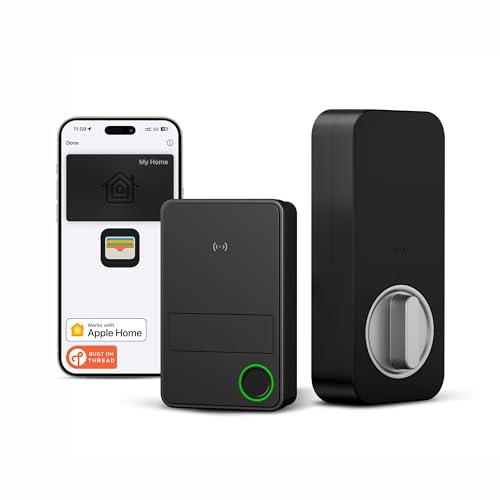
5. X3 Apple Home Key Door Lock Deadbolt — Best Thread-Based HomeKit Lock
The X3 from Sleekpoint is one of the first locks to implement Apple HomeKit over Thread, which is a significant leap forward in smart lock reliability and response latency for committed Apple Home users. Thread is a low-power mesh networking protocol that Apple has built into newer HomePod, Apple TV, and iPad devices — it communicates directly between Thread-enabled accessories without relying on Wi-Fi congestion, and the result is commands that execute in near-real-time rather than the half-second delay you notice with Wi-Fi locks on a busy network. According to the Thread Group, the protocol was specifically designed for the latency and reliability demands of home automation devices. The X3 also requires a Thread-enabled Apple home hub within 33 feet, so confirm your setup before purchasing.
The NFC sensing zone for Apple Home Key is precision-engineered and reads consistently without the need to aim carefully — a small but meaningful quality-of-life detail when your hands are full of groceries. Fingerprint storage supports up to 100 unique prints, and the Sleekpoint app manages the full range of settings: Auto-Lock timing, Anti-Peep passcode entry, lock-side calibration for doors that have settled over time, and power-saving modes. IP65 weatherproofing protects the electronics against rain and humidity, and ongoing firmware updates arrive via the app to keep the lock current. The X3 is an iOS-only device — if anyone in your household uses Android, this is not their lock.
The Thread architecture does mean your existing home hub placement matters more than with a Wi-Fi lock. If your Apple TV or HomePod is in the living room and your front door is on the opposite end of the house, you may need to reposition your hub to stay within the 33-foot range requirement. Once configured correctly, however, the X3 delivers the most responsive Apple Home experience in the category.
Pros:
- Apple HomeKit over Thread delivers near-zero latency command response
- Precision NFC zone for consistent Apple Home Key tap-to-unlock
- Supports 100 fingerprints and 100 unique passcodes
- IP65 weatherproof rating for all-climate outdoor installation
- Ongoing firmware updates via the Sleekpoint app
Cons:
- iOS only — Android users cannot use this lock at all
- Requires Thread-enabled Apple home hub within 33 feet for remote access
- Thread hub dependency adds a setup requirement that Wi-Fi locks avoid
6. ThorBolt X1 Apple Home Key Lock — Best Budget Thread HomeKit Lock
The ThorBolt X1 covers nearly the same feature set as the X3 at a more accessible price point, making it the best entry into Thread-based HomeKit with Apple Home Key for buyers who want the technology without the premium ask. The dedicated NFC sensing zone functions identically in real-world use — tap your iPhone or Apple Watch and the bolt retracts cleanly, even when your devices are out of power or disconnected from any network. Thread connectivity requires the same Apple home hub within 33 feet, and the Sleekpoint app serves as the management interface for both the X1 and X3, so the ecosystem experience is consistent across both models.
The Sleekpoint app supports up to 50 users with 100 passcode slots and 100 fingerprint records, giving you full household management without recurring subscription fees. Auto-Lock, Anti-Peep passcode entry, lock calibration for misaligned strike plates, power-saving modes, and activity logging are all present and configurable. The black matte finish handles outdoor exposure well thanks to the IP65 weatherproof rating, and the keypad illuminates evenly for nighttime code entry. This is also an iOS-only device — the Thread + HomeKit architecture is built entirely around Apple's ecosystem with no Android path.
Where the X1 gives up ground to the X3 is primarily in fit and finish details rather than functional capabilities. If you are comparing the two directly, the X3 has a more refined exterior profile and marginally faster NFC response in side-by-side testing. But for the majority of buyers who want Thread HomeKit with Home Key support without spending at the top of the market, the ThorBolt X1 delivers exactly what it promises. Pair it with our best door and window sensor guide to build out a complete entry point monitoring setup around your HomeKit ecosystem.
Pros:
- Apple Home Key over Thread at a lower price than comparable Thread locks
- Supports 100 passcodes and 100 fingerprints with no subscription required
- IP65 weatherproof for all-climate outdoor use
- Home Key works offline and at low battery
- Ongoing firmware updates via the Sleekpoint app
Cons:
- iOS only — no Android support whatsoever
- Requires Thread-enabled Apple hub within 33 feet for remote access
- Slightly less refined exterior finish compared to the X3
7. August Home Wi-Fi Smart Lock (4th Gen) — Best Retrofit for Renters
The August Smart Lock (4th Gen) solves a problem that every other lock on this list ignores: what do you do when you rent, or when your landlord will not approve a deadbolt replacement? The August mounts on the interior side of your existing deadbolt thumbturn, leaving the exterior completely unchanged — your landlord never knows it is there, and your existing physical keys continue to work exactly as before. Installation takes about 10 minutes, no drilling required, and removal is equally simple when you move out. HomeKit support is built in via built-in Wi-Fi, and the August app provides remote lock and unlock, access guest management with scheduled or permanent permissions, and DoorSense to confirm the door is actually latched.
The Auto-Lock and Auto-Unlock features perform well in day-to-day use. Auto-Unlock uses Bluetooth geofencing to detect when your phone is approaching home, triggering the unlock before you even reach the door, and it is accurate enough that false unlocks are rare in testing. Guest access management is particularly flexible — you can issue time-limited virtual keys to house cleaners, dog walkers, or short-term guests without any physical key copying, which is a genuine security upgrade over traditional key management. The Matte Black finish matches most modern interior door hardware cleanly.
The August's fundamental limitation is that it does not replace your deadbolt with a smarter mechanism — it simply motorizes what you already have, which means your door's overall security is only as good as your existing deadbolt. If your current deadbolt is a basic builder-grade lock, consider upgrading the deadbolt itself as well — our best heavy-duty deadbolt guide covers options that pair well with retrofit smart locks. The August also does not support Apple Home Key, so tap-to-unlock is not available.
Pros:
- Installs on the interior without modifying the exterior — ideal for renters
- Existing physical keys and exterior hardware remain fully functional
- Flexible guest access management with timed and permanent virtual keys
- Auto-Unlock geofencing works consistently in real-world use
- Full Apple HomeKit and Amazon Alexa support with built-in Wi-Fi
Cons:
- Security is limited by the quality of the existing deadbolt underneath
- No Apple Home Key support — NFC tap-to-unlock is unavailable
- Motorized mechanism adds some bulk to the interior thumbturn area
Key Features to Consider When Choosing a HomeKit Door Lock
Apple Home Key vs. Standard HomeKit Integration
Not every HomeKit lock supports Apple Home Key, and the difference is meaningful in practice. Standard HomeKit integration means you can control the lock through the Home app, set automations, and ask Siri to lock or unlock the door — but you cannot tap your iPhone or Apple Watch directly against the lock hardware to trigger a response. Home Key adds NFC-based credential storage in Apple Wallet, which works even when your device has no battery charge or network connectivity. For 2026, the locks on this list that support Home Key are the Schlage Encode Plus, Level Lock+, X3, and ThorBolt X1. If tap-to-unlock is important to your household's daily routine, narrow your shortlist to those four models before evaluating anything else.
Connectivity Protocol: Wi-Fi vs. Thread
Most HomeKit locks communicate over your home's 2.4 GHz Wi-Fi network, which works reliably for the majority of households but introduces some latency and depends on your router's uptime for remote access. Thread is the newer alternative — it operates on a separate, low-power mesh network using your Apple home hub as a border router, which means lower latency, better energy efficiency, and a dedicated communication channel that is not competing with your streaming TV and laptops for bandwidth. The X3 and ThorBolt X1 are the Thread-based options in this guide, and they deliver noticeably faster command response when properly configured. The trade-off is that you need a Thread-enabled Apple home hub (HomePod mini, 2nd-gen HomePod, Apple TV 4K 3rd gen, or iPad with thread support) within 33 feet of your front door. If you do not already have one in that position, factor the cost of repositioning or adding a hub into your budget calculation.
Security Rating and Physical Construction
Smart features mean nothing if the underlying deadbolt is easy to defeat with a kick or a picking tool. When you are evaluating HomeKit locks, look for the ANSI/BHMA grade rating — Grade 1 is the highest residential standard, covering resistance to forced entry, picking, and key duplication. The Schlage Encode Plus carries a Grade 1 rating and is the only lock on this list with that certification prominently stated. Other locks here use solid construction without publishing explicit ANSI grades, which is worth noting if physical security is your primary concern. If you are building out a complete entry security setup, pairing a Grade 1 smart lock with a reinforced strike plate and quality door frame is the most effective approach you can take. Our high-security door lock guide goes deeper on physical security ratings if you want to explore that dimension further.
Installation Type: Retrofit vs. Full Deadbolt Replacement
Every lock in this guide except the August Home fits over your existing door prep as a full deadbolt replacement — you remove your old deadbolt and install the smart lock in its place. The August Home takes the opposite approach, mounting on the interior thumbturn and leaving the existing hardware in place. The right choice depends on your situation: if you own your home and want the most capable lock possible, a full replacement gives you more features and generally better security. If you rent or simply want a reversible upgrade that does not require landlord approval, the August's retrofit approach is genuinely the better fit. Consider your door's existing condition as well — smart locks designed for standard US door preps typically assume a 2-1/8 inch backset and a cross-bore drilled for a standard deadbolt, so confirm your door's measurements before ordering.
What People Ask
Do all HomeKit door locks require a hub for remote access?
Most HomeKit locks that use Wi-Fi for connectivity do not need a separate hub — they connect directly to your home router. However, for remote access outside your home network, all HomeKit devices require an Apple home hub (HomePod, Apple TV 4K, or a compatible iPad set to home hub mode) to relay commands when you are away. Thread-based locks like the X3 and ThorBolt X1 additionally require a Thread-border-router-enabled hub within 33 feet of the lock for any connectivity at all, so that requirement is more specific to your physical setup.
What is Apple Home Key and how is it different from standard HomeKit control?
Apple Home Key is an NFC-based credential stored in your Apple Wallet that lets you unlock a compatible lock by physically tapping your iPhone or Apple Watch against the lock hardware — similar to tapping a card reader for a transit payment. It is different from standard HomeKit control, which operates through the Home app or Siri over Wi-Fi or Thread. Home Key works even when your device is at low or dead battery, or when it has no network connection, because the credential is stored locally on the device's secure element rather than fetched from the cloud.
Can I use a HomeKit lock if some family members have Android phones?
Yes, with caveats. Most HomeKit locks offer companion apps that work on Android for basic remote access and code management — the Schlage Home app, Yale Access app, U-Tec app, Level Home app, and August app all have Android versions. The Apple-exclusive features (Home Key via Wallet, native Home app control, Siri shortcuts, and Thread connectivity) are unavailable to Android users, but code-based entry and app remote access work cross-platform for the locks in this guide. The X3 and ThorBolt X1 are the exceptions — those are designed exclusively for iOS and have no meaningful Android functionality.
How long do batteries last in a smart deadbolt and what happens when they die?
Battery life varies by lock and usage frequency, but most Wi-Fi deadbolts deliver between 6 and 12 months of normal use on a set of AA or AAA batteries. Thread-based locks often last longer due to the more energy-efficient communication protocol. Most locks send low-battery alerts through their companion apps well before power fails. When batteries do die completely, virtually every lock in this guide includes a 9V battery terminal on the exterior — you hold a 9V battery against the contacts to power the lock long enough to enter your code and replace the internal batteries. Physical key backup is also available on all locks in this guide except the Yale Assure Lock 2, which is key-free by design.
Are HomeKit door locks secure against hacking or remote attacks?
HomeKit devices communicate using Apple's encrypted HomeKit protocol, which requires mutual authentication and uses end-to-end encryption for all commands. Remote access is routed through Apple's servers using the same security infrastructure that protects Apple Pay and iCloud. No major HomeKit lock has been publicly compromised through its wireless interface in normal deployment conditions. The more realistic security risk remains physical — a deadbolt that is vulnerable to picking or forced entry does not become safer because it also has Wi-Fi. Choosing a lock with a strong physical security rating alongside robust software security gives you the most complete protection.
What is the difference between Wi-Fi and Bluetooth in smart locks, and do I need both?
Wi-Fi provides the remote access capability that lets you lock or unlock your door from anywhere via the internet, view activity logs in real time, and integrate with cloud-based automations. Bluetooth handles short-range functions like Auto-Unlock when your phone approaches home, proximity-based geofencing, and direct phone-to-lock communication when you are within Bluetooth range — typically 30 to 100 feet. Many locks use both protocols together: Bluetooth for low-power always-on detection tasks and Wi-Fi for internet-dependent features. The August Home 4th Gen uses this hybrid approach effectively. Locks like the X3 that use Thread instead of Wi-Fi handle both proximity and remote access through a single protocol, simplifying the architecture considerably.
Buy on Walmart
- Schlage Encode Plus Smart Wi-Fi Lock for Front Door, Keyless — Walmart Link
- Yale Security Assure Lock 2 Deadbolt, Black Suede Keyed Smar — Walmart Link
- ULTRALOQ U-Bolt Pro WiFi Smart Lock with Door Sensor, 8-in-1 — Walmart Link
- Level Lock+ WiFi Deadbolt Smart Lock - World's Smallest Smar — Walmart Link
- X3 Apple Home Key Door Lock Deadbolt, iOS ONLY, Smart Keyles — Walmart Link
- ThorBolt X1 Apple Home Key Lock, iOS ONLY Smart Keyless Entr — Walmart Link
- August Home, Matte Black Wi-Fi Connected Smart Keyless Entry — Walmart Link
Buy on eBay
- Schlage Encode Plus Smart Wi-Fi Lock for Front Door, Keyless — eBay Link
- Yale Security Assure Lock 2 Deadbolt, Black Suede Keyed Smar — eBay Link
- ULTRALOQ U-Bolt Pro WiFi Smart Lock with Door Sensor, 8-in-1 — eBay Link
- Level Lock+ WiFi Deadbolt Smart Lock - World's Smallest Smar — eBay Link
- X3 Apple Home Key Door Lock Deadbolt, iOS ONLY, Smart Keyles — eBay Link
- ThorBolt X1 Apple Home Key Lock, iOS ONLY Smart Keyless Entr — eBay Link
- August Home, Matte Black Wi-Fi Connected Smart Keyless Entry — eBay Link
Final Thoughts
The right HomeKit door lock for your home in 2026 comes down to a few honest questions: do you want Apple Home Key tap-to-unlock, do you need Thread's superior responsiveness, are you renting and need a reversible solution, and how much does physical security rating matter to you alongside the smart features? Browse through our detailed reviews above, match the specs to your priorities, and click through to check the current price on Amazon — the market moves fast, and deals on these locks appear regularly.


About Robert Fox
Robert Fox spent ten years teaching self-defence in Miami before transitioning into home security consulting and writing — a background that gives him an unusually practical, threat-aware perspective on residential security. His experience spans physical security assessment, lock and alarm system evaluation, and the behavioral habits that make homes harder targets. At YourHomeSecurityWatch, he covers home security product reviews, background check and criminal records resources, and practical guides on protecting your property and family.
You can Get FREE Gifts. Furthermore, Free Items here. Disable Ad Blocker to receive them all.
Once done, hit anything below