Best Pool Safety Devices for Kids: Reviews, Buying Guide, and FAQs 2026
by Robert Fox
Drowning is the leading cause of accidental death in children ages 1–4, claiming more than 800 young lives in the United States every single year — and the vast majority of those tragedies happen in residential pools with no barrier or alarm in place. If you have a pool or spend time near one with small children, the right safety gear is not optional. For 2026, the market has improved significantly across every product category, from certified life vests and NSF-rated pool alarms to heavy-duty mesh covers and four-foot code-compliant fencing. This guide cuts through the noise and puts the seven best options directly in front of you.
Pool safety devices span a wide range of protection layers. No single product is enough on its own. The most effective strategy layers passive barriers — fencing, net covers — with active monitoring tools like alarms, and personal floatation devices for when kids are actually in the water. Think of it as a three-ring defense system: keep them out when unsupervised, alert you when a barrier is breached, and keep them afloat when they're in with you. Each of the products reviewed here fills one of those rings. Visit our pool safety guide for a full framework on building your layered protection plan.
Whether you're outfitting a backyard pool for the first time or upgrading aging safety gear before the 2026 swim season, you'll find a concrete recommendation for every budget and pool type below. All products were evaluated against current CDC drowning prevention guidelines and relevant ASTM/CPSC standards. Let's get into it.

Contents
Standout Models in 2026
- #PreviewProductRating
- Bestseller No. 1
 Rating:

- Bestseller No. 2
 Rating:
 - Bestseller No. 3
 Rating:
 - Bestseller No. 4
 Rating:
 - Bestseller No. 5
 Rating:
 - Bestseller No. 6
 Rating:
 - Bestseller No. 7
 Rating:

Product Reviews
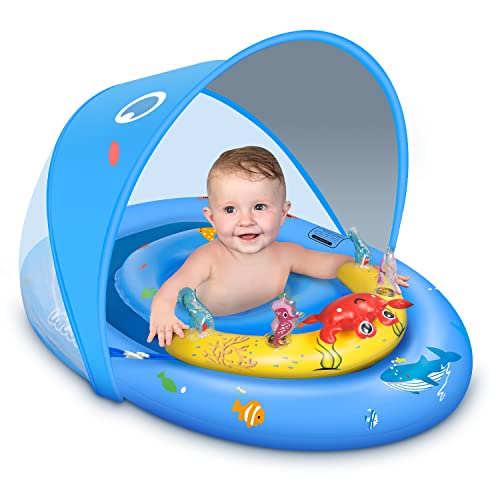
1. LAYCOL Baby Pool Float with Canopy UPF50+ — Best for Infants 6–36 Months
If you've ever tried to keep a six-month-old shaded and stable in the water simultaneously, you know how quickly standard infant floats fall short. The LAYCOL addresses both problems directly. The canopy adjusts through four discrete positions — 0°, 60°, 100°, and 120° — giving you full directional sun coverage regardless of where the sun sits in the sky. UPF 50+ rated fabric blocks over 98% of UV radiation, which is meaningfully better than the UPF 30 you'll find on cheaper competitors.
The float itself is built from 0.35mm PVC, a measurable step up from the 0.3mm standard. That extra thickness translates directly into puncture resistance — a real concern when poolside surfaces and toy edges are involved. The dual inflation chambers are the safety feature that matters most here: if one chamber deflates, the second keeps the float buoyant. Combined with the anti-tip seat design that lowers the center of gravity, this float genuinely does not flip. The 360° breathable mesh seat also prevents the sweaty-bottom issue common in solid-bottom infant floats during extended use.
Certifications include CPC and California Prop 65 (CA65) compliance. It's BPA-free and non-toxic — the kind of baseline you'd expect, but still worth confirming when a product spends time in contact with infant skin. Sized for 6 to 36 months, you get a meaningful window of use before the child outgrows it. The included animal pool toys are a bonus, not a selling point — the float's design is the reason to buy this one.
Pros:
- Four-position adjustable UPF 50+ canopy provides genuine all-direction sun protection
- Dual inflation chambers + anti-tip seat design prevents flipping
- 0.35mm PVC construction offers superior puncture and leak resistance vs. standard 0.3mm floats
- CPC and CA65 certified; BPA-free, non-toxic materials
- 360° breathable mesh seat improves airflow for extended sessions
Cons:
- Requires adult supervision at all times — this is a float, not a life jacket
- Canopy adjustment can be stiff initially and requires two hands to reposition

2. Poolguard PGRM-2 In-Ground Pool Alarm — Best Pool Alarm for In-Ground Pools
The Poolguard PGRM-2 has been around long enough to have a track record, and that track record is solid. It's one of the few pool alarms that carries NSF certification to ASTM Standard F2208 — the specific benchmark for pool and spa alarms. That certification is not a marketing claim; it means an independent laboratory verified that the alarm detects subsurface waves consistent with a child entering the water. Most cheap pool alarms on Amazon are not F2208 certified. This one is.
Made in the USA, the PGRM-2 mounts directly to the pool wall for in-ground installations. The alarm itself triggers at 85 decibels at 10 feet — loud enough to be heard clearly from inside an adjacent home. More practically useful is the in-house remote receiver, which extends that alert range up to 200 feet. You can be in the kitchen, a back bedroom, or a garage and still receive the alert. The remote receiver plugs into a standard outlet and connects wirelessly, so there's no complicated wiring involved.
One insider note: pool alarms like this one work best as a secondary barrier, not a primary one. The alarm detects entry after it happens — it doesn't prevent access. Pair this with physical barriers like the fencing or net cover reviewed below for a complete system. If you're building out a full home security approach for your property, it's worth reading how door and window sensors can further reduce unauthorized pool access from inside the home.
Pros:
- NSF certified to ASTM F2208 — independently verified performance standard
- 85 dB alarm is audible from significant distances
- In-house remote receiver with 200-foot range extends coverage throughout your home
- Made in the USA with a strong reliability history
- Straightforward pool-wall installation for in-ground pools
Cons:
- Designed specifically for in-ground pools — not suitable for above-ground installations
- Detects entry after the fact; must be paired with physical barriers for full protection
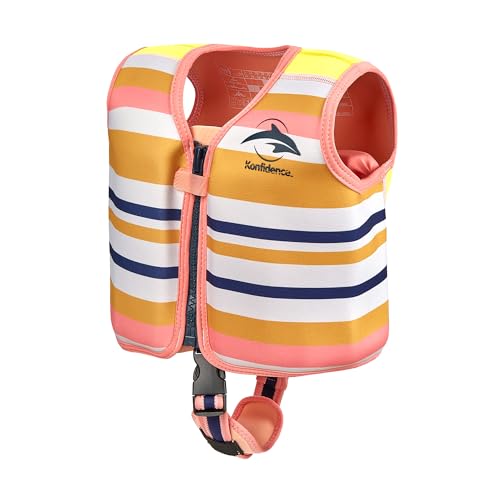
3. Konfidence Swim Jacket — Best Adjustable Swim Vest for Skill Development
Most swim vests are a binary proposition: full float or nothing. The Konfidence Swim Jacket operates on a completely different principle. With eight removable foam floats distributed around the vest, you dial up buoyancy when the child is learning and progressively remove floats as their skills develop. This makes it one of the most pedagogically sound products in the pool safety category — it grows with the child rather than being replaced when they outgrow it.
The headline feature for 2026 is the world-first fully adjustable, fully removable support strap — a crotch strap that prevents the vest from riding up under the arms, which is the most common fit problem with swim jackets on smaller children. Critically, it's fully detachable, so if your child finds it uncomfortable or restrictive, you remove it without compromising the jacket's core buoyancy. The Konfidence is the only swim jacket recommended by the Starfish Aquatics Institute, backed by 25+ years of design and testing experience. It carries both UKCA and CE compliance certifications for European and UK markets.
Available sizing covers 19–30kg for the Large reviewed here, with additional sizes across the range. The Gelato Rose colorway offers good visibility in the water. This isn't a life jacket in the US Coast Guard sense — it's a swimming aid designed for supervised pool learning. For emergency rescue scenarios, see the SwimWays Swim Trainer below.
Pros:
- Eight removable foam floats allow progressive buoyancy reduction as skills improve
- Fully detachable support strap — the only jacket offering this feature
- Endorsed by the Starfish Aquatics Institute; 25+ years of design history
- UKCA and CE certified for compliance in multiple markets
- Reusable across multiple children as floats are redistributable
Cons:
- Not a US Coast Guard approved life jacket — not suitable as a standalone emergency PFD
- Premium price point compared to entry-level swim vests
4. SwimWays Swim Trainer Life Vest — Best USCG-Approved Toddler PFD
When you need an actual Coast Guard-approved personal flotation device rather than a swim aid, the SwimWays Swim Trainer is the pick in this weight class. Rated for children weighing 33–55 lbs and fitting most 2-to-4-year-olds, this is a dual-function product: a certified Type II PFD and a swimming aid combined into one garment. That distinction matters enormously if you're taking children to open water, a boat, or any situation where certified buoyancy is legally required or genuinely life-critical.
The bright mermaid colorway is not just aesthetic — high visibility in the water is a real safety feature that reduces response time if a child goes under. UPF 30+ sun protection is built into the exterior fabric. The twill exterior wipes clean quickly, which anyone who's dealt with sunscreen-coated toddler gear knows is a practical daily benefit. The design supports kids in learning to kick and move in the water rather than just floating passively, making it useful in swim lessons as well as open-water outings.
A note for comparison shoppers: the Konfidence Swim Jacket reviewed above offers better adjustability for progressive swim training in controlled pool environments. The SwimWays earns its place in this list specifically because of the Coast Guard certification — that's what you need for open water and boats. For a complete home safety picture, pairing a certified PFD with monitoring tools like a hidden nanny camera pointed at the pool area gives you coverage when eyes aren't directly on the water.
Pros:
- US Coast Guard approved Type II PFD — legally certified for emergency buoyancy
- Fits children 33–55 lbs; designed for 2–4 year olds
- High-visibility color scheme reduces response time during incidents
- UPF 30+ exterior sun protection
- Easy-clean twill exterior holds up to daily use
Cons:
- Less adjustable than training-focused vests like the Konfidence — limited buoyancy progression
- Mermaid design is gender-specific; additional colorways would improve lineup
5. 20 Inch Safety Life Preserver Ring Buoy — Best Poolside Rescue Device
Every pool that children use should have a throw-able rescue device mounted on the wall within arm's reach of the water. This ring buoy is that device. At 20 inches in outer diameter with a 10.6-inch inner opening, it's large enough for a child to grab and hold while you pull them to safety. The 110 lb weight rating is sufficient for any child and most adults, making it a genuinely multi-purpose rescue tool rather than a child-only specialty item.
The foam construction keeps the ring lightweight enough to throw accurately at distance — a critical factor that heavy plastic rings consistently fail on. You can wall-mount it as a visible, immediately accessible rescue station or use it as a pool accessory during supervised swim sessions. The blue colorway is the universal international color for water rescue equipment, which creates instant visual recognition for anyone approaching the pool.
This is the least expensive product in this lineup and deliberately so — there's no reason a functional rescue ring should cost a premium. It works at pools, lakes, rivers, and oceanside. The only caveat is that this is a throwing aid, not a personal flotation device — it requires someone to throw it to a struggling swimmer. Keep it in a fixed, visible location. Do not store it in a shed or garage where access during an emergency requires additional steps.
Pros:
- 110 lb weight bearing capacity — suitable for children and adults
- Lightweight foam construction allows accurate throws at distance
- Dual use: active pool rescue device and wall-mount safety station
- Works across pool, lake, river, and seaside environments
- Highly affordable — no reason to skip this one
Cons:
- Requires a capable person to throw it — not a passive safety device
- No rope included in the base listing; pairing with a throw rope is recommended
6. Chunm 18x36 ft Pool Safety Net Cover with Anchors — Best Passive Barrier for Inground Pools
A pool safety net cover is the single most effective passive barrier for preventing accidental access when the pool is not in use. The Chunm 18x36 ft cover is built from polyethylene netting with stainless steel expansion anchors — the combination of UV-resistant netting and corrosion-resistant anchors gives this cover legitimate longevity in an outdoor chemical environment. Pool chlorine degrades inferior anchor materials fast; stainless steel eliminates that failure mode.
The 10cm mesh size is small enough to prevent children and pets from getting limbs through, but stretches to isolate debris larger than that threshold. Installation is anchor-based: drill the stainless expansion anchors into poolside concrete, then clip the heavy-duty reinforced rope edge of the net directly to the anchors. The process is straightforward and produces a taut, stable surface that won't sag under the weight of a child who wanders onto it. Available in multiple sizes beyond the 18x36 reviewed here.
One practical note: no pool net cover is a substitute for a fence around unsupervised access from outside the property. The net handles the scenario where a child inside the yard reaches the pool edge unseen. The Life Saver fencing reviewed next handles the approach from outside. Together, they cover both vectors. For comparison, if you're thinking about perimeter security beyond just the pool, our review of the best home security systems covers comprehensive property monitoring options that integrate well with outdoor cameras pointed at pool zones.
Pros:
- Polyethylene netting resists UV degradation and pool chemicals over multiple seasons
- Stainless steel expansion anchors won't corrode from chlorine or weather exposure
- 10cm mesh prevents limb penetration by children and pets
- Quick-clip installation requires no special tools beyond a drill
- Available in multiple sizes to fit non-standard pool dimensions
Cons:
- Requires drilling into poolside concrete — not suitable for rental properties without permission
- Anchor holes remain after removal; not reversible without patching
7. Pool Fence DIY by Life Saver Fencing Section Kit — Best Removable Pool Barrier
The Life Saver Pool Fence represents the gold standard approach to pool perimeter protection. At exactly 4 feet — the height recommended by the US Consumer Product Safety Commission (CPSC) — this fence meets the specific code height that reduces child drowning risk by up to 83% compared to pools with no barrier. That statistic comes from peer-reviewed research, and it's the reason every serious pool safety framework starts with a four-foot fence.
Each boxed section covers 4 feet high by 12 feet wide and arrives pre-assembled. The kit includes the deck sleeves, caps, and a brass safety latch. The mesh design means children can't use it as a climbing frame — there are no horizontal rails to step on. The fence is removable, which is one of its most practical features: you install the sleeves permanently into the deck surface, then click fence sections in and out of those sleeves as needed. Hosting an adult pool party? Remove the sections. Kids coming over? Snap them back in. The system takes minutes either way.
Installation requires drilling sleeve holes into your pool deck, which is a one-time permanent step. After that, the fence sections themselves are fully removable and storable. Sections interlock seamlessly for longer runs — purchase additional kits to cover your full perimeter. Black is the standard colorway; it blends into most pool and landscaping environments without the visual disruption of white aluminum fencing. If you take perimeter security seriously across your whole property, this pairs naturally with other access control tools — similar logic applies when choosing high security door locks for entry points facing the pool area from inside the home.
Pros:
- Meets US CPSC recommended 4-foot height for drowning prevention compliance
- Removable sections click in and out of permanent deck sleeves in minutes
- Mesh design eliminates horizontal rails — no toe-holds for climbing
- Pre-assembled 4x12 ft sections reduce installation time significantly
- Includes deck sleeves, caps, and brass safety latch in each box
Cons:
- Requires permanent sleeve installation into pool deck — not renter-friendly
- Each 12-foot section sold separately; full-perimeter coverage requires multiple kits
Key Features to Consider When Choosing Pool Safety Devices
1. Identify Which Safety Layer You're Filling
Before purchasing any pool safety product, categorize what gap you're addressing. The three protection layers are:
- Passive barriers — fencing and net covers that physically prevent access when the pool is unattended. These are your first line of defense and should be in place before any child is on your property.
- Detection and alerting — pool alarms like the Poolguard PGRM-2 that notify you when a barrier has been breached. Detection is a backup layer, not a primary one.
- In-water flotation — swim vests, floats, and life jackets that keep a child buoyant when they're in the water with supervision. These do not replace barriers or alarms.
Identify which layer is missing from your current setup and prioritize accordingly. A family that already has a fence but no alarm has different needs than one starting from zero.
2. Certifications and Standards — Know What They Mean
Not all safety certifications are equivalent. Here's what the key standards actually mean for pool products in 2026:
- ASTM F2208 — the specific standard for pool alarms. NSF certification to this standard means the alarm was independently tested to detect subsurface waves. Require this for any pool alarm purchase.
- US Coast Guard Type II PFD — the minimum certification for emergency open-water use. Required for boats; recommended for any non-pool water environments. The SwimWays carries this.
- UKCA / CE — European and UK conformity marks indicating the product meets regional safety standards. Relevant for the Konfidence Swim Jacket and comparable imports.
- CPC / CA65 — US Children's Product Certificate and California Proposition 65 compliance for chemical safety in children's products. Look for this on infant floats and anything that contacts skin.
3. Age and Weight Compatibility
Pool safety products have precise age and weight ranges, and exceeding them meaningfully reduces effectiveness. Key ranges for the products in this guide:
- LAYCOL Baby Pool Float: 6–36 months
- SwimWays Swim Trainer: 33–55 lbs, approximately 2–4 years old
- Konfidence Swim Jacket (Large): 19–30 kg
- Life Saver Pool Fence: no weight restriction — barrier protection for all ages
Never use an infant float for a child outside the weight range. Buoyancy geometry is calibrated to specific weight distributions. An oversized child in an undersized float creates an active tipping risk.
4. Installation Requirements and Property Constraints
Several products in this category require permanent modifications to your pool deck or wall. Evaluate the following before purchasing:
- Rental properties — drilling sleeve holes for pool fencing or anchor holes for safety nets may violate lease terms. Confirm before purchasing permanent-install products.
- Pool type compatibility — the Poolguard PGRM-2 is in-ground only. Above-ground pool owners need a different alarm model.
- Pool dimensions — the Chunm net cover reviewed is 18x36 ft. Non-standard pool shapes may require custom sizing or combining multiple sections.
- Deck material — stainless steel expansion anchors perform differently in poured concrete vs. pavers vs. wood decking. Verify anchor compatibility with your specific deck material before purchasing.

What People Ask
What is the most effective pool safety device for young children?
No single device is most effective in isolation — the research consistently shows that layered protection reduces drowning risk most significantly. Start with a four-foot code-compliant fence (the Life Saver DIY Kit meets this standard), add a certified pool alarm like the Poolguard PGRM-2 as a backup detection layer, and equip children in the water with a certified personal flotation device appropriate for their age and weight. All three layers working together are what the CDC recommends for residential pools in 2026.
Is a pool alarm a substitute for a pool fence?
No. A pool alarm detects entry after a child has already reached the water. A fence prevents access to the water in the first place. These are complementary devices, not alternatives. The CPSC is explicit on this point: alarms are a supplementary layer, not a replacement for physical barriers. Install the fence first. Add the alarm second.
What is the difference between a swim vest and a life jacket?
A swim vest (like the Konfidence Swim Jacket) is a swimming aid designed for supervised pool use and skill development. It provides buoyancy but is not independently tested or certified for emergency open-water rescue. A life jacket (like the SwimWays Swim Trainer) is a US Coast Guard-approved Personal Flotation Device that meets specific federal buoyancy and self-righting standards. Use a certified life jacket any time children are on or near open water, boats, or lakes. Swim vests are appropriate for supervised pool learning environments only.
Can an infant pool float be left unattended?
Absolutely not. Infant pool floats — including the LAYCOL reviewed here — are flotation aids that require constant adult supervision within arm's reach. They are not life jackets, and they do not prevent drowning if a caregiver is not present. The float's anti-tip design reduces tipping risk but does not eliminate it. The only safe rule: if you cannot see and immediately reach the child, they should not be in or near the water.
How do I know if a pool net cover can support a child's weight if they fall on it?
Look for pool net covers that specify a static load rating or use heavy-duty reinforced rope edges with stainless steel anchor hardware — the Chunm net cover reviewed here uses both. The mesh design distributes weight across multiple anchor points rather than concentrating it at one spot. That said, pool net covers are designed to prevent a child from reaching the water, not to serve as a play surface. They should be removed when adults are supervising children at the pool, and reinstalled when the pool is not in active supervised use.
What height does a pool fence need to be to meet safety standards?
The US Consumer Product Safety Commission recommends a minimum height of 4 feet for pool enclosure fencing. Many local building codes require this as a legal minimum, and some jurisdictions have stricter requirements of 5 or 6 feet for pools adjacent to public areas. The Life Saver Pool Fence reviewed here is built to the 4-foot CPSC recommendation. Before installing any pool fence, verify your local municipal code — requirements vary by state and county, and non-compliant fencing may not satisfy homeowners insurance requirements or local inspection standards.
Buy on Walmart
- LAYCOL Baby Pool Float with Canopy UPF50+, 120°Adjustable Su — Walmart Link
- Poolguard PGRM-2 In-Ground Pool Alarm, White — Walmart Link
- Konfidence Swim Jacket - Premium Swim Vest with Removeable S — Walmart Link
- SwimWays Swim Trainer, US Coast Guard Approved Life Vest Kid — Walmart Link
- 20 Inch Safety Life Preserver Ring Buoy for Swimming, Swim F — Walmart Link
- Chunm 18 x 36 ft Pool Safety Net Cover with Anchors, 10 cm M — Walmart Link
- Pool Fence DIY by Life Saver Fencing Section Kit, 4 x 12-Fee — Walmart Link
Buy on eBay
- LAYCOL Baby Pool Float with Canopy UPF50+, 120°Adjustable Su — eBay Link
- Poolguard PGRM-2 In-Ground Pool Alarm, White — eBay Link
- Konfidence Swim Jacket - Premium Swim Vest with Removeable S — eBay Link
- SwimWays Swim Trainer, US Coast Guard Approved Life Vest Kid — eBay Link
- 20 Inch Safety Life Preserver Ring Buoy for Swimming, Swim F — eBay Link
- Chunm 18 x 36 ft Pool Safety Net Cover with Anchors, 10 cm M — eBay Link
- Pool Fence DIY by Life Saver Fencing Section Kit, 4 x 12-Fee — eBay Link
Key Takeaways
- The Life Saver Pool Fence DIY Kit is the single most impactful purchase you can make — a CPSC-compliant 4-foot barrier reduces child drowning risk by up to 83% compared to unfenced pools.
- The Poolguard PGRM-2 is the only NSF-certified ASTM F2208 alarm on this list and delivers a 200-foot range in-house alert system that no cheap pool alarm can match.
- For in-water protection, the SwimWays Swim Trainer is your pick when Coast Guard certification is required (open water, boats, lakes), while the Konfidence Swim Jacket is the superior tool for progressive pool-based swim training.
- No single product is sufficient — build a layered system using a passive barrier, a detection alarm, and appropriate in-water flotation to achieve the multi-ring defense that the evidence supports.


About Robert Fox
Robert Fox spent ten years teaching self-defence in Miami before transitioning into home security consulting and writing — a background that gives him an unusually practical, threat-aware perspective on residential security. His experience spans physical security assessment, lock and alarm system evaluation, and the behavioral habits that make homes harder targets. At YourHomeSecurityWatch, he covers home security product reviews, background check and criminal records resources, and practical guides on protecting your property and family.
You can Get FREE Gifts. Furthermore, Free Items here. Disable Ad Blocker to receive them all.
Once done, hit anything below