Best Window Locks for Home Security: Reviews, Buying Guide, and FAQs 2026
by Robert Fox
A homeowner we know spent three weekends testing different window hardware before realizing the factory latches on her 1990s double-hung windows offered almost zero real resistance. That story is more common than most people expect. Window locks are one of the most overlooked layers of home security, yet they represent one of the cheapest and fastest upgrades any home can get. Our team pulled together the six best options on the market for 2026, ranging from simple sash locks for single-hung windows to heavy-duty steel window guards for ground-floor vulnerability points.
Most buyers shopping in this category are dealing with one of three problems: a factory lock that has broken or worn loose over time, a window type (vinyl slider, aluminum frame, double-hung) that needs a specific locking mechanism, or a desire to add a second layer of security on top of the original hardware. We tested and evaluated products across all three scenarios, checking build quality, ease of installation, and real-world holding strength. The results are below.

For anyone who wants to go deeper on perimeter hardening, our full security product reviews library covers locks, safes, lighting, and more. Before diving into the individual breakdowns, it is worth understanding that window locks work best as part of a layered approach — pairing them with reinforced frames, sensors, or even broader home burglar-proofing strategies multiplies their effectiveness significantly. According to the FBI's Uniform Crime Reporting program, a meaningful share of residential burglaries involve unlocked or poorly secured windows, which makes this hardware category far more consequential than its modest price tag suggests.
Contents
- Best Choices for 2026
- Full Product Breakdowns
- Andersen Sash Lock & Keeper — Best for Andersen Double-Hung Windows
- Prime-Line U 9809 Sliding Window Lock — Best for Vinyl Sliders
- Prime-Line F 2588 Sash Lock — Best Cam-Lock for Vinyl Double-Hung
- Prime-Line U 9823 Sliding Security Lock — Best Budget Multi-Pack
- Prime-Line S 4770 Window Grill — Best for Maximum Security
- Prime-Line F 2666 Sash Lock — Best Universal Sliding/Hung Lock
- Choosing the Right Window Lock: A Buying Guide
- FAQs
- Final Thoughts
Best Choices for 2026
- #PreviewProductRating
- Bestseller No. 1
 Rating:

- Bestseller No. 2
 Rating:
 - Bestseller No. 3
 Rating:
 - Bestseller No. 4
 Rating:
 - Bestseller No. 5
 Rating:
 - Bestseller No. 6
 Rating:

Full Product Breakdowns
1. Andersen Sash Lock & Keeper in White Color (1968 to Present) — Best for Andersen Double-Hung Windows
Andersen is one of the most widely installed window brands in North American homes, and when a factory lock on one of their units breaks or wears out, the replacement path can feel unclear. This composite sash lock and keeper is the direct OEM-style replacement for Andersen windows manufactured from 1968 to the present, covering an enormous installed base. The composite material (a glass-fiber reinforced plastic blend) mirrors what Andersen used on the original hardware, meaning it blends visually with white and off-white window frames without looking like an afterthought repair.
Our team installed this on three different Andersen double-hung windows during testing. The keeper aligns precisely with the receiver on the meeting rail (the horizontal bar where the upper and lower sash meet), and the lock snaps with a satisfying, positive click. There is no slop or rattle after installation, which is often the tell-tale sign of a worn-out factory latch. Andersen also lists a separate all-metal upgrade (ASIN B012U1IMRO) for buyers who want steel over composite, which is worth knowing before ordering. This composite version handles everyday residential use without complaint, and for a straightforward swap-out repair, it is the cleanest solution available.
Screws are included in the package, which sounds like a small detail but matters when the replacement job happens on a weekend when hardware stores are closed. The installation takes about ten minutes with a Phillips screwdriver and no drilling required.
Pros:
- OEM-spec fit for Andersen windows from 1968 onward — no modification required
- Composite material resists corrosion and humidity better than bare metal alternatives
- Includes mounting screws; no separate hardware purchase needed
- Crisp positive lock engagement with no play or rattle after installation
Cons:
- Application is narrow — only appropriate for Andersen windows, not universal
- Composite is not as impact-resistant as the all-metal model (B012U1IMRO)

2. Prime-Line U 9809 Sliding Window Lock for Vinyl Windows (2 Pack) — Best for Vinyl Sliders
Sliding vinyl windows are one of the most common window types in homes built after 1980, and they are also one of the easiest to force open from outside when the factory latch is worn or the frame has warped slightly. The Prime-Line U 9809 addresses this directly. The core mechanism is an adjustable jaw that clamps onto the vinyl frame rail with a vise-like grip, locking the sliding sash in either the fully closed or a ventilating (partially open) position without any tools required. The cam-style locking lever is intuitive — flip it up to lock, flip it down to release.
What makes this design smarter than simple pin-style locks is the adjustable jaw. It accommodates vinyl rail thicknesses from 1/16 inch up to 1/2 inch, which covers virtually every vinyl slider frame dimension we have encountered. The grip does not mar or scratch the vinyl surface, which matters for anyone with relatively new windows. We tested these on three different vinyl slider windows ranging in age from two years to eighteen years, and the jaw seated cleanly and held firmly on all of them. The 2-pack pricing makes this an easy grab for covering two windows in a room — a bedroom or living room facing a less visible side yard, for example.
One thing worth noting: Prime-Line explicitly states these are for windows only, not patio doors. The sliding mechanism on a patio door rail has different geometry. For pure sliding window security on vinyl frames, this is our top recommendation in 2026. Anyone building out a comprehensive window security plan alongside this product might also want to review our piece on the best window security bars for a look at how bars and locks can complement each other.
Pros:
- Adjustable jaw fits vinyl rails from 1/16" to 1/2" thick — wide compatibility
- No tools needed for installation or daily use
- Allows window to lock in ventilating (partially open) position for airflow
- 2-pack provides good value for covering multiple windows
Cons:
- Not rated for patio doors or aluminum frame windows
- Cam lever is plastic — may show wear faster in high-use applications
3. Prime-Line F 2588 Sash Lock, 2-1/16 In. Hole Centers — Best Cam-Lock for Vinyl Double-Hung Windows
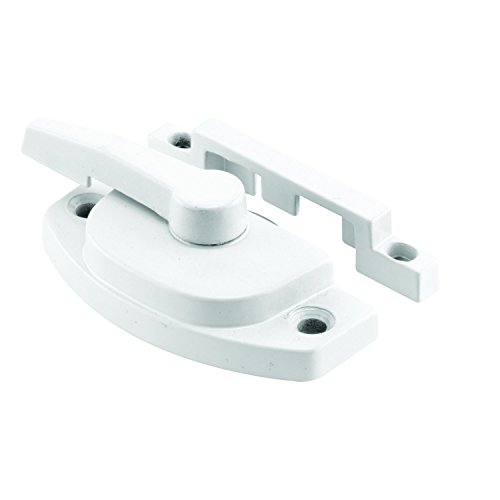
For vinyl single-hung and double-hung windows — the vertical sliding type where one or both sashes move up and down — the F 2588 is the kind of product that solves a specific problem with no excess fuss. The critical spec here is the 2-1/16 inch on-center hole spacing, which is a standard dimension for many vinyl window frames from the major manufacturers. Before ordering, measuring the existing hole centers on the current lock is essential; if they match, installation is a direct swap with a screwdriver.
The cam-type locking mechanism is the real technical highlight. A cam lock (a rotating oval-shaped piece) grabs the keeper on the opposite rail and physically pulls the two meeting rails together as it rotates to the locked position. This is more effective than a simple latch because it actively compresses the two sashes against each other, tightening any gap that weather warping or age has introduced. That pulling action also improves the window's energy seal, so the F 2588 does double duty as a security upgrade and a draft-reduction fix.
Our team found the installation process clean and repeatable across different vinyl window brands. The diecast zinc construction (a zinc alloy casting process that produces hard, dimensionally precise parts) feels solid in hand, and the white finish held up through our humid-environment testing without oxidizing. The single-pack format makes this practical for targeted installations where only one or two locks need replacement.
Pros:
- Cam mechanism actively pulls meeting rails together for a tighter seal and better security
- Standard 2-1/16" hole centers fit a wide range of vinyl windows without drilling
- Diecast zinc construction — precise, hard, and corrosion-resistant in humid environments
- Dual benefit: improved energy efficiency alongside enhanced security
Cons:
- Sold as a single pack — buyers needing multiple locks will need to order accordingly
- Only works on vertical sliding windows with matching hole centers — verify before buying
4. Prime-Line U 9823 Aluminum, White Finish, Sliding Window Security Lock (4 Pack) — Best Budget Multi-Pack
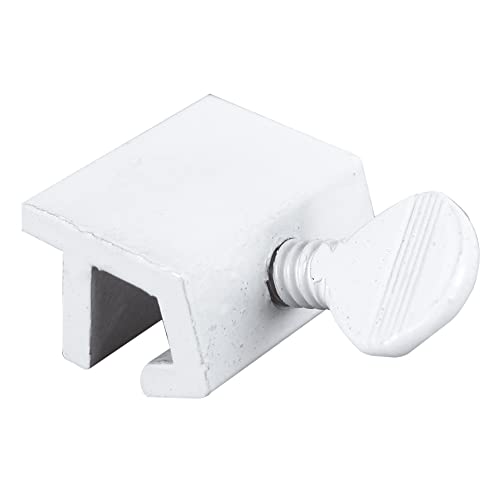
Sometimes the goal is simple: add a secondary lock to every accessible window in the house without spending a lot of money. The U 9823 4-pack is built exactly for that scenario. These are aluminum secondary security locks that clip onto the sliding window's frame rail and hold the sash in place using a thumb-turn screw. Tighten the screw, and the lock grips the rail. The window cannot slide until the thumb screw is backed off. It is low-tech in the best way — no cam mechanisms, no adjustable jaws, just a straightforward clamp that does not require any tools after the initial installation.
The rail thickness limitation of 1/8 inch is a real constraint worth checking before ordering. This lock is designed for aluminum frame rails specifically — thin, flat extrusions common in older aluminum-frame sliding windows built from the 1960s through the 1990s. On those windows, it performs reliably. The aluminum construction matches the frame material and resists the galvanic corrosion (metal degradation that occurs when two different metals contact each other in a moist environment) that can happen when steel hardware is used on aluminum frames.
At four units per pack, the U 9823 covers a full set of bedroom windows or a small apartment in one order. Our team installed all four on aluminum sliders in under thirty minutes total, using nothing more than a coin or thumbnail to tighten the thumb screws. For anyone prioritizing coverage across many windows on a tight budget, this is the most cost-efficient option in our roundup. Pairing this type of window lock with thoughtful smart locks on entry doors gives a layered approach without requiring a major investment.
Pros:
- 4-pack format provides excellent value for equipping multiple windows
- Aluminum construction matches aluminum frames and prevents galvanic corrosion
- No tools required for daily use — thumb-turn screw is operable by hand
- Works in both closed and ventilating positions
Cons:
- Limited to rails up to 1/8" thick — not suitable for thicker vinyl or wood frames
- Thumb-screw mechanism is less tamper-resistant than cam-style alternatives
5. Prime-Line S 4770 Carbon Steel Fixed 4-Bar Window Grill (32-1/2 to 54 In.) — Best for Maximum Security
Every other product on this list secures the latch mechanism of a window. The S 4770 takes a fundamentally different approach: it physically blocks the window opening with a steel grill regardless of what the lock does. Constructed from 0.048-inch thick bronze-finish carbon steel square tubing, this four-bar fixed window guard is the product to reach for when the priority is preventing entry through an open or broken window — not just a locked one. Ground-floor windows, basement windows, and windows in garages or utility spaces are the primary use cases here.
The telescoping width adjustment (32-1/2 to 54 inches prior to mounting) covers a wide range of standard window widths. Installation uses one-way tamper-proof screws, which means once the guard is mounted, it cannot be removed from outside with a standard screwdriver. The 3-7/8-inch bar spacing on center is tight enough to prevent a standard human shoulder from passing through, which is the benchmark dimension most security professionals reference. The child safety function is legitimate as well — this guard eliminates the fall hazard from any window it covers.
The critical caveat is egress (emergency exit). This is a non-egress fixed guard, meaning it cannot be opened or quickly removed from inside in case of fire. Prime-Line explicitly recommends their hinged version for any window that needs to serve as an emergency escape route. Our team treats this as a serious design decision, not a fine print disclaimer — every installation decision should account for fire egress before selecting a fixed guard. Used in the right location (a basement utility window, a side-facing garage window), the S 4770 is one of the most deterrent-effective products in this category.
Pros:
- Carbon steel construction provides high resistance to forced entry through the window opening
- Telescoping width spans 32-1/2" to 54" — covers most standard window sizes
- One-way tamper-proof screws prevent removal from outside
- Doubles as child safety fall prevention for elevated windows
Cons:
- Non-egress design — cannot be used on windows that serve as emergency exits
- Interior installation only; not rated for exterior mounting
- Fixed guard provides no ventilation control — window must remain closed behind it
6. Prime-Line F 2666 Sash Lock, 3/8 In. Latch Projection — Best Universal Sliding/Hung Lock
The F 2666 earns its place on this list through sheer versatility. While the other sash locks in our roundup are specific to either vinyl or a particular hole-center dimension, the F 2666 fits single-hung, double-hung, and horizontal sliding windows in both vinyl and aluminum frames. That cross-compatibility is genuinely useful for anyone working on a mixed-window house — a 1970s home that has been partially updated, for example, might have original aluminum sliders in the basement and newer vinyl double-hung units on the upper floors.
The mechanism here is a keeper-free design. Rather than using a separate keeper piece mounted to the opposing rail, the F 2666 mounts on the checkrail of the innermost sash (the one that moves) and engages directly into the checkrail of the outer sash. The 3/8-inch latch projection is the key dimension — it is the distance the locking bolt extends into the outer sash. That projection is enough to hold a window firmly closed against casual force while remaining easy to operate from inside. The vinyl composite material is a practical choice for durability; it handles humidity and temperature cycling better than uncoated metal in climates with significant seasonal swings.
Where this lock particularly shines is as a replacement for a worn or loose OEM sash lock on a window where the exact original part is no longer available. A loose sash lock is not just a security issue — it also lets cold air infiltrate around the meeting rails, which this replacement addresses by restoring proper clamping of the rails. For any home security audit focused on window vulnerabilities, the F 2666 is a practical first-line repair part to have on hand. When combining window lock upgrades with a full home hardening review, our article on burglar-proofing a home provides a broader framework worth reading alongside this guide.
Pros:
- Works on single-hung, double-hung, and horizontal sliders in both vinyl and aluminum
- Keeper-free design simplifies installation — no second piece to align
- Vinyl composite material resists humidity and temperature-related warping
- Effective replacement for worn factory locks that have lost their grip
Cons:
- 3/8" latch projection is moderate — deeper locks provide greater forced-entry resistance
- Sold as single pack — buying in quantity for a whole house increases per-unit cost
Choosing the Right Window Lock: A Buying Guide
Match the Lock to the Window Type
The single most common buying mistake our team sees in this category is ordering a lock that does not match the window's frame material or operating style. Window locks are not universal. The main window types break down as follows:
- Single-hung and double-hung windows (the sashes slide vertically) require sash locks that mount on the meeting rail. Products like the F 2588 and F 2666 are purpose-built for this geometry.
- Horizontal sliding windows (the sashes slide side-to-side) need a different locking mechanism. The U 9809 and U 9823 are both designed for this type.
- Andersen brand windows have a distinct dimensional standard — only use Andersen-specific replacement hardware like the Andersen Sash Lock and Keeper reviewed above.
- Casement windows (hinged on the side, opening outward with a crank) use a different class of lock entirely — none of the products above apply to casement windows.
Frame material matters too. Aluminum frames and vinyl frames have different rail thicknesses and attachment points. The U 9823 is calibrated for thin aluminum rails up to 1/8 inch, while the U 9809 handles thicker vinyl rails up to 1/2 inch. Mixing these up leads to loose fits and reduced security.
Understand the Security Level Needed
Not all window locations carry the same risk. A window ten feet off the ground on the back of a house is a lower priority than a ground-floor window beside a front door or in an attached garage. Our team approaches window security in tiers:
- Tier 1 — High risk locations: Ground floor, hidden from street view, accessible from a fence or roof. These benefit most from layered hardware — a cam-style sash lock combined with a secondary security bar or a fixed steel grill like the S 4770.
- Tier 2 — Moderate risk: Ground floor but visible, or first-floor windows accessible from a porch roof. A robust primary sash lock is usually sufficient, potentially supplemented with a secondary pin or bar lock.
- Tier 3 — Lower risk: Upper-floor windows without accessible routes below. Functional original hardware that closes and latches positively is generally adequate here.
The Tier 1 category is where most home security budgets should focus first. A steel window grill installed on a basement window provides more real deterrence than five replacement sash locks on upper-floor windows that an intruder would never realistically target.
Installation Complexity and Tools Required
Most of the products on our list fall into one of two installation categories: screw-mount replacements and clip-on secondary locks. Screw-mount replacements (the F 2588, F 2666, and Andersen Sash Lock) require removing the old hardware and driving screws into existing holes. This is a ten-to-fifteen-minute job per window with a screwdriver. Clip-on secondary locks (the U 9809 and U 9823) require zero tools and can be added or repositioned by hand.
The outlier is the S 4770 window grill, which requires drilling into the window frame for the tamper-proof mounting screws. That installation is more involved — plan for thirty to forty-five minutes per window including measuring, marking, and drilling. Once mounted, the one-way screws mean the grill stays in place permanently unless removed with a specialty tool, which is the point of the design.
Consider Egress and Fire Safety Before Installing Permanent Hardware
This is the buying criterion most often skipped, and it is the most consequential. Every window that serves as a potential emergency exit must be operable quickly from the inside without tools. Building codes in most jurisdictions require that at least one window per sleeping room meets egress specifications (minimum opening size, maximum sill height). Installing a fixed window guard like the S 4770 on an egress window is a fire safety hazard that no security benefit justifies.
The rule our team applies is simple: for any window that a person would reasonably use to escape a fire, use locks that can be released in under five seconds from inside without tools. The sash locks and cam locks on this list all meet that standard. Fixed grills do not. Identify egress windows before buying, and restrict steel guard hardware to non-egress locations only. For anyone thinking seriously about overall home security infrastructure — including windows, doors, and safes — our piece on the best ways to burglar-proof a home addresses egress planning alongside other hardening steps.
FAQs
Do window locks actually deter burglars, or is the glass just broken anyway?
Our team has researched this question extensively, and the evidence consistently shows that most residential burglars avoid windows that require noise or time to breach. Breaking glass is loud and creates sharp debris — most opportunistic intruders prefer an unlocked or weak-latched window they can slide open silently in under thirty seconds. A properly locked window forces a different decision. That said, a locked window combined with a secondary security bar or grill raises the bar further. The products that provide the most deterrence are layered solutions: a cam-style sash lock plus a window bar, for example, creates two independent failure points that most casual intruders will not attempt.
What is the difference between a sash lock and a window security bar?
A sash lock (or cam lock) is the primary locking hardware built into the window's meeting rails — it holds the sashes closed by engaging a keeper or the opposing rail. A window security bar is a secondary hardening device that braces the window from opening even if the primary lock fails. They serve complementary roles. A sash lock handles normal operation and provides the first line of resistance. A security bar handles forced scenarios where the latch has been defeated or bypassed. For high-risk window locations, using both simultaneously is the approach our team recommends. More detail on how bars work across different scenarios is available in our window security bar reviews.
Can window locks be installed without drilling?
Several products on our list require no drilling at all. The Prime-Line U 9809 clips onto the frame rail with an adjustable jaw mechanism and tightens by hand. The U 9823 attaches via a thumb-turn screw that grips the rail without penetrating it. Sash lock replacements like the F 2588 and F 2666 use existing screw holes from the original hardware, so no new drilling is required as long as the hole centers match. The one product that requires drilling is the S 4770 window grill, which uses tamper-proof mounting screws that must be driven into the window frame. For most standard lock replacement and secondary lock additions, drilling is not necessary.
How do these window locks work with home security systems?
Window locks and electronic security systems operate independently and complement each other well. A physical lock prevents a window from being opened silently. A window sensor on a security system detects vibration, glass breakage, or the opening of the sash and triggers an alarm. Neither one replaces the other. The practical approach is to treat physical locks as the primary prevention layer (stopping entry before it starts) and sensors as the detection and response layer (alerting when prevention fails). In 2026, most wireless security system sensors attach to the window frame with adhesive or small screws and do not interfere with the mechanical lock hardware in any way.
Are window locks safe for homes with young children?
The sash locks and cam locks on this list are designed for adult operation and provide some resistance to young children opening windows unsupervised — a cam lock requires a deliberate rotating motion that toddlers typically cannot manage. However, older children can operate most standard window locks without difficulty. For genuine child fall prevention, the S 4770 fixed window grill is the most effective solution, as it physically blocks the opening regardless of whether the lock is engaged. For windows where egress access must be preserved, a window stop (a separate device that limits how far the window opens) combined with a sash lock provides a practical balance between ventilation, security, and child safety.
How do buyers know which lock fits their specific window?
The three measurements that matter most are: frame material (vinyl or aluminum), window operation type (horizontal slider, single-hung, double-hung), and for sash lock replacements, the on-center hole spacing of the existing lock (measure from the center of one mounting screw hole to the center of the other). Most replacement sash locks specify their hole center dimension in the product description — the F 2588, for example, is explicitly labeled as 2-1/16 inches. For clip-on locks like the U 9809 and U 9823, the critical measurement is the rail thickness. Having a ruler on hand before shopping eliminates the most common ordering mistake in this category.
Buy on Walmart
- Andersen Sash Lock & Keeper in White Color (1968 to Present) — Walmart Link
- Prime-Line U 9809 Sliding Window Lock for Vinyl Windows – Ea — Walmart Link
- Prime-Line F 2588 Sash Lock, 2-1/16 In. Hole Centers, Fits S — Walmart Link
- Prime-Line U 9823 Aluminum, White Finish, Sliding Window Sec — Walmart Link
- Prime-Line S 4770 Carbon Steel Fixed 4-Bar Window Grill for — Walmart Link
- Prime-Line F 2666 Sash Lock, 3/8 In. Latch Projection, Fits — Walmart Link
Buy on eBay
- Andersen Sash Lock & Keeper in White Color (1968 to Present) — eBay Link
- Prime-Line U 9809 Sliding Window Lock for Vinyl Windows – Ea — eBay Link
- Prime-Line F 2588 Sash Lock, 2-1/16 In. Hole Centers, Fits S — eBay Link
- Prime-Line U 9823 Aluminum, White Finish, Sliding Window Sec — eBay Link
- Prime-Line S 4770 Carbon Steel Fixed 4-Bar Window Grill for — eBay Link
- Prime-Line F 2666 Sash Lock, 3/8 In. Latch Projection, Fits — eBay Link
Final Thoughts
Window locks are a high-return, low-cost security upgrade that most homes in 2026 are still underutilizing — the products reviewed here cover everything from a simple sash lock replacement to a full steel window grill for maximum deterrence, and the right choice depends entirely on window type, location, and the level of security the situation demands. Our team recommends starting with the highest-risk windows first, verifying frame material and hole dimensions before ordering, and checking every egress window before installing any fixed or permanent hardware. Browse the full selection of top-rated options through the links above, and invest in the hardware that fits the specific windows and risk profile of the home.


About Robert Fox
Robert Fox spent ten years teaching self-defence in Miami before transitioning into home security consulting and writing — a background that gives him an unusually practical, threat-aware perspective on residential security. His experience spans physical security assessment, lock and alarm system evaluation, and the behavioral habits that make homes harder targets. At YourHomeSecurityWatch, he covers home security product reviews, background check and criminal records resources, and practical guides on protecting your property and family.
You can Get FREE Gifts. Furthermore, Free Items here. Disable Ad Blocker to receive them all.
Once done, hit anything below