What separates a door that saves lives in an emergency from one that simply closes a room? More often than you'd expect, the answer comes down to the hardware on the latch side. This Dynasty Hardware panic bar review examines one of the more practical safety investments you can make for a commercial space, rental property, or high-traffic secondary exit. If you've been comparing exit devices through our security product reviews, this product belongs near the top of your research list — and the details ahead will show you exactly why.
Dynasty Hardware has built a consistent reputation in the exit device category by delivering UL-listed, ANSI/BHMA-compliant hardware at accessible price points. The DYN-500P series targets property owners who need code-compliant egress without paying premium commercial locksmith markups. Whether you're outfitting a small business, a church, or a rental property's back exit, this product positions itself as a dependable mid-tier solution that performs well above its price class.
Before diving into the breakdown, it helps to frame what you're actually evaluating. Panic bars — sometimes called crash bars or exit devices — exist for one purpose: enabling rapid, single-motion egress under pressure. They're not deadbolts. They're not smart locks. Judging them fairly means applying the right standard, which this review does throughout.
Contents
Understanding Panic Bars and the Dynasty Hardware Line
What Makes an Exit Device Worth Buying
Not all exit hardware earns its keep. A quality panic bar must meet ANSI/BHMA A156.3 standards for exit device performance — covering cycle life, operational force requirements, and reliability under repeated use. When you're selecting an exit device, those certifications aren't just paperwork; they're the baseline that separates hardware that holds up in a real evacuation from hardware that doesn't.
The core mechanical requirement is deliberately simple: the bar must release with a single pushing motion, no special knowledge required, no significant force needed. This simplicity under pressure is the entire engineering purpose of a panic bar. A product that fails on this axis fails at everything, regardless of finish quality or price. Your evaluation should start here and work outward.
Dynasty Hardware's Place in the Market
Dynasty Hardware occupies a practical middle tier between budget no-name exit devices and high-end commercial brands like Von Duprin or Sargent. Their DYN-500P series targets the buyer who needs genuine compliance — UL listing, ANSI/BHMA Grade 1 — without the institutional procurement budget that premium brands assume. That positioning is consistent, and for most small-to-medium installations, it's exactly where the value lives.
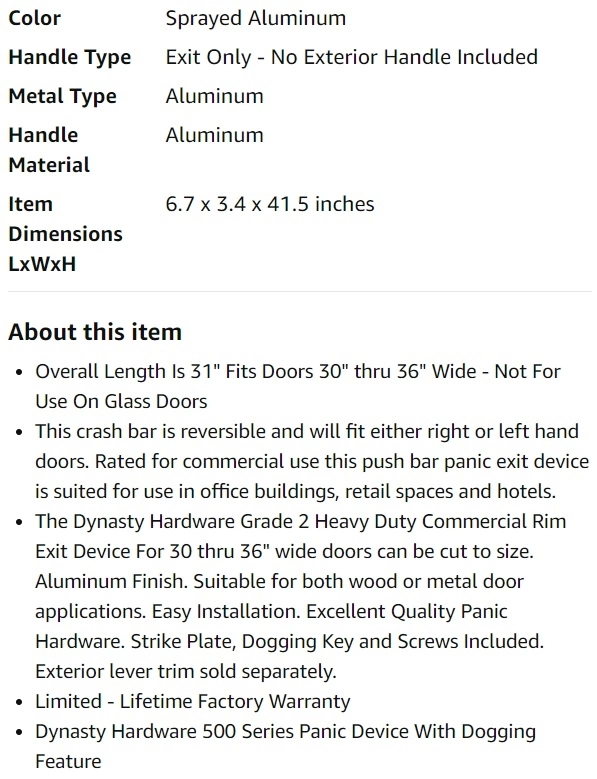
The DYN-500P ships with a 36-inch aluminum touchbar, a steel latch mechanism, a dogging hex key for holding the latch open during high-traffic periods, and all necessary mounting hardware. Finish options — satin stainless and dark bronze — cover the most common architectural contexts. For buyers already familiar with the CRL cross bar exit device, Dynasty offers a comparable specification sheet at a noticeably lower price point, making it a serious contender for multi-door installations where per-unit cost adds up quickly.
Getting the Installation Right
Pre-Installation Preparation
Before you touch a screwdriver, verify that your door meets the hardware's requirements. The DYN-500P is designed for standard 1-3/4 inch thick doors with a 3-1/2 inch backset. Door width matters too — the 36-inch bar suits doors from 30 to 36 inches wide. Install it on a door outside that range and you're either compromising coverage or introducing a snag hazard that undermines the entire purpose of the device.
Check your door frame condition before mounting. A warped frame or a door with significant gap variance across its height creates alignment problems that no amount of adjustment hardware can fully correct. This is the step most DIY installers skip, and it's where the majority of post-installation complaints originate. A ten-minute inspection before drilling saves hours of troubleshooting afterward.
Pro tip: Test the door's full swing range before mounting the strike plate — a door that catches or drags mid-swing will cause the latch to misalign under repeated use and accelerate wear on the mechanism far ahead of its rated cycle life.
Mounting and Alignment Tips
Dynasty Hardware includes a detailed installation template — use it. Mark your pilot hole locations with the template before drilling, and verify level both horizontally and vertically. The touchbar height should sit between 34 and 48 inches from the finished floor to comply with ADA clearance guidelines, which also happen to be the ergonomically optimal range for most adults in a rushing exit scenario.
Torque the mounting screws to specification rather than hand tight plus a fraction more. Under-torqued fasteners back out with repeated bar actuation; over-torqued screws strip the door skin on hollow-core doors and compromise structural integrity around the mount. A clean, properly torqued installation dramatically extends the operational life of the latch mechanism. The same longevity principles that apply to exit hardware apply more broadly — the characteristics of high-quality mechanical deadbolts offer a useful parallel framework for understanding what separates durable hardware from hardware that fails early.
What Most Buyers Get Wrong About Panic Bars
Myth: Panic Bars Are Only for Commercial Buildings
This is the most common misconception, and it costs residential property owners real money — sometimes in code violation fines, sometimes in liability exposure. Many local fire codes apply panic bar requirements to any assembly occupancy, which includes larger residential buildings, multi-family units with shared exit corridors, and commercial-residential hybrid spaces. If your property houses multiple unrelated occupants or exceeds a certain occupant load threshold, a panic bar may be legally required, not optional.
Even outside code requirements, a panic bar on a secondary residential exit — a basement door, a garage side door, a back patio exit — provides real safety value. In a disorienting evacuation scenario, a single-motion release door requires no cognitive load, which matters when seconds count and visibility is limited. That's not a commercial concern. That's a human one.
Myth: Exit Devices Sacrifice Entry-Side Security
A panic bar only operates in the egress direction. From the outside, your door remains secured by whatever entry-side hardware you've installed — typically a deadbolt, a rim cylinder, or an electric strike. The panic bar itself provides no exterior entry point. This is worth emphasizing because some buyers conflate "easy to exit" with "easy to enter," and they're mechanically unrelated functions on a well-specified door assembly.
That said, the quality of your exterior cylinder matters independently. Understanding how lock picking works helps you evaluate whether your exterior cylinder is adequate for your actual threat model. Pairing a Dynasty Hardware panic bar with a high-grade deadbolt cylinder on the entry side gives you the best of both: compliant egress and secure entry. For primary entry points, reviewing the best options among bump-proof locks is a logical next step in that same security audit.
Dynasty Hardware Panic Bar Review: How It Measures Up
Feature-by-Feature Breakdown
| Feature | Dynasty Hardware DYN-500P | CRL Cross Bar | Generic Budget Bar |
|---|---|---|---|
| UL Listing | Yes | Yes | No |
| ANSI/BHMA Grade | Grade 1 | Grade 1 | Unrated |
| Touchbar Material | Aluminum alloy | Aluminum alloy | Zinc alloy |
| Finish Options | Satin SS, Dark Bronze | Satin SS, Oil-Rubbed Bronze | Chrome only |
| Door Thickness | 1-3/4" | 1-3/4" | 1-3/8" to 1-3/4" |
| Dogging Feature | Yes (hex key) | Yes (hex key) | No |
| ADA Compliant | Yes | Yes | No |
| Warranty | 1-year limited | 1-year limited | 90 days or none |
Where Dynasty Hardware Wins and Where It Falls Short
Dynasty Hardware's clearest advantage is its certification profile relative to price. For the cost, very few competitors offer both UL listing and ANSI/BHMA Grade 1 compliance in the same package. That combination is what satisfies most insurance requirements and local code inspections — without it, you're carrying liability exposure regardless of how well the hardware physically performs in day-to-day use.
Where Dynasty falls slightly short is finish durability in high-humidity environments. The satin stainless finish holds up well indoors; in covered outdoor applications or coastal climates, users report minor surface oxidation on the steel latch components after extended exposure. This is not a functional failure — the mechanism continues to operate correctly — but it's a real consideration if the installation context involves regular moisture exposure. For a sense of how purpose-built outdoor hardware handles these conditions differently, the Code-A-Key all-weather keyless lock offers a useful point of comparison on corrosion resistance design.
Integrating Exit Hardware Into Your Security Plan
Pairing With Other Security Layers
A panic bar addresses one specific vulnerability: emergency egress. It doesn't address unauthorized entry, perimeter detection, or deterrence. A complete security posture pairs exit hardware with complementary systems across your property. Consider your full envelope — your overall burglar-proofing strategy should account for all possible entry and exit points, not just primary doors, because secondary exits are common opportunistic entry vectors.
If you're relying on Dynasty Hardware for a secondary exit on a commercial or mixed-use property, think carefully about how your alarm system integrates with that door. Most security panels accept standard door contact inputs; wiring a panic bar exit door to your panel creates an event log and audible deterrent whenever the door opens. That data, layered with crime forecasting insights for your area, can help you determine whether secondary exits are being used as unauthorized entry points during off-hours — a pattern worth catching early.
Maintenance and Longevity
The DYN-500P is rated for 500,000 operation cycles under ANSI testing conditions. In practice, a moderate-traffic commercial installation might see 50 to 100 cycles per day, which puts the hardware's theoretical service life at roughly 14 to 27 years of continuous use. That's a reasonable expectation for a Grade 1 product — provided you maintain it consistently.
Annual lubrication of the latch mechanism and pivot points extends operational life significantly. Use a dry PTFE lubricant rather than oil-based products, which attract dust and debris over time and can gum up the latch housing. Inspect the mounting hardware annually for loosening, and check the strike plate alignment each time you service the latch. Deferred maintenance on exit hardware is the primary driver of early mechanism failure — not manufacturing defect. Treat it like any other life-safety component and it will outlast most of the building hardware around it.
Frequently Asked Questions
Is the Dynasty Hardware DYN-500P suitable for residential use?
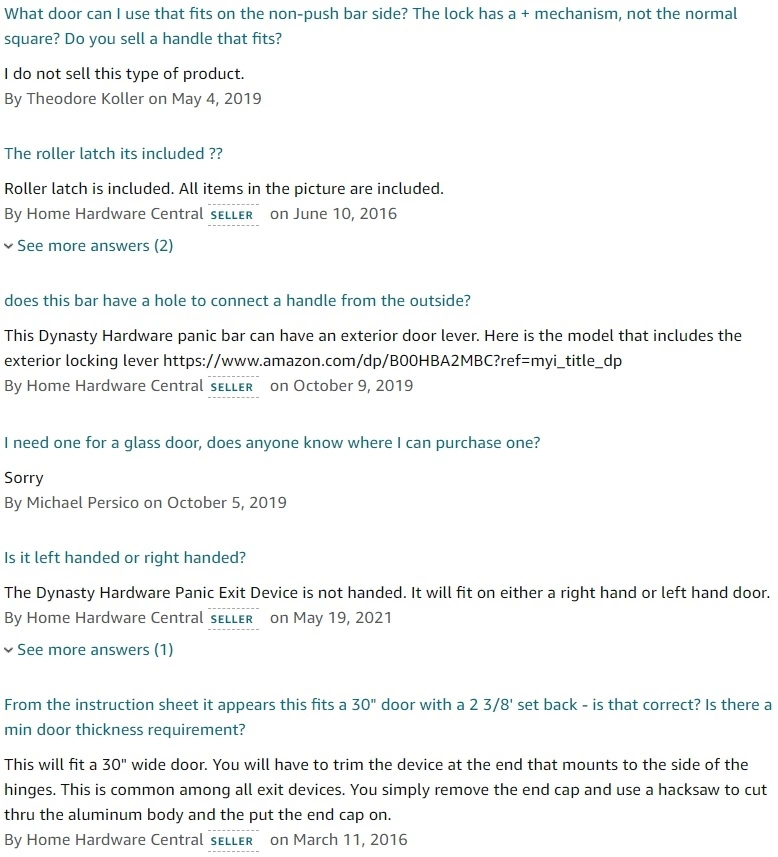
Yes, though it's sized and engineered for commercial-grade doors. If you're installing it on a standard residential exterior door — particularly a back door or secondary exit — verify that your door thickness and backset match the product specifications: 1-3/4 inch door thickness and a 3-1/2 inch backset. Many homeowners use it successfully on outbuildings, workshops, and multi-family rental units where code compliance is required or where a fast-release exit adds meaningful safety value.
Does the Dynasty Hardware panic bar work with an alarm system?
The panic bar itself has no built-in alarm connectivity, but standard door contact sensors mount easily to the door frame alongside the latch strike plate. Most security panels support normally-closed door contacts, which trigger an alarm event whenever the door opens. For an audible-only deterrent without a full security panel, stand-alone door alarm sensors accomplish the same function at minimal additional cost and require no wiring expertise.
Can I install the Dynasty Hardware panic bar myself without a locksmith?
Yes, for most standard commercial-style doors. The product includes a mounting template and step-by-step instructions, and a competent DIYer with basic tools can complete the installation in under two hours. The scenarios where professional installation is genuinely advisable include non-standard door thickness, hollow-core doors requiring backing plates, and fire-rated door assemblies where modifications must be documented to maintain the door's fire certification and code compliance.
What does the dogging feature on the DYN-500P do?
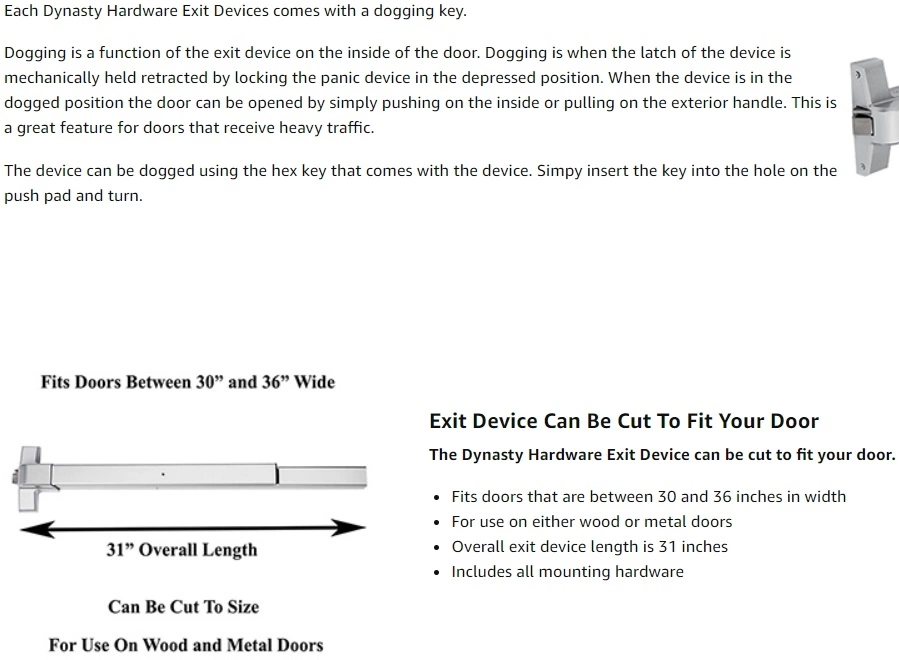
Dogging holds the latch in the retracted position so the door operates as a simple push-pull door without activating the panic mechanism on every cycle. It's useful during high-traffic periods — loading docks, event venues, school dismissal — where you want free flow without constant latching. The hex key supplied with the unit controls the dogging function, and removing the key automatically re-engages the latch mechanism and restores the door to its secure, latched state.
How does the Dynasty Hardware panic bar compare to more expensive commercial options?
For most small-to-medium commercial applications and residential compliance installations, the functional gap between Dynasty and premium brands like Von Duprin is narrower than the price difference suggests. The DYN-500P carries the same Grade 1 rating and UL listing as hardware costing two to three times more. Where premium brands pull ahead is in finish longevity under heavy institutional use, wider accessory ecosystems — electric strikes, key override cylinders, alarm trim — and the depth of manufacturer support infrastructure that matters most for large, multi-building deployments.
Final Thoughts
If you've been weighing whether a mid-tier exit device can genuinely meet your compliance and safety needs, this Dynasty Hardware panic bar review should give you a clear answer: the DYN-500P delivers certified, reliable performance at a price that makes multi-door installations realistic for property owners who aren't working with institutional budgets. Measure your door, confirm your local code requirements, and use the comparison table above to pressure-test your shortlist — you'll have everything you need to make a confident, well-informed purchase decision.


About Robert Fox
Robert Fox spent ten years teaching self-defence in Miami before transitioning into home security consulting and writing — a background that gives him an unusually practical, threat-aware perspective on residential security. His experience spans physical security assessment, lock and alarm system evaluation, and the behavioral habits that make homes harder targets. At YourHomeSecurityWatch, he covers home security product reviews, background check and criminal records resources, and practical guides on protecting your property and family.
You can Get FREE Gifts. Furthermore, Free Items here. Disable Ad Blocker to receive them all.
Once done, hit anything below