You're standing in front of your laptop at midnight, scrolling through dozens of tactical pens that all look the same. Same aluminum barrel, same glass-breaker tip, same vague promises about "military-grade" materials. It's hard to know which one actually holds up and which one snaps in half the first time you clip it to your jacket. We've tested, handled, and researched every pen on this list so you don't have to guess.
A tactical pen is a hardened writing instrument built from aircraft-grade aluminum or titanium, designed to double as a self-defense tool and everyday carry (EDC) item. Unlike a regular pen, it features reinforced construction, a carbide or tungsten glass-breaker tip, and a grip profile that gives you control under pressure. Think of it as the quiet, discreet cousin of a kubotan keychain — it goes everywhere with you, passes through most security checkpoints, and writes your grocery list just as well as it helps you escape a jammed car door.
In 2026, the tactical pen market has matured. The gap between budget and premium options is wider than ever, and the right choice depends heavily on what you actually need from your carry pen. Whether you want a precision-machined American heirloom or a rugged multi-tool loaded with survival features, this guide covers the seven best tactical pens available right now. For a broader look at personal protection tools, check out our personal security equipment guide covering pepper spray, stun guns, and more.

Contents
- Editor's Recommendation: Top Picks of 2026
- Detailed Product Reviews
- SureFire Pen III — Best Premium Duty Pen
- Tactile Turn Titanium Bolt Action — Best American-Made
- MTP-6 Tactical Pen — Best Multi-Tool Survival Pen
- UZI Tactical TACPEN2 — Best Budget EDC Pen
- KEPEAK Military Tactical Pen — Best Value Defense Pen
- BOKER Plus MPP — Best Minimalist Option
- Nitecore NTP31 — Best Bolt Action Dual-Tip Design
- Key Features to Consider When Choosing
- Questions Answered
- Key Takeaways
Editor's Recommendation: Top Picks of 2026
- #PreviewProductRating
- Bestseller No. 1
 Rating:

- Bestseller No. 2
 Rating:
 - Bestseller No. 3
 Rating:
 - Bestseller No. 4
 Rating:
 - Bestseller No. 5
 Rating:
 - Bestseller No. 6
 Rating:
 - Bestseller No. 7
 Rating:

Detailed Product Reviews

1. SureFire Pen III — Best Premium Duty Pen
SureFire built its reputation on tactical flashlights trusted by law enforcement and military personnel, and the Pen III carries that same DNA. The body is machined from rugged aerospace aluminum with a Mil-Spec hard-anodized finish — the same coating used on military equipment to resist corrosion, impact, and daily abuse. It's heavier than a grocery store ballpoint, but that weight is purposeful. In your hand it feels solid and controlled, not clunky.
What separates this pen from lookalikes is the Schmidt easyFLOW 9000 ink cartridge. That cartridge writes at virtually any angle, in cold weather, and even on slightly damp surfaces. Most tactical pens pair their tough exterior with a mediocre cartridge that skips and blobs. SureFire didn't cut that corner. The heavy-duty stainless steel pocket clip holds firm without tearing fabric, and the clip geometry is flat enough to clear a pants pocket or shirt pocket without snagging.
This is the pen you carry when you want zero compromises. It won't disappoint as a writing instrument, and the hardened aluminum body gives you a reliable defensive tool if you ever need it. If you work in law enforcement, security, or simply refuse to carry anything that isn't built to last, the SureFire Pen III is the correct answer in 2026.
Pros:
- Mil-Spec hard-anodized aerospace aluminum body — genuinely rugged
- Schmidt easyFLOW 9000 cartridge writes flawlessly in all conditions
- Heavy-duty stainless steel clip holds without damaging fabric
- Trusted brand with military and law enforcement pedigree
Cons:
- Premium price point — one of the most expensive pens on this list
- No integrated multi-tool features like a glass breaker tip

2. Tactile Turn Titanium Bolt Action Pen — Best American-Made
Tactile Turn operates out of a Texas machine shop where every component is cut, finished, and assembled by hand. The result is a pen that feels like a precision instrument because it is one. The bolt action mechanism — the same kind of smooth, satisfying lever action you'd find on a quality rifle — advances and retracts the refill in one fluid motion. Both the bolt and the receiver are precision-machined to tolerances tight enough that the action feels almost liquid-smooth after break-in.
Titanium is the material of choice here, and for good reason. It's lighter than steel, stronger than aluminum, and completely corrosion-proof. The pen comes with a lifetime warranty — not a "limited" warranty with asterisks, a genuine lifetime guarantee backed by a company that clearly intends to be around long enough to honor it. The Tactile Turn is the kind of pen you hand down to your kids. That's not marketing copy; that's the explicit design intent.
If you're looking at this pen, you're probably someone who appreciates quality for its own sake. You want something made in the USA by people who care about their craft. The Tactile Turn delivers that without compromise. It's not a survival multi-tool — it's a superbly engineered everyday carry instrument that happens to be made from aerospace-grade titanium.
Pros:
- 100% machined and assembled in the USA — no overseas outsourcing
- Titanium construction: lighter than steel, stronger than aluminum, corrosion-proof
- Silky bolt action mechanism with precision-machined lock
- Genuine lifetime warranty with real customer service in the machine shop
Cons:
- High price reflects premium materials and craftsmanship
- Minimalist design — no glass breaker or survival features
3. MTP-6 Tactical Pen — Best Multi-Tool Survival Pen
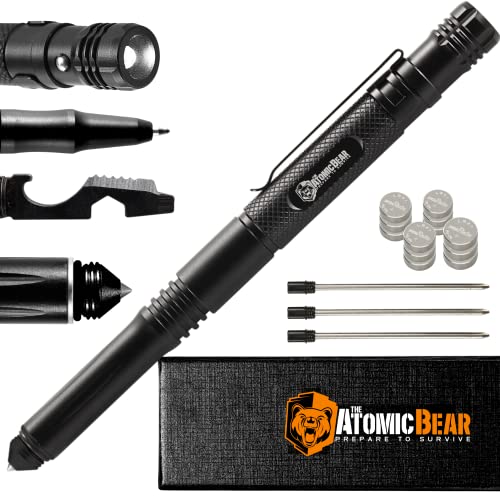
The MTP-6 is the answer to the question: what if your tactical pen did everything? The barrel houses a multi-mode LED flashlight, the tip is a premium tungsten carbide glass breaker, and the body integrates a screwdriver, hex driver, and bottle opener. It ships with three ink cartridge refills and four sets of batteries, so you're ready to use it the moment it arrives. For someone who wants maximum utility from a single pocket tool, this package is hard to beat.
The machined aircraft-grade 6061-T6 aluminum holds up to drops and exposure to the elements. The manufacturer tested this pen for drops and water resistance, and the construction reflects that — no rattling, no flex, no weak points where components join. The multi-mode flashlight is genuinely useful for low-light situations, not just a gimmick. You can signal, navigate, or simply find a keyhole without pulling out your phone.
The trade-off is size and weight. More tools mean more pen, and the MTP-6 is bulkier than a minimalist carry pen. If you want something that disappears in a shirt pocket, this isn't it. But if you're building out an EDC kit and want one tool that handles writing, emergency egress, lighting, and basic repairs, the MTP-6 earns its place.
Pros:
- Combines flashlight, glass breaker, screwdriver, hex driver, and bottle opener in one tool
- Ships with 3 ink refills and 4 battery sets — immediately ready to use
- Drop-tested, water-resistant aircraft aluminum construction
- Limited lifetime warranty included
Cons:
- Bulkier and heavier than single-purpose tactical pens
- Flashlight adds battery dependency

4. UZI Tactical TACPEN2-BK — Best Budget EDC Pen
UZI is a name you recognize from firearms, and the brand carries that reputation into its tactical pen line. The TACPEN2-BK gives you a smooth ballpoint writing tip at one end and a carbide emergency tip at the other — the same hardened material used in the more expensive pens on this list. The aircraft-grade aluminum body keeps the weight down while maintaining the structural rigidity you need for a defensive tool.
What makes this pen stand out at its price point is the cartridge compatibility. It accepts both standard ballpoint refills and Fisher Space Pen cartridges. Fisher cartridges (the kind used by NASA) write in extreme temperatures, underwater, upside-down, and at high altitude. That flexibility means you're not locked into a proprietary refill that becomes unavailable next year. You can always find a compatible cartridge at any office supply store or online.
This is the pen you buy when you want a solid, functional EDC tool without a premium price tag. It won't feel as refined as the SureFire or Tactile Turn, but it does the job. It's also a great option as a gift for someone who's new to the tactical pen concept — low risk, genuine utility, recognizable brand name. See how tactical pens compare to other EDC security tools in our guide to auto anti-theft devices if you're building out a broader personal security kit.
Pros:
- Affordable entry point for a genuine carbide emergency tip pen
- Compatible with both standard and Fisher Space Pen cartridges
- Aircraft-grade aluminum — lightweight without sacrificing durability
- Well-known UZI brand with a reputation for reliability
Cons:
- Finish and machining quality won't match premium options
- Less refined pocket clip compared to higher-end pens
5. KEPEAK Military Tactical Pen — Best Value Defense Pen
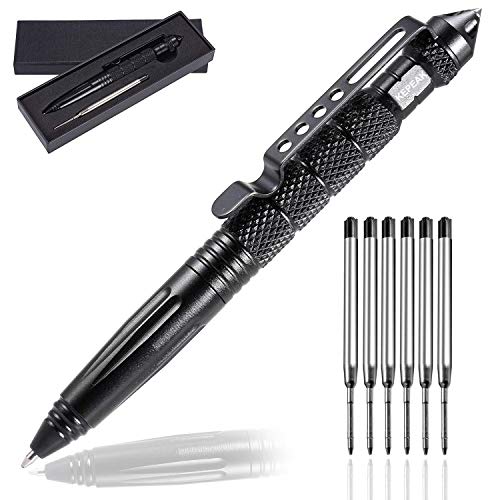
The KEPEAK tactical pen leads with its most important feature: a cap made from tungsten steel, one of the hardest materials on earth. Tungsten steel rates between 89–92.5 HRA on the Rockwell scale (a measure of material hardness), which puts it second only to diamond. That cap punches through tempered car windows cleanly and with minimal force — exactly what you need if you're ever trapped in a vehicle after an accident.
The pen body is aerospace-grade aluminum, keeping the overall package light enough for daily carry. The round nib writes smoothly for everyday use — this isn't one of those tactical pens that works great as a weapon and scratches the page when you actually try to write with it. KEPEAK includes six refill cartridges in the package, which is genuinely generous at this price level. You'll be writing with the same pen for years before you need to source replacements.
One interesting feature: KEPEAK markets a DNA collector function in the pen's design. The idea is that if you're attacked, the pen retains trace biological material from the attacker that can assist law enforcement later. It's a detail worth noting, though the primary value here is the tungsten tip, solid construction, and strong value proposition. Six refills alone make this a competitive buy.
Pros:
- Tungsten steel cap rates 89–92.5 HRA hardness — extremely effective glass breaker
- Six refill cartridges included — exceptional value
- Smooth round nib suitable for comfortable everyday writing
- Aerospace-grade aluminum body keeps carry weight low
Cons:
- Less-known brand with a smaller community reputation than SureFire or UZI
- Finish quality is functional but not premium
6. BOKER Plus MPP Multi Purpose Pen — Best Minimalist Option
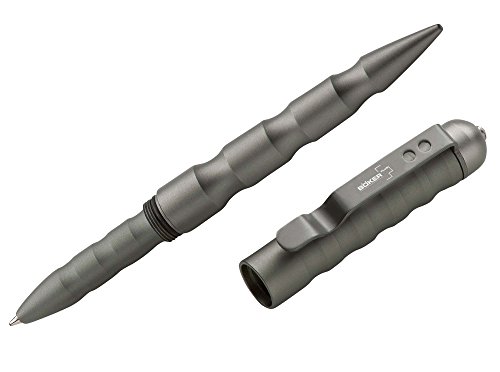
BOKER is a German knife and tool manufacturer with over 150 years of history. The MPP (Multi Purpose Pen) reflects that heritage — it's clean, purposeful, and built without unnecessary complexity. The lightweight aluminum grip body is finished in silver, giving it a professional appearance that works in a boardroom as well as outdoors. The screwed-on cap is a design choice that prioritizes security over speed: you won't accidentally deploy the pen, and the cap won't rattle or fall off in a bag.
The glass breaker tip is integrated cleanly into the cap design without looking aggressive or out of place. This is one of the few tactical pens you could carry into a client meeting without anyone raising an eyebrow. It looks like a nice aluminum pen — because it is one. The defensive capability is there when you need it, invisible when you don't.
The BOKER MPP is the right choice if your priority is a pen that writes well, carries discreetly, and backs you up in an emergency without drawing attention in professional settings. It won't win a multi-tool shootout against the MTP-6, and it won't feel as refined as the Tactile Turn — but for a no-fuss, no-drama EDC pen with a trusted brand behind it, the MPP hits the mark.
Pros:
- Clean, professional appearance — works in office environments
- Screwed-on cap eliminates accidental deployment
- Lightweight aluminum body — comfortable for extended writing sessions
- 150+ year BOKER brand reputation
Cons:
- Screwed cap requires two hands to deploy in an emergency
- Fewer multi-tool features than competitors at a similar price
7. Nitecore NTP31 Bolt Action Tactical Pen — Best Dual-Tip Design
Nitecore is best known for premium LED flashlights, and the NTP31 brings that precision engineering approach to the tactical pen category. The standout feature is the bidirectional bolt mechanism — a genuine engineering achievement in a writing instrument. The slider moves in an L-shaped groove, letting you deploy either the pen refill or the tungsten steel tapered tip depending on which direction you work the bolt. You get full functionality from both ends without removing any caps or switching components.
The tungsten steel tip rates 89–92.5 HRA on the Rockwell hardness scale (second only to diamond), making it one of the most capable glass-breaking tips on this list. The lockout position in the bolt mechanism keeps the pen in a safe, carry-ready state so the tip doesn't engage unexpectedly in your pocket or bag. That's a thoughtful safety feature that most bolt action pens skip entirely.
Another important detail: the NTP31 is designed to pass airport security screening. The bolt mechanism deploys the defensive tip only when you deliberately manipulate it — to security equipment, it reads as a pen. This makes it one of the most practical tactical pens for frequent travelers who want to carry a capable tool without problems at checkpoints. According to Wikipedia, tactical pens are legal in most jurisdictions and airports specifically because they function as writing instruments first. The NTP31 leans into that legal and practical advantage better than almost any pen on this list.
Pros:
- Bidirectional bolt deploys either pen refill or tungsten tip independently
- L-shaped groove lockout prevents accidental deployment
- 89–92.5 HRA tungsten tip — among the hardest glass breakers available
- Designed to pass airport security screening
Cons:
- Bolt mechanism takes practice to operate smoothly under stress
- More expensive than single-function tactical pens

Key Features to Consider When Choosing a Tactical Pen
Not every tactical pen is built for the same person. Before you buy, nail down what you actually need from the pen — and match those needs to the right specs. Here are the four factors that matter most in 2026.
Body Material: Aluminum vs. Titanium
Most tactical pens fall into one of two material categories: aircraft-grade aluminum or titanium. Both materials appear throughout this list, and the right choice depends on your priorities.
- Aluminum (6061-T6 or aerospace grade) — Lighter, less expensive to machine, and plenty strong for daily carry and defensive use. Almost every pen on this list at a mid-range price uses 6061-T6 aluminum. It's the practical choice for most people.
- Titanium — More expensive, lighter than steel, stronger than aluminum, and completely corrosion-proof. If you carry your pen in saltwater environments, work outdoors year-round, or simply want the best material money can buy, titanium justifies its cost. The Tactile Turn is the clearest example here.
- Anodized finishes — Look for Mil-Spec hard anodizing (Type III) on aluminum pens. It adds a layer of hardness that resists scratching and protects against corrosion. The SureFire Pen III uses this treatment.
Glass Breaker Tip: Carbide vs. Tungsten Steel
A glass breaker tip is one of the most practical features on a tactical pen — and there's a meaningful difference between materials.
- Tungsten carbide or tungsten steel (89–92.5 HRA hardness) — The hardest glass breaker material available short of diamond. Pens in this category — the KEPEAK, Nitecore NTP31, and UZI TACPEN2 — can shatter tempered car windows with a single sharp strike to a corner. This is the material you want if vehicle egress is a real concern for you.
- Hardened steel carbide tips — Functional glass breakers that appear on many mid-range pens. They get the job done in most emergency scenarios, though they won't last as long as tungsten variants under heavy use.
- Strike corners of windows — not the center. A tempered window's weakest point is always its edge. A single firm strike to the corner will break it cleanly regardless of which glass breaker tip you're using.
Writing Performance: Cartridge Quality Matters
A tactical pen that writes badly is frustrating to use every day — and you need to use it every day to actually have it when you need it. Don't overlook cartridge quality.
- Schmidt easyFLOW 9000 (SureFire Pen III) — One of the best ballpoint cartridges available. Writes at any angle, in cold, and on difficult surfaces. If you write a lot, this cartridge makes a real difference.
- Fisher Space Pen compatibility (UZI TACPEN2) — Fisher cartridges write in extreme conditions: upside-down, underwater, in temperatures from -30°F to 250°F. Great for outdoor professionals.
- Standard ballpoint refills — Most pens accept standard Parker-style or Cross-style refills. Widely available and cheap to replace. Fine for normal daily writing.
- Check cartridge availability before you buy. A pen that uses a proprietary cartridge that gets discontinued becomes useless as a writing instrument.
Deployment Mechanism: Cap vs. Bolt Action
How you access the pen matters in an emergency. Two main mechanisms dominate the market:
- Screw-on cap (BOKER Plus MPP) — Secure, prevents accidental deployment, looks professional. The trade-off is that you need two hands to write or deploy in a hurry. Best for low-stress daily carry and professional environments.
- Bolt action (Tactile Turn, Nitecore NTP31) — One-handed operation. Advance and retract the refill or tip with a single smooth motion. Faster to deploy, more satisfying to operate, and more versatile for the Nitecore's dual-tip design. The preferred mechanism for active carry users.
- Pocket clip quality is often overlooked — look for stainless steel clips with enough tension to hold without tearing fabric. Weak clips lead to lost pens.
For more on layering your personal security tools effectively, browse our full list of tactical pen reviews or explore our broader coverage of personal security equipment including pepper spray and stun guns.
Questions Answered
Are tactical pens legal to carry?
In most U.S. states and many countries, yes — tactical pens are legal to carry in public, on planes, and in most buildings because they function as legitimate writing instruments. Unlike knives or firearms, they have no dedicated legal restrictions in most jurisdictions. Always check local regulations before carrying in government buildings, courthouses, or across international borders, as rules vary. The Nitecore NTP31 was specifically designed to pass TSA screening without triggering additional scrutiny.
Can a tactical pen actually break a car window?
Yes — but technique matters as much as the tool. A tungsten carbide or tungsten steel tip rated 89+ HRA hardness will shatter a tempered car window when you strike a corner or edge with a sharp, focused blow. Don't strike the center of the window; the edges and corners are far weaker. Tempered glass (used in most vehicle side windows) is designed to shatter into small pieces rather than large shards — so a successful strike is safe for the occupant. Laminated windshields require more effort and may not break the same way.
What's the difference between a tactical pen and a regular pen?
The core difference is construction and intent. A tactical pen is machined from hardened metals (aluminum, titanium, or steel) rather than plastic, making the barrel itself a solid defensive tool. Most feature a reinforced tip (glass breaker), a robust pocket clip, and a grip profile designed for control under pressure. A regular pen is designed solely for writing and would break or bend under impact. A well-made tactical pen writes just as well as a quality everyday pen — that's the whole point of carrying one daily.
What should I look for in a tactical pen for self-defense?
Focus on three things: weight and balance (heavier pens transfer more energy on impact), grip texture (knurling or ridges prevent slipping under stress), and tip design (a hardened point concentrates force on pressure points effectively). Pens with a DNA collector groove or sharp tungsten tip add utility. Don't prioritize gadgets over fundamentals — a simple, solid aluminum pen with a well-designed grip is more effective than a pen loaded with features that compromise the grip or balance.
Can I take a tactical pen on a plane in 2026?
Generally, yes. The TSA classifies tactical pens as writing instruments rather than weapons, and they're permitted in carry-on bags. The Nitecore NTP31 is specifically engineered to pass security screening — its bolt mechanism looks and functions like a regular pen mechanism to screening equipment. However, TSA agents have discretion, and an agent who identifies a glass breaker tip may flag it for additional screening. To minimize friction, choose a pen with a discreet, professional appearance and keep it in your bag rather than your pocket at checkpoints.
How do I choose between a pen with a glass breaker and one without?
Ask yourself one question: do you regularly drive a car, ride in taxis or rideshares, or find yourself near vehicles where entrapment could be a risk? If yes, the glass breaker is a genuinely valuable feature — it can save your life in a submerged or crushed vehicle when a door won't open. If your carry pen is primarily for self-defense pressure-point techniques or as a writing backup, a pen without a glass breaker (like the SureFire Pen III or Tactile Turn) may serve you better with a cleaner grip profile and superior writing quality.
Buy on Walmart
- SureFire Pen III with Schmidt easyFLOW 9000 ballpoint pen ca — Walmart Link
- Tactile Turn Titanium Bolt Action Pen - Standard Length - 10 — Walmart Link
- Tactical Pen – Self Defense Pen & Multi-tool Pen - Flashligh — Walmart Link
- UZI Tactical (UZI-TACPEN2-BK) Aircraft Aluminum Multitool Pe — Walmart Link
- KEPEAK Military Tactical Pen, Professional Self Defense Pen, — Walmart Link
- BOKER Plus MPP Multi Purpose Pen, Silver — Walmart Link
- Nitecore NTP31 Aluminum Multifunctional Bolt Action Design T — Walmart Link
Buy on eBay
- SureFire Pen III with Schmidt easyFLOW 9000 ballpoint pen ca — eBay Link
- Tactile Turn Titanium Bolt Action Pen - Standard Length - 10 — eBay Link
- Tactical Pen – Self Defense Pen & Multi-tool Pen - Flashligh — eBay Link
- UZI Tactical (UZI-TACPEN2-BK) Aircraft Aluminum Multitool Pe — eBay Link
- KEPEAK Military Tactical Pen, Professional Self Defense Pen, — eBay Link
- BOKER Plus MPP Multi Purpose Pen, Silver — eBay Link
- Nitecore NTP31 Aluminum Multifunctional Bolt Action Design T — eBay Link
Key Takeaways
- The SureFire Pen III is the best overall tactical pen in 2026 — Mil-Spec construction, an exceptional Schmidt cartridge, and a trusted brand with law enforcement and military credentials.
- The Tactile Turn Titanium Bolt Action is the best investment if you want a lifetime carry pen machined in the USA from aerospace-grade titanium with a genuine lifetime warranty.
- The Nitecore NTP31 is the smartest choice for frequent travelers — its bidirectional bolt mechanism deploys either the pen or the tungsten tip independently, and it's designed to pass airport security without hassle.
- For maximum value on a budget, the KEPEAK Military Tactical Pen delivers a tungsten steel glass-breaker tip and six included refill cartridges at a price point that makes it an easy first tactical pen for anyone new to EDC carry.


About Robert Fox
Robert Fox spent ten years teaching self-defence in Miami before transitioning into home security consulting and writing — a background that gives him an unusually practical, threat-aware perspective on residential security. His experience spans physical security assessment, lock and alarm system evaluation, and the behavioral habits that make homes harder targets. At YourHomeSecurityWatch, he covers home security product reviews, background check and criminal records resources, and practical guides on protecting your property and family.
You can Get FREE Gifts. Furthermore, Free Items here. Disable Ad Blocker to receive them all.
Once done, hit anything below