Lock Bumping Interview With Wayne Winton of Tri-County Locksmith Service
by Robert Fox
Studies by security researchers estimate that roughly 80 percent of all pin tumbler locks sold for residential use are susceptible to an entry technique requiring no locksmith training, no destructive tools, and under 30 seconds of effort. That technique is lock bumping, and understanding lock bumping residential security explained through the lens of working locksmiths exposes a significant gap between the protection homeowners believe they have and what their door hardware actually delivers. This guide draws directly on insights from Wayne Winton, owner and operator of Tri-County Locksmith Service, a practitioner with years of firsthand experience evaluating, defeating, and upgrading residential lock hardware for clients across multiple service areas. His perspective cuts through the marketing language surrounding most lock purchases. For a broader framework on layering home defenses, the home security guides section covers physical access control alongside cameras and alarm systems.

Winton's central argument is deceptively simple: most residential locks are engineered to resist casual picking, not a bump key. That distinction matters enormously. Casual picking demands skill, practice, and patience. Bumping demands none of those things. A correctly cut bump key, combined with a single sharp impact, exploits the fundamental mechanics of the pin tumbler mechanism — the same mechanism found in the deadbolts installed on the vast majority of American homes. The technique has been formally documented and studied, with Wikipedia's entry on lock bumping tracing its documented history to Dutch locksmiths in the 1970s, though the underlying physics were exploitable long before that.
What makes Winton's account particularly instructive is not just the technical explanation but the operational context. He describes insurance-adjuster consultations and post-break-in forensic reviews where the absence of obvious forced entry led investigators and homeowners alike to wrong conclusions. Bumping leaves no scratches on the door frame, no bent metal, no broken glass. The evidence — or deliberate lack of it — is part of what makes this attack method worth understanding in full detail.
Contents
Lock Bumping Residential Security Explained: The Threat Most Homeowners Miss
The Pin Tumbler Flaw at the Core
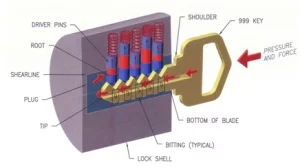
The pin tumbler lock design has remained largely unchanged since Linus Yale Jr. patented his version in 1865. It is elegant in its simplicity: a series of spring-loaded pin stacks sit inside a cylindrical plug, and the correct key lifts each stack to the precise height that allows the plug to rotate. The vulnerability is a direct product of that same simplicity. When an impact is applied to a specially cut bump key inserted in the lock, kinetic energy briefly causes all driver pins to jump simultaneously — creating a fraction-of-a-second window where no pin stack crosses the shear line. Apply rotational tension at exactly that moment, and the lock opens cleanly.
The bump key itself is cut to the maximum depth at every position, which ensures it contacts all the driver pins at once. It requires no knowledge of the internal configuration of any specific lock. The same bump key, made to fit a common keyway like Kwikset's KW1, will work on thousands of different locks sharing that keyway profile. This universality is what elevated bumping from a locksmith's workshop curiosity to a genuine residential security concern.
Wayne Winton's Practitioner View
Winton has encountered the aftermath of bump attacks on multiple service calls — cases where nothing was visibly forced but entry was clearly made. His description of those scenes underscores a point that security analysts consistently emphasize: the absence of physical evidence is not evidence of absence. Bumping, when executed competently, leaves the lock fully functional. The cylinder still turns. The key still works. For insurance investigators operating from visual cues alone, that can mean a legitimate claim gets questioned or denied entirely.
Pro insight: A bumped lock remains fully operational after the attack — it accepts the real key and turns freely — meaning homeowners often have no idea their lock was bypassed until after a theft is discovered.
Winton's firm fields regular calls from homeowners who upgraded from a basic deadbolt to a name-brand replacement and assumed the problem was solved. His consistent finding: the brand on the lock face is far less important than the internal mechanism's resistance rating and whether the keyway is a proprietary profile or a common one available at any hardware store.
The Mechanics of a Bump Attack
What a Bump Key Is — and Isn't
A bump key is not sophisticated equipment. It is a key blank ground or cut so that every cut sits at the deepest allowable depth for that keyway profile. The result is a key that, when inserted one position and then struck, imparts energy to the pin stacks in a predictable and exploitable way. The striking tool can be anything with modest mass — a rubber mallet, the heel of a hand, or a purpose-made bump hammer sold openly online for a few dollars.
What a bump key is not: a skeleton key. It does not work on all locks. It works on all standard pin tumbler locks that share its keyway profile, which is a narrower but still enormous category. It does not work on disc detainer locks, sidebar locks, or lever-style mechanisms common in European hardware. That specificity matters when making upgrade decisions. Understanding what the threat actually targets allows for a focused, efficient response rather than a blanket hardware replacement that may not address the real vulnerability.
The Role of Tension and Timing
The technique requires two simultaneous actions: applying light rotational tension to the lock plug while delivering the impact. Too much tension before the impact prevents the pins from jumping; too little means no rotation occurs when they do. This coordination is the only skill component in the entire operation, and Winton estimates that most people with ten minutes of unguided practice can open a standard deadbolt reliably.
The speed of the attack in practice deserves emphasis. Winton describes competent bumping as a 10-to-30-second operation at a front door, visually indistinguishable from someone fumbling with a stubborn key. No crowbar. No broken glass. No raised voices. In a neighborhood with modest foot traffic, an attacker has no meaningful exposure window. This operational reality — combined with the well-documented fact that most burglars prioritize low-risk, low-effort entry points — is precisely why bump resistance has become a standard criterion in professional residential security assessments.
Warning: Bump key sets for the most common residential keyways are available for purchase online with no restrictions — assuming scarcity of the tool provides any protection is a dangerous and persistent misconception.
Where Homeowners Underestimate the Risk

Trusting Brand Name Over Engineering
The residential lock market is dominated by a handful of major brands, and consumer familiarity with those names creates a confidence that is not always warranted. A standard entry-level deadbolt from a recognizable manufacturer — the kind sold at every major home improvement retailer — typically uses a common keyway and a conventional pin tumbler mechanism. It opens with a bump key. The brand is reputable; the entry-level product is not bump-resistant. This is not a manufacturing defect. It is a deliberate engineering and pricing decision for a particular market tier.
The same dynamic plays out across the full consumer hardware spectrum. A recognized logo communicates nothing about the cylinder's resistance to physical attacks. Winton's recommendation for homeowners who prefer to stay within familiar brand ecosystems is to move specifically to models with security pin configurations — spool pins, serrated pins, or mushroom pins — which disrupt the bump technique by creating false set positions that require additional manipulation beyond simple impact and tension. These upgraded cylinders exist within most major brand product lines but require deliberate selection, not simply buying the familiar name off the shelf.
The False Security of Any Deadbolt Alone
A deadbolt is one component in a layered access-control system, not a standalone security solution. Winton is direct on this point. A high-security deadbolt installed in a hollow-core door with a short-throw strike plate and an under-reinforced door frame is still a vulnerable system overall. The bump attack targets the lock cylinder specifically, but brute-force attacks exploit the door assembly. Addressing one without the other leaves a well-defined gap.
The practical upgrade path Winton describes for most residential clients runs through three steps: replace or upgrade the cylinder to a bump-resistant model first; reinforce the strike plate with three-inch screws reaching the door frame studs rather than just the door casing; then consider a door reinforcement kit that adds steel backing to the frame around both the latch and deadbolt area. These three steps, taken together, address the most common residential forced-entry methods without requiring a complete door replacement or a security contractor.
Auditing Your Home's Lock Exposure
Signs a Lock Has Been Bumped
Because bumping leaves so little physical evidence, the clearest diagnostic indicators are indirect. Fine scratches or tool marks around the keyway — particularly on the face of the plug itself — can suggest multiple insertion attempts, though these marks are also consistent with normal key use over time. More telling is fresh brass debris or small metal shavings visible near or inside the keyway, which can result from the impact force dislodging material from the key tip or plug face during repeated attempts.
The most reliable indicator is contextual: a confirmed entry with no visible damage to the door, frame, or window glass strongly points toward a bypass attack rather than a brute-force entry. Insurance adjusters and responding officers unfamiliar with bumping methodology sometimes misclassify these cases, which creates downstream complications for the homeowner filing a theft claim. Knowing what to ask for — specifically, a cylinder inspection — protects that process.
Tip: After any suspected break-in with no visible forced entry, request that the responding officer or a hired locksmith inspect the cylinder specifically for bump or pick evidence before concluding the lock was simply left unlocked.
When to Call a Professional
Homeowners conducting a self-audit of their door hardware should focus on three specific things: whether the lock uses a common keyway profile (KW1, SC1, and similar profiles are the most widely bumped), whether the lock carries any ANSI Grade 1 or UL 437 certification indicating tested resistance to physical attacks, and whether the strike plate screws penetrate the door frame studs rather than simply anchoring in the door casing trim.
A licensed locksmith can identify bump vulnerability in under five minutes per lock, assess the complete door assembly, and recommend targeted upgrades. Winton notes that a professional assessment of a full residence typically costs less than a single mid-grade deadbolt replacement — and delivers substantially more actionable information. For homeowners who have recently purchased an older property, a full lock audit is among the highest-value early security investments available. Many locksmiths will also evaluate whether existing hardware qualifies for any insurance premium discount that carriers may offer for certified high-security installations.
Bump-Resistant vs. Standard Locks: A Direct Comparison
Certifications and Features That Actually Matter
Not all bump-resistant locks are created equal, and the marketing language surrounding security hardware requires careful interpretation. Terms like "pick-resistant" and "security pins" describe meaningful engineering differences, but they are not standardized consumer labels — any manufacturer can apply them without external verification. The reliable filter is third-party certification. ANSI/BHMA Grade 1 is the baseline commercial-grade standard. UL 437 is a substantially more rigorous test that includes pick, drill, and bump resistance under controlled conditions. High-security cylinder brands operating with proprietary keyways and modified internal mechanisms are designed specifically to defeat bump, pick, and drill attacks simultaneously.
| Lock Type | Bump Resistant | Proprietary Keyway | Typical Certification | Approximate Cost |
|---|---|---|---|---|
| Standard pin tumbler (entry-level) | No | No (common KW1/SC1) | ANSI Grade 3 | $15–$40 |
| Security pin tumbler (mid-grade) | Partially | Sometimes | ANSI Grade 2 | $40–$90 |
| High-security cylinder (Medeco, Mul-T-Lock) | Yes | Yes | UL 437 / ANSI Grade 1 | $90–$200+ |
| SmartKey / sidebar mechanism | Yes | Yes (rekeying system) | ANSI Grade 1 | $60–$130 |
| Electronic keypad (no external cylinder) | Yes (no cylinder to bump) | N/A | ANSI Grade 1 (model-dependent) | $100–$300+ |
For homeowners evaluating electronic options, keypad and smart deadbolts with no external keyway — or with a proprietary high-security keyway for backup access — eliminate the bump attack vector entirely. The best electronic keyless deadbolts reviewed on this site include models that address bump vulnerability through fundamental mechanism design rather than relying on cylinder hardening alone. Winton's general guidance aligns with this framework: invest appropriately for the actual threat level of the location and the value of what is being protected — not for the aesthetic finish of the hardware.
Frequently Asked Questions
Does a standard deadbolt provide any meaningful protection against lock bumping?
A standard deadbolt with a conventional pin tumbler mechanism and a common keyway provides virtually no resistance to a bump attack. The technique exploits the fundamental physics of the pin tumbler design, meaning the deadbolt grade classification — single cylinder, double cylinder, Grade 2 or Grade 3 — does not change the underlying vulnerability. Genuine bump resistance requires modified internal pin geometry such as spool or serrated pins, a sidebar mechanism, or a fundamentally different locking technology altogether.
How can a homeowner determine whether an existing lock is bump-resistant?
The most reliable method is verifying UL 437 or ANSI Grade 1 certification on the product packaging or the manufacturer's published documentation. A licensed locksmith can also inspect the cylinder directly and confirm whether security pins are present in the stack configuration. Locks marketed as pick-resistant without accompanying third-party certification may offer marginally improved resistance but cannot be assumed bump-proof without independent verification of the internal mechanism.
Is possessing or using a bump key illegal?
Possessing a bump key is legal in most U.S. jurisdictions because key blanks and lock tools are sold commercially and used by licensed locksmiths in normal professional practice. Using a bump key to enter a property without authorization is a criminal act under trespassing, breaking-and-entering, or burglary statutes depending on jurisdiction and intent. The legal landscape varies internationally — some European jurisdictions treat lock-picking tools as controlled items subject to locksmith licensing requirements.
Key Takeaways
- Lock bumping exploits the standard pin tumbler mechanism found in the majority of residential deadbolts, requiring minimal skill and leaving almost no physical evidence of forced entry.
- Bump resistance is a function of internal engineering — security pin configurations, sidebar mechanisms, or proprietary keyways — not brand recognition or basic ANSI grade classification alone.
- A complete door-assembly assessment covering the cylinder, strike plate, and frame reinforcement provides substantially stronger protection than a cylinder upgrade in isolation.
- UL 437 certification and electronic keyless options that eliminate the external cylinder entirely are the most reliable consumer benchmarks for defeating the bump attack vector.


About Robert Fox
Robert Fox spent ten years teaching self-defence in Miami before transitioning into home security consulting and writing — a background that gives him an unusually practical, threat-aware perspective on residential security. His experience spans physical security assessment, lock and alarm system evaluation, and the behavioral habits that make homes harder targets. At YourHomeSecurityWatch, he covers home security product reviews, background check and criminal records resources, and practical guides on protecting your property and family.
You can Get FREE Gifts. Furthermore, Free Items here. Disable Ad Blocker to receive them all.
Once done, hit anything below